Helin Semi, Rajander Johan, Aromaa Jussi, Arponen Eveliina, Helin Jatta S, Solin Olof
Turku PET Centre, Radiopharmaceutical Chemistry Laboratory, University of Turku, Kiinamyllynkatu 4-8, 20520, Turku, Finland.
Turku PET Centre, Accelerator Laboratory, Åbo Akademi University, Kiinamyllynkatu 4-8, 20520, Turku, Finland.
EJNMMI Radiopharm Chem. 2024 Mar 25;9(1):24. doi: 10.1186/s41181-024-00255-1.
Production of [C]CH from gas targets is notorious for weak performance with respect to yield, especially when using high beam currents. Post-target conversion of [C]CO to [C]CH is a widely used roundabout method in C-radiochemistry, but the added complexity increase the challenge to control carrier carbon. Thus in-target-produced [C]CH is superior with respect to molar activity. We studied the in-target production of [C]CO and [C]CH from nitrogen gas targets as a function of beam current, irradiation time, and target temperature.
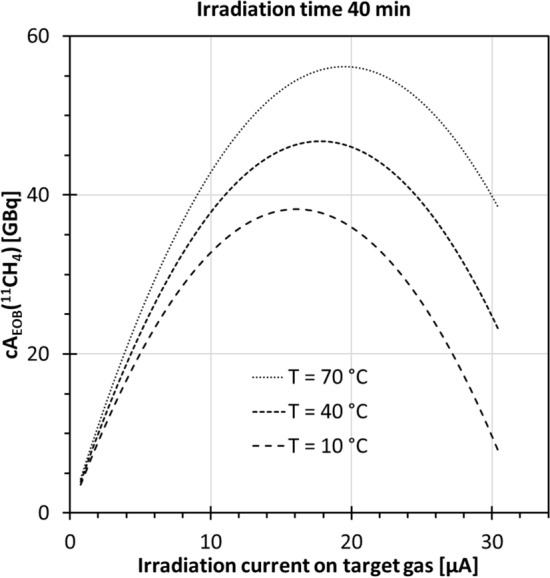
[C]CO production was practically unchanged across the range of varied parameters, but the [C]CH yield, presented in terms of saturation yield Y(CH), had a negative correlation with beam current and a positive correlation with target chamber temperature. A formulated model equation indicates behavior where the [C]CH formation follows a parabolic graph as a function of beam current. The negative square term, i.e., the yield loss, is postulated to arise from Haber-Bosch-like NH formation: N + 3H → 2NH. The studied conditions suggest that the NH (liq.) would be condensed on the target chamber walls, thus depleting the hydrogen reserve needed for the conversion of nascent C to [C]CH.
[C]CH production can be improved by increasing the target chamber temperature, which is presented in a mathematical formula. Our observations have implications for targetry design (geometry, gas volume and composition, pressure) and irradiation conditions, providing specific knowledge to enhance [C]CH production at high beam currents. Increased [C]CH radioactivity is an obvious benefit in radiosynthesis in terms of product yield and molar radioactivity.
从气体靶标中生产[C]CH在产率方面表现不佳,尤其是在使用高束流时。在C - 放射化学中,将[C]CO靶后转化为[C]CH是一种广泛使用的迂回方法,但增加的复杂性增加了控制载体碳的挑战。因此,靶内产生的[C]CH在摩尔活度方面更具优势。我们研究了以氮气为靶标时,[C]CO和[C]CH的靶内生产情况与束流、辐照时间和靶标温度的关系。
在各种参数变化范围内,[C]CO的产量基本保持不变,但以饱和产率Y(CH)表示的[C]CH产率与束流呈负相关,与靶室温度呈正相关。一个公式化的模型方程表明,[C]CH的形成行为随束流呈抛物线状。负平方项,即产率损失,被假定是由类似哈伯 - 博施法的NH形成引起的:N + 3H → 2NH。研究条件表明,NH(液)会凝结在靶室壁上,从而耗尽将新生碳转化为[C]CH所需的氢储备。
通过提高靶室温度可以提高[C]CH的产量,这在一个数学公式中有所体现。我们的观察结果对靶标设计(几何形状、气体体积和成分、压力)和辐照条件具有启示意义,为在高束流下提高[C]CH产量提供了具体知识。就产物产率和摩尔放射性而言,增加[C]CH放射性在放射合成中具有明显优势。