Division of Genetics and Epidemiology, The Institute of Cancer Research, London, UK.
Department of Medical Oncology, Dana-Farber Cancer Institute, Boston, MA, USA.
Nat Commun. 2024 Mar 25;15(1):2637. doi: 10.1038/s41467-024-46927-z.
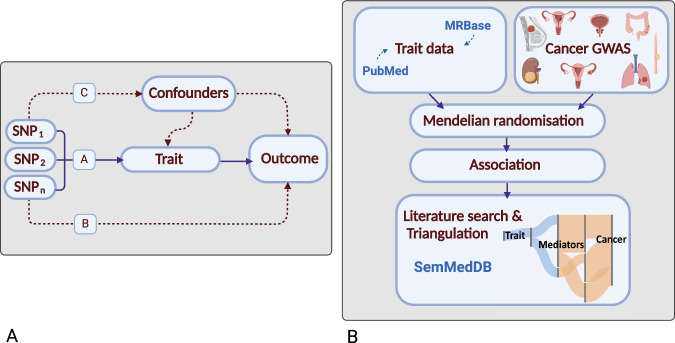
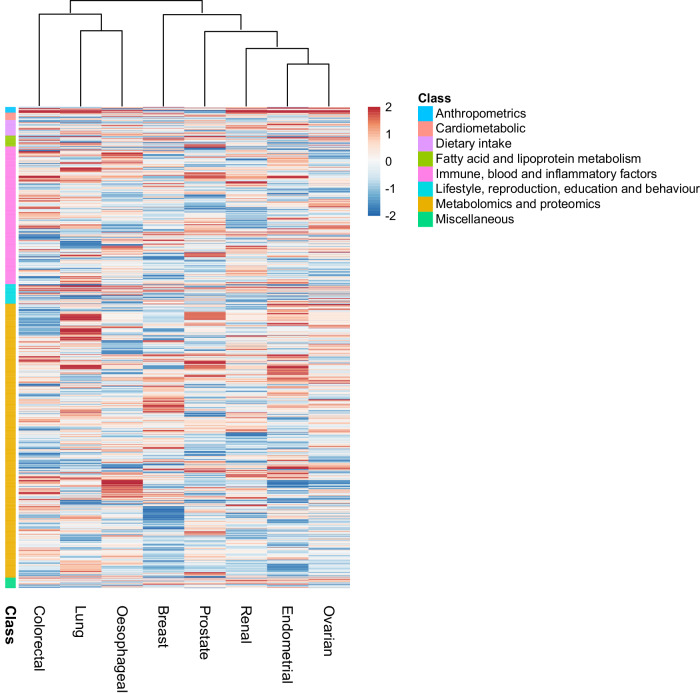
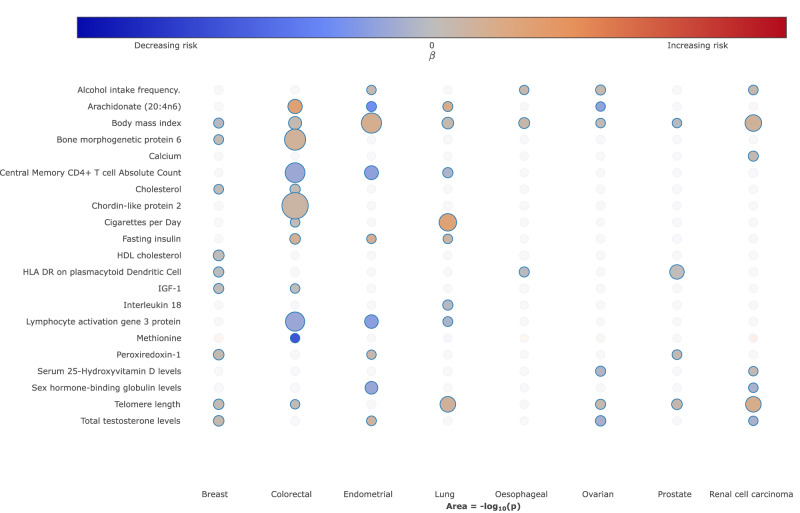
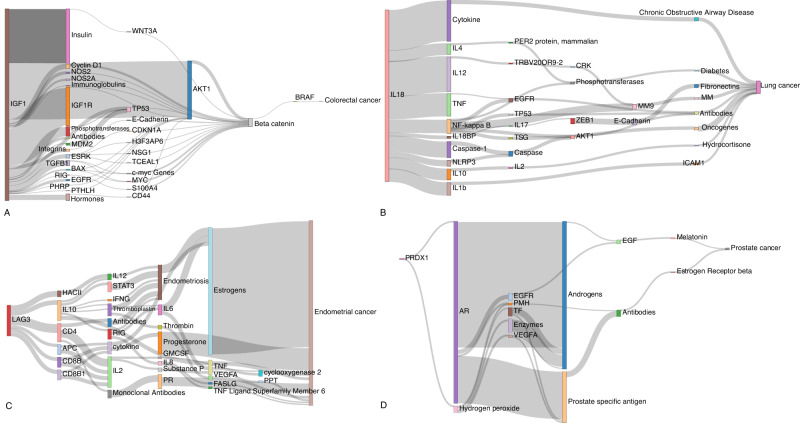
For many cancers there are only a few well-established risk factors. Here, we use summary data from genome-wide association studies (GWAS) in a Mendelian randomisation (MR) phenome-wide association study (PheWAS) to identify potentially causal relationships for over 3,000 traits. Our outcome datasets comprise 378,142 cases across breast, prostate, colorectal, lung, endometrial, oesophageal, renal, and ovarian cancers, as well as 485,715 controls. We complement this analysis by systematically mining the literature space for supporting evidence. In addition to providing supporting evidence for well-established risk factors (smoking, alcohol, obesity, lack of physical activity), we also find sex steroid hormones, plasma lipids, and telomere length as determinants of cancer risk. A number of the molecular factors we identify may prove to be potential biomarkers. Our analysis, which highlights aetiological similarities and differences in common cancers, should aid public health prevention strategies to reduce cancer burden. We provide a R/Shiny app to visualise findings.
对于许多癌症,只有少数几个经过充分证实的风险因素。在这里,我们使用全基因组关联研究(GWAS)的汇总数据,在孟德尔随机化(MR)表型全基因组关联研究(PheWAS)中,鉴定了 3000 多种特征的潜在因果关系。我们的结果数据集包括来自乳腺癌、前列腺癌、结直肠癌、肺癌、子宫内膜癌、食道癌、肾癌和卵巢癌的 378142 例病例和 485715 例对照。我们通过系统地挖掘文献空间来补充这项分析,以寻找支持证据。除了为已确立的风险因素(吸烟、饮酒、肥胖、缺乏体育锻炼)提供支持证据外,我们还发现性激素、血浆脂质和端粒长度是癌症风险的决定因素。我们确定的一些分子因素可能被证明是潜在的生物标志物。我们的分析突出了常见癌症的病因相似性和差异性,应该有助于公共卫生预防策略,以减轻癌症负担。我们提供了一个 R/Shiny 应用程序来可视化研究结果。