Herold Ryan A, Schofield Christopher J, Armstrong Fraser A
Inorganic Chemistry Laboratory Department of Chemistry University of Oxford South Parks Road Oxford OX1 3QR UK.
Department of Chemistry and the Ineos Oxford Institute for Antimicrobial Research University of Oxford Mansfield Road Oxford OX1 3QY UK.
Angew Chem Weinheim Bergstr Ger. 2023 Oct 16;135(42):e202309149. doi: 10.1002/ange.202309149. Epub 2023 Sep 12.
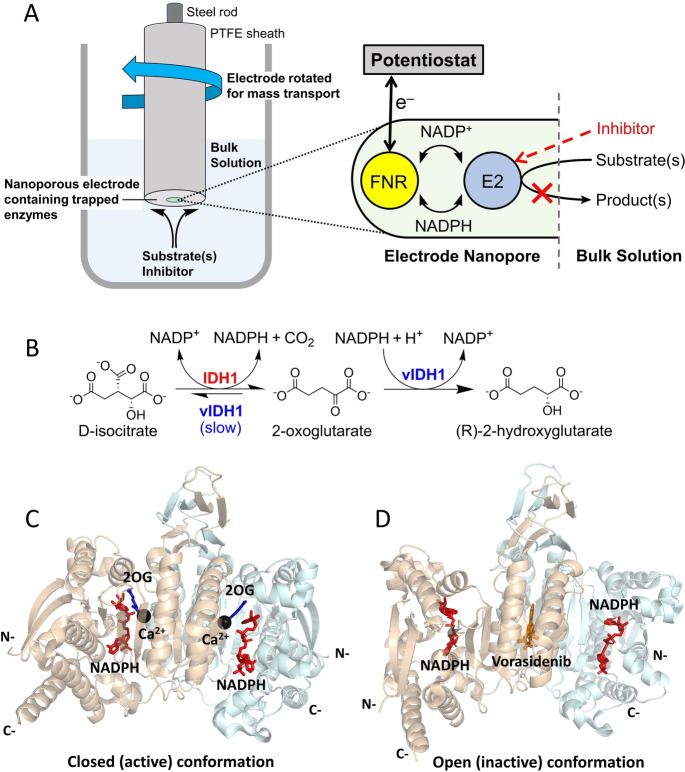
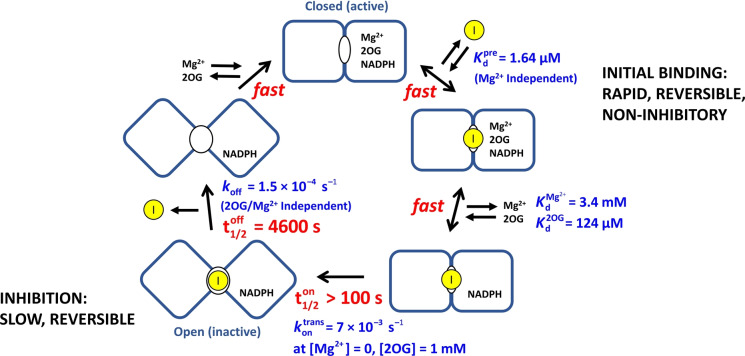
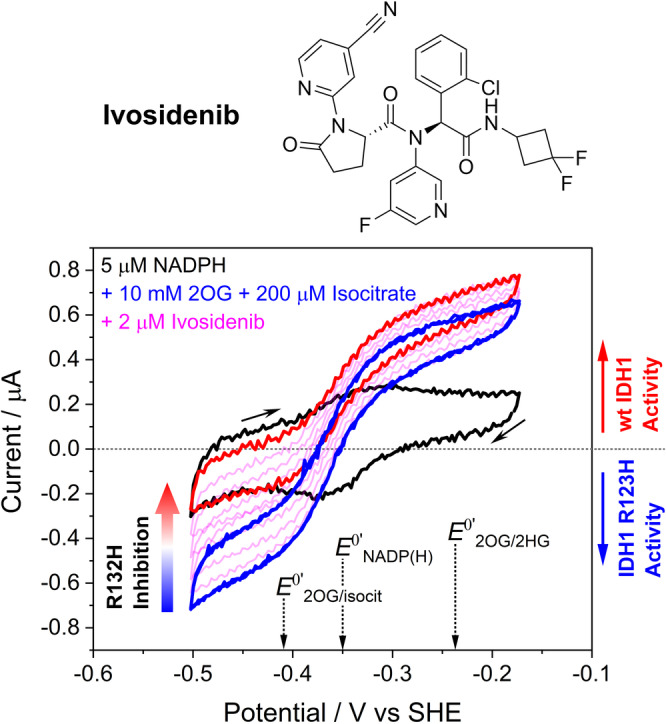
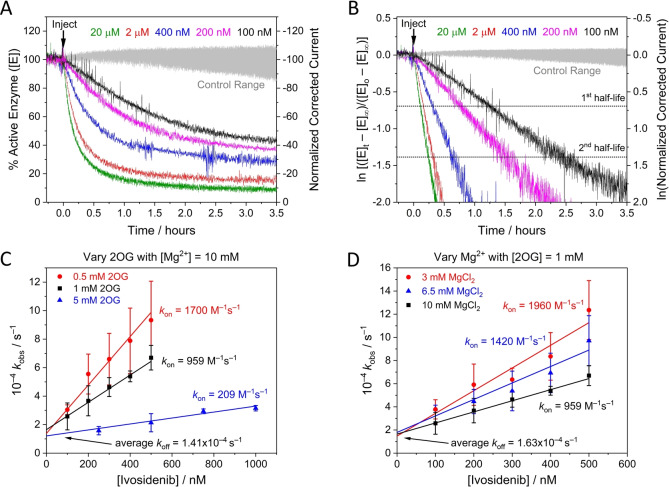
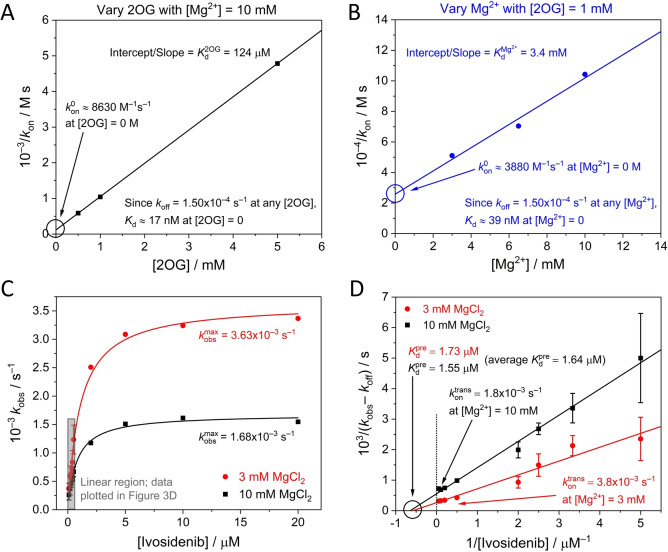
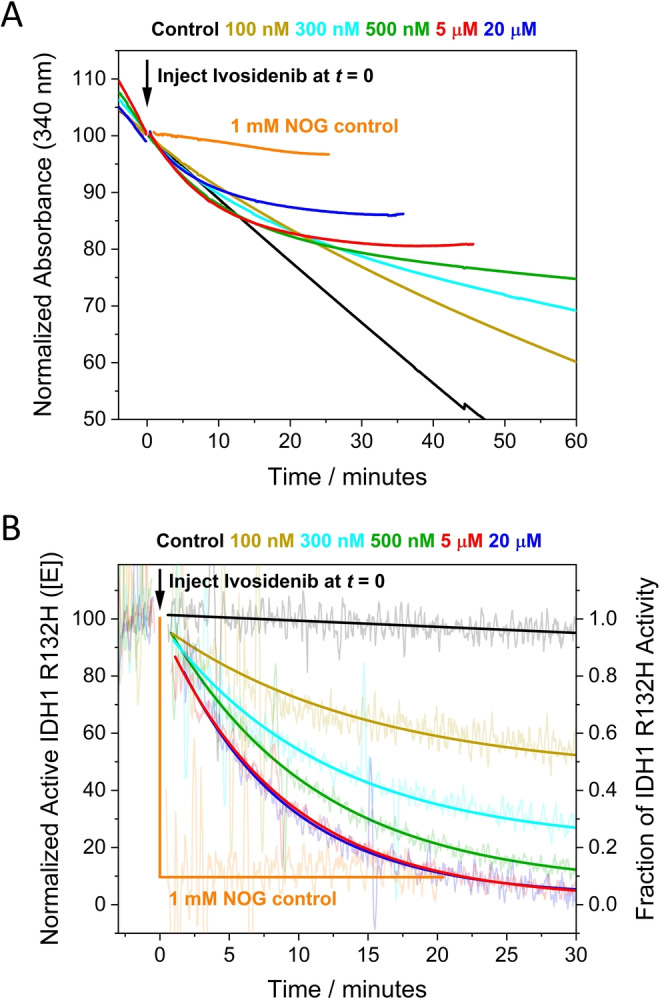
The ability to control enzyme cascades entrapped in a nanoporous electrode material (the "Electrochemical Leaf", e-Leaf) has been exploited to gain detailed kinetic insight into the mechanism of an anti-cancer drug. Ivosidenib, used to treat acute myeloid leukemia, acts on a common cancer-linked variant of isocitrate dehydrogenase 1 (IDH1 R132H) inhibiting its "gain-of-function" activity-the undesired reduction of 2-oxoglutarate (2OG) to the oncometabolite 2-hydroxyglutarate (2HG). The e-Leaf quantifies the kinetics of IDH1 R132H inhibition across a wide and continuous range of conditions, efficiently revealing factors underlying the inhibitor residence time. Selective inhibition of IDH1 R132H by Ivosidenib and another inhibitor, Novartis 224, is readily resolved as a two-stage process whereby initial rapid non-inhibitory binding is followed by a slower step to give the inhibitory complex. These kinetic features are likely present in other allosteric inhibitors of IDH1/2. Such details, essential for understanding inhibition mechanisms, are not readily resolved in conventional steady-state kinetics or by techniques that rely only on measuring binding. Extending the new method and analytical framework presented here to other enzyme systems will be straightforward and should rapidly reveal insight that is difficult or often impossible to obtain using other methods.
控制包裹在纳米多孔电极材料(“电化学叶片”,即e-Leaf)中的酶级联反应的能力,已被用于深入了解一种抗癌药物的作用机制。用于治疗急性髓系白血病的艾伏尼布作用于异柠檬酸脱氢酶1(IDH1 R132H)的一种常见癌症相关变体,抑制其“功能获得性”活性——即2-酮戊二酸(2OG)意外还原为致癌代谢物2-羟基戊二酸(2HG)。e-Leaf可在广泛且连续的条件范围内量化IDH1 R132H抑制的动力学,有效揭示影响抑制剂停留时间的因素。艾伏尼布和另一种抑制剂诺华224对IDH1 R132H的选择性抑制很容易解析为一个两阶段过程,即最初快速的非抑制性结合之后是较慢的步骤,形成抑制性复合物。这些动力学特征可能存在于IDH1/2的其他变构抑制剂中。这些对于理解抑制机制至关重要的细节,在传统稳态动力学中或仅依靠测量结合的技术中不易解析。将本文提出的新方法和分析框架扩展到其他酶系统将很简单,并且应该能迅速揭示使用其他方法难以或通常无法获得的见解。