Gorelik Daniel, Dhanda Aatin K, Choi Alexander, Takashima Masayoshi, Khan Najm S, Rowan Nicholas R, Jafari Aria, Syed Tariq, Ahmed Omar G
Division of Rhinology and Skull Base Surgery, Department of Otolaryngology-Head and Neck Surgery Houston Methodist Hospital Houston Texas USA.
Rutgers New Jersey Medical School Newark New Jersey USA.
Laryngoscope Investig Otolaryngol. 2024 Mar 25;9(2):e1238. doi: 10.1002/lio2.1238. eCollection 2024 Apr.
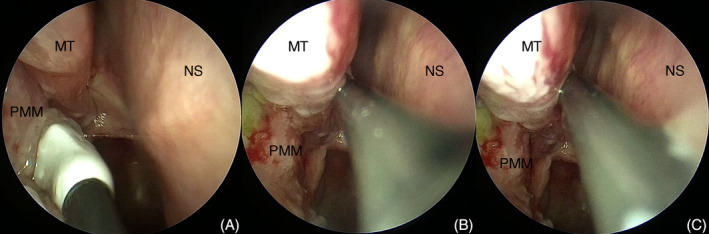
Posterior nasal nerve (PNN) ablation is a minimally invasive treatment option for patients with chronic rhinitis. Recent evidence shows that parasympathetic innervation of the nasal cavity is more extensive and there are many fibers posterior to the lateral attachment of the middle turbinate. We describe a modified ablative technique that targets the extensive innervation of the posterior nasal nerves.
Description of the technique and retrospective cohort analysis. In addition to the traditional radiofrequency and cryoablation targets, three additional treatment sites posterior to the middle turbinate were targeted using radiofrequency ablation, as well as one focused treatment posteroinferior to the middle turbinate attachment using cryotherapy ablation. The primary outcome collected was a 30% improvement in overall rhinitis symptoms.
Forty-five patients received treatment and completed 3-month follow-up using the modified technique for radiofrequency and cryotherapy PNN ablation. Previously, our institution documented a 64.5% responder rate at 3 months. After introducing the modified technique, the response rate at 3 months significantly improved (64.5% vs. 91.1%, = .004).
This report suggests improved efficacy with implementation of the modified technique for in-office PNN ablation. Given the extensive nature of the post-ganglionic parasympathetic fibers of the nasal cavity which often emerge posterior to the middle turbinate attachment, a modified technique to target these branches should be considered. Prospective randomized studies comparing this modified technique to the traditional technique are needed.
III.
鼻后神经(PNN)消融术是慢性鼻炎患者的一种微创治疗选择。最近的证据表明,鼻腔的副交感神经支配更为广泛,在中鼻甲外侧附着部后方有许多纤维。我们描述了一种改良的消融技术,该技术针对鼻后神经的广泛支配。
技术描述及回顾性队列分析。除了传统的射频和冷冻消融靶点外,使用射频消融术对中鼻甲后方的三个额外治疗部位进行靶向治疗,并使用冷冻消融术对中鼻甲附着部下后方的一个部位进行聚焦治疗。收集的主要结果是总体鼻炎症状改善30%。
45例患者接受了治疗,并使用改良的射频和冷冻疗法进行PNN消融术完成了3个月的随访。此前,我们机构记录了3个月时64.5%的缓解率。引入改良技术后,3个月时的缓解率显著提高(64.5%对91.1%,P = 0.004)。
本报告表明,改良技术用于门诊PNN消融术可提高疗效。鉴于鼻腔节后副交感神经纤维通常在中鼻甲附着部后方出现的广泛性,应考虑采用改良技术来靶向这些分支。需要进行前瞻性随机研究,将这种改良技术与传统技术进行比较。
III级。