Hertz Ellen, Perez Gani, Hao Ying, Rytel Krystyna, Ma Charis, Kirby Martha, Anderson Stacie, Wincovitch Stephen, Andersh Kate, Ahfeldt Tim, Blanchard Joel, Andy Qi Yue, Lopez Grisel, Tayebi Nahid, Sidransky Ellen, Chen Yu
Medical Genetics Branch, National Human Genome Research Institute, National Institutes of Health, Bethesda, MD.
Aligning Science Across Parkinson's (ASAP) Collaborative Research Network, Chevy Chase, MD, 20815.
bioRxiv. 2024 Feb 28:2024.02.25.581985. doi: 10.1101/2024.02.25.581985.
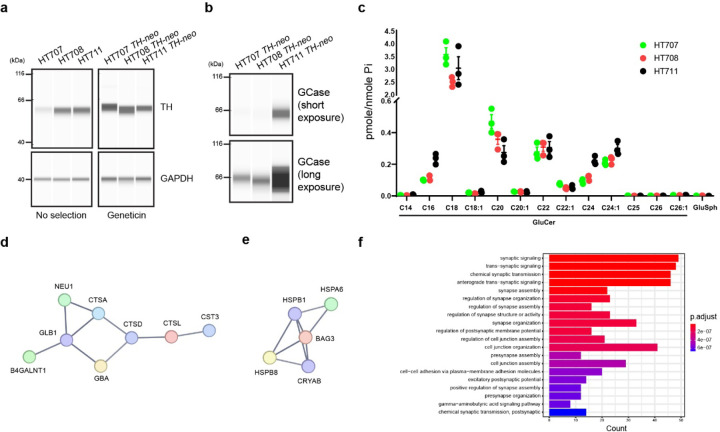
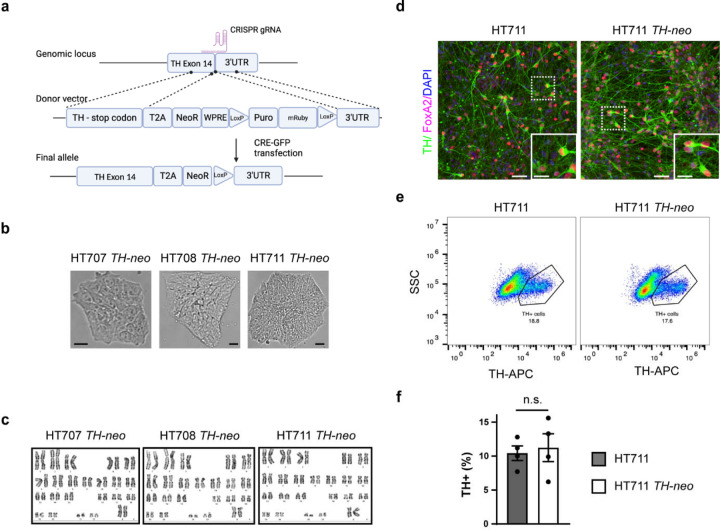
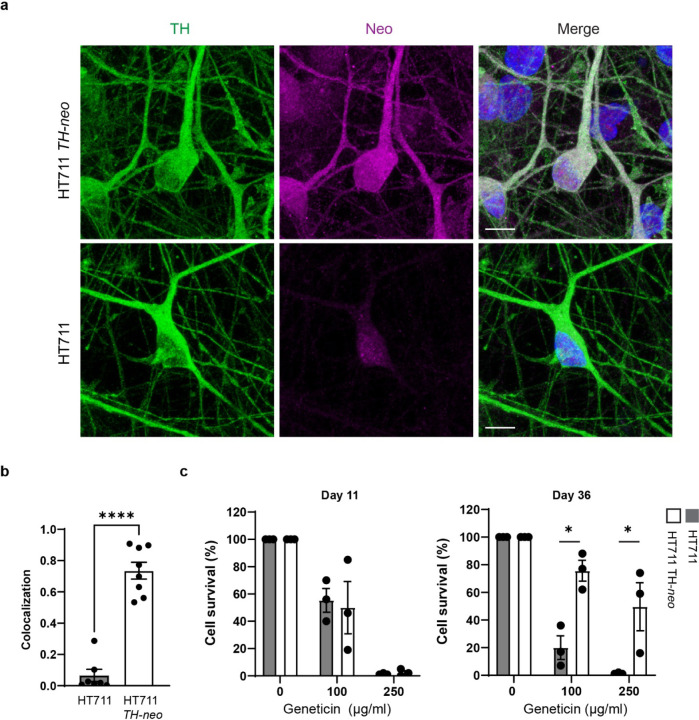
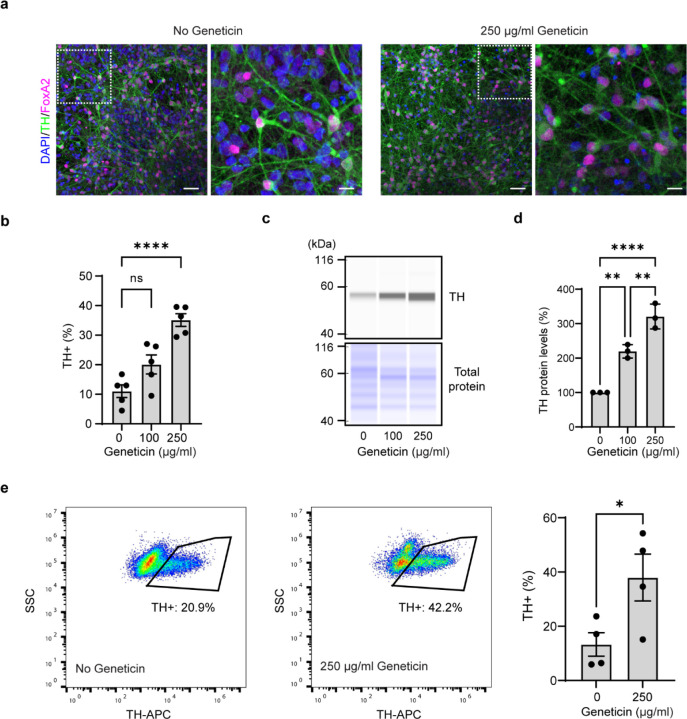
Inducible pluripotent stem cells (iPSCs) derived from patient samples have significantly enhanced our ability to model neurological diseases. Comparative studies of dopaminergic (DA) neurons differentiated from iPSCs derived from siblings with Gaucher disease discordant for parkinsonism provides a valuable avenue to explore genetic modifiers contributing to -associated parkinsonism in disease-relevant cells. However, such studies are often complicated by the inherent heterogeneity in differentiation efficiency among iPSC lines derived from different individuals. To address this technical challenge, we devised a selection strategy to enrich dopaminergic (DA) neurons expressing tyrosine hydroxylase (TH). A neomycin resistance gene was inserted at the C-terminus of the gene following a T2A self-cleavage peptide, placing its expression under the control of the promoter. This allows for TH+ DA neuron enrichment through geneticin selection. This method enabled us to generate comparable, high-purity DA neuron cultures from iPSC lines derived from three sisters that we followed for over a decade: one sibling is a healthy individual, and the other two have Gaucher disease (GD) with genotype N370S/c.203delC+R257X (p.N409S/c.203delC+p.R296X). Notably, the younger sister with GD later developed Parkinson disease (PD). A comprehensive analysis of these high-purity DA neurons revealed that although GD DA neurons exhibited decreased levels of glucocerebrosidase (GCase), there was no substantial difference in GCase protein levels or lipid substrate accumulation between DA neurons from the GD and GD/PD sisters, suggesting that the PD discordance is related to of other genetic modifiers.
源自患者样本的诱导多能干细胞(iPSC)显著增强了我们对神经疾病进行建模的能力。对来自患有帕金森症的戈谢病(Gaucher disease)的兄弟姐妹的iPSC分化产生的多巴胺能(DA)神经元进行比较研究,为探索在疾病相关细胞中导致帕金森症的遗传修饰因子提供了一条有价值的途径。然而,此类研究常常因源自不同个体的iPSC系之间分化效率的固有异质性而变得复杂。为应对这一技术挑战,我们设计了一种选择策略来富集表达酪氨酸羟化酶(TH)的多巴胺能(DA)神经元。在T2A自切割肽之后,将新霉素抗性基因插入到TH基因的C末端,使其表达受TH启动子的控制。这使得通过遗传霉素选择来富集TH+ DA神经元成为可能。该方法使我们能够从我们跟踪了十多年的三姐妹的iPSC系中生成可比的、高纯度的DA神经元培养物:一个姐妹是健康个体,另外两个患有戈谢病(GD),基因型为N370S/c.203delC+R257X(p.N409S/c.203delC+p.R296X)。值得注意的是,患有GD的妹妹后来患上了帕金森病(PD)。对这些高纯度DA神经元的全面分析表明,尽管GD DA神经元中葡萄糖脑苷脂酶(GCase)水平降低,但来自GD姐妹和GD/PD姐妹的DA神经元之间,GCase蛋白水平或脂质底物积累并无实质性差异,这表明PD不一致与其他遗传修饰因子有关。