Department of Family Medicine, Uijeongbu Eulji Medical Center, Eulji University School of Medicine, Uijeongbu, Korea.
Department of Clinical Epidemiology and Biostatics, Asan Medical Center, University of Ulsan College of Medicine, Seoul, Korea.
J Korean Med Sci. 2024 Mar 25;39(11):e103. doi: 10.3346/jkms.2024.39.e103.
Conflicting evidence exists regarding the association between smoking and the risk of severe acute respiratory syndrome coronavirus 2 (SARS-CoV-2) infection. We investigated the association between combustible cigarette (CC) smoking, noncombustible tobacco product (NCTP) use, and the use of any tobacco product with various coronavirus disease 2019 (COVID-19) outcomes.
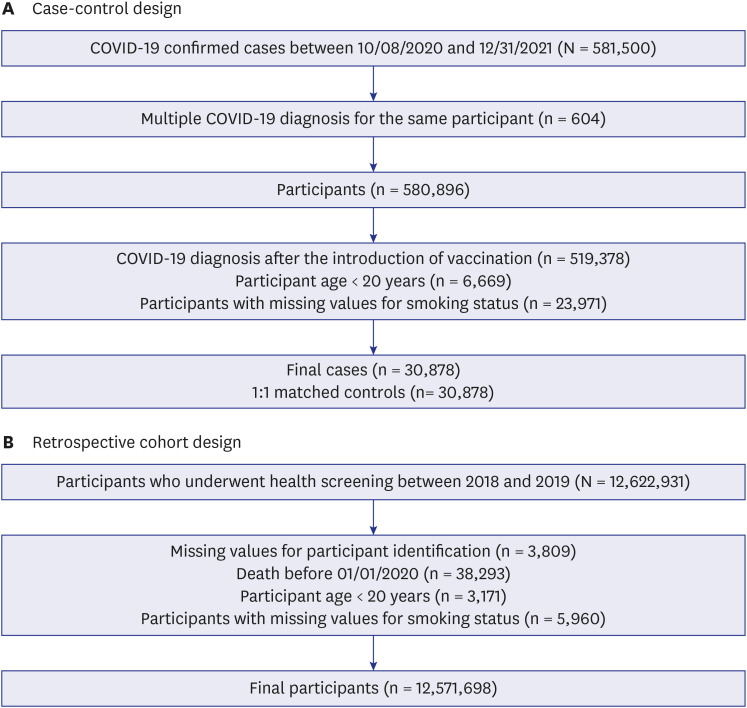
A case-control study was conducted using the Korea Disease Control and Prevention Agency-COVID19-National Health Insurance Service (NHIS) cohort. A retrospective cohort study was conducted using 12,571,698 individuals from the NHIS cohort. Logistic regression evaluated the association between CC smoking, NCTP use, and use of any tobacco product with SARS-CoV-2 infection. Poisson regression evaluated the association between these forms of tobacco product use and COVID-19-related hospitalization and mortality.
In the case-control study, we identified 30,878 cases of SARS-CoV-2 infection. The odds ratios (95% confidence intervals [CIs]) for SARS-CoV-2 infection were lower among current CC smokers (0.51, 0.48-0.54), current- and former-NCTP users (0.80, 0.74-0.88; 0.82, 0.74-0.91), and current users of any tobacco product (0.52, 0.49-0.55) relative to never user controls. In retrospective cohort study, we identified 16,521 COVID-19-related hospitalization and 362 COVID-19-related deaths. The relative risks (95% CIs) for COVID-19-related hospitalization were lower among current CC smokers (0.51, 0.48-0.54) and current users of any tobacco product (0.53, 0.50-0.56) relative to never user controls. There was no association between the use of tobacco product and COVID-19-related mortality.
Current CC smokers and current users of any tobacco product showed reduced risk of SARS-CoV-2 infection and COVID-19-related hospitalization. It remains uncertain whether these relationships are causal.
关于吸烟与严重急性呼吸综合征冠状病毒 2(SARS-CoV-2)感染风险之间的关联,存在相互矛盾的证据。我们调查了可燃香烟(CC)吸烟、非可燃烟草制品(NCTP)使用以及使用任何烟草制品与各种 2019 年冠状病毒病(COVID-19)结局之间的关联。
使用韩国疾病控制与预防局-COVID19-国家健康保险服务(NHIS)队列进行病例对照研究。使用 NHIS 队列中的 12571698 人进行回顾性队列研究。逻辑回归评估了 CC 吸烟、NCTP 使用以及使用任何烟草制品与 SARS-CoV-2 感染之间的关联。泊松回归评估了这些形式的烟草制品使用与 COVID-19 相关住院和死亡之间的关联。
在病例对照研究中,我们确定了 30878 例 SARS-CoV-2 感染病例。当前 CC 吸烟者(比值比 [95%置信区间] [OR]:0.51,0.48-0.54)、当前和以前的 NCTP 用户(OR:0.80,0.74-0.88;0.82,0.74-0.91)以及当前使用任何烟草制品的用户(OR:0.52,0.49-0.55)与从未使用者对照相比,SARS-CoV-2 感染的可能性较低。在回顾性队列研究中,我们确定了 16521 例 COVID-19 相关住院和 362 例 COVID-19 相关死亡。当前 CC 吸烟者(OR:0.51,0.48-0.54)和当前使用任何烟草制品的用户(OR:0.53,0.50-0.56)与从未使用者对照相比,COVID-19 相关住院的相对风险(95%置信区间)较低。使用烟草制品与 COVID-19 相关死亡率之间没有关联。
当前 CC 吸烟者和当前使用任何烟草制品的用户显示出 SARS-CoV-2 感染和 COVID-19 相关住院的风险降低。这些关系是否具有因果关系仍不确定。