
吸烟与 COVID-19 结局:一项使用英国生物库队列的观察性和孟德尔随机化研究。
Smoking and COVID-19 outcomes: an observational and Mendelian randomisation study using the UK Biobank cohort.
机构信息
Nuffield Department of Primary Care Health Sciences, University of Oxford, Oxford, UK
Cancer Research UK Oxford Centre, Department of Oncology, University of Oxford, Oxford, UK.
出版信息
Thorax. 2022 Jan;77(1):65-73. doi: 10.1136/thoraxjnl-2021-217080. Epub 2021 Sep 27.
BACKGROUND
Conflicting evidence has emerged regarding the relevance of smoking on risk of COVID-19 and its severity.
METHODS
We undertook large-scale observational and Mendelian randomisation (MR) analyses using UK Biobank. Most recent smoking status was determined from primary care records (70.8%) and UK Biobank questionnaire data (29.2%). COVID-19 outcomes were derived from Public Health England SARS-CoV-2 testing data, hospital admissions data, and death certificates (until 18 August 2020). Logistic regression was used to estimate associations between smoking status and confirmed SARS-CoV-2 infection, COVID-19-related hospitalisation, and COVID-19-related death. Inverse variance-weighted MR analyses using established genetic instruments for smoking initiation and smoking heaviness were undertaken (reported per SD increase).
RESULTS
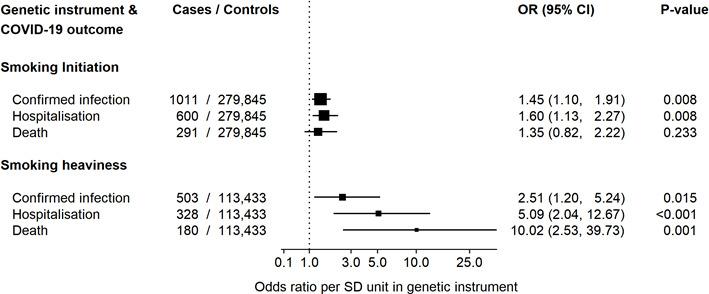
There were 421 469 eligible participants, 1649 confirmed infections, 968 COVID-19-related hospitalisations and 444 COVID-19-related deaths. Compared with never-smokers, current smokers had higher risks of hospitalisation (OR 1.80, 95% CI 1.26 to 2.29) and mortality (smoking 1-9/day: OR 2.14, 95% CI 0.87 to 5.24; 10-19/day: OR 5.91, 95% CI 3.66 to 9.54; 20+/day: OR 6.11, 95% CI 3.59 to 10.42). In MR analyses of 281 105 White British participants, genetically predicted propensity to initiate smoking was associated with higher risks of infection (OR 1.45, 95% CI 1.10 to 1.91) and hospitalisation (OR 1.60, 95% CI 1.13 to 2.27). Genetically predicted higher number of cigarettes smoked per day was associated with higher risks of all outcomes (infection OR 2.51, 95% CI 1.20 to 5.24; hospitalisation OR 5.08, 95% CI 2.04 to 12.66; and death OR 10.02, 95% CI 2.53 to 39.72).
INTERPRETATION
Congruent results from two analytical approaches support a causal effect of smoking on risk of severe COVID-19.
背景
关于吸烟与 COVID-19 风险及其严重程度的相关性,出现了相互矛盾的证据。
方法
我们使用英国生物库进行了大规模的观察性和孟德尔随机化(MR)分析。最近的吸烟状况是根据初级保健记录(70.8%)和英国生物库问卷调查数据(29.2%)确定的。COVID-19 结局是从英格兰公共卫生署 SARS-CoV-2 检测数据、住院数据和死亡证明中得出的(截至 2020 年 8 月 18 日)。逻辑回归用于估计吸烟状况与确诊的 SARS-CoV-2 感染、COVID-19 相关住院和 COVID-19 相关死亡之间的关联。使用已建立的用于吸烟起始和吸烟量的遗传工具进行了逆方差加权 MR 分析(每增加一个标准差报告)。
结果
纳入了 421469 名合格参与者,其中 1649 人确诊感染,968 人因 COVID-19 住院,444 人因 COVID-19 死亡。与从不吸烟者相比,当前吸烟者的住院风险更高(比值比 1.80,95%置信区间 1.26 至 2.29)和死亡风险(吸烟 1-9 支/天:比值比 2.14,95%置信区间 0.87 至 5.24;10-19 支/天:比值比 5.91,95%置信区间 3.66 至 9.54;20+/天:比值比 6.11,95%置信区间 3.59 至 10.42)。在对 281465 名白种英国人的 MR 分析中,遗传预测的吸烟起始倾向与更高的感染风险(比值比 1.45,95%置信区间 1.10 至 1.91)和住院风险(比值比 1.60,95%置信区间 1.13 至 2.27)相关。遗传预测每天吸烟量更高与所有结局的风险增加相关(感染比值比 2.51,95%置信区间 1.20 至 5.24;住院比值比 5.08,95%置信区间 2.04 至 12.66;死亡比值比 10.02,95%置信区间 2.53 至 39.72)。
解释
两种分析方法的一致结果支持吸烟对严重 COVID-19 风险的因果效应。


 Zotero 插件