Brooks Carthon J Margo, Brom Heather, Grantham-Murrillo Marsha, Sliwinski Kathy, Mason Aleigha, Roeser Mindi, Miles Donna, Garcia Dianne, Bennett Jovan, Harhay Michael O, Flores Emilia, Amenyedor Kelvin, Clark Rebecca
University of Pennsylvania, Philadelphia, PA, United States.
Penn Medicine at Home, Philadelphia, PA, United States.
JMIR Res Protoc. 2024 Mar 26;13:e54211. doi: 10.2196/54211.
Disparities in posthospitalization outcomes for people with chronic medical conditions and insured by Medicaid are well documented, yet interventions that mitigate them are lacking. Prevailing transitional care interventions narrowly target people aged 65 years and older, with specific disease processes, or limitedly focus on individual-level behavioral change such as self-care or symptom management, thus failing to adequately provide a holistic approach to ensure an optimal posthospital care continuum. This study evaluates the implementation of THRIVE-an evidence-based, equity-focused clinical pathway that supports Medicaid-insured individuals with multiple chronic conditions transitioning from hospital to home by focusing on the social determinants of health and systemic and structural barriers in health care delivery. THRIVE services include coordinating care, standardizing interdisciplinary communication, and addressing unmet clinical and social needs following hospital discharge.
The study's objectives are to (1) examine referral patterns, 30-day readmission, and emergency department use for participants who receive THRIVE support services compared to those receiving usual care and (2) evaluate the implementation of the THRIVE clinical pathway, including fidelity, feasibility, appropriateness, and acceptability.
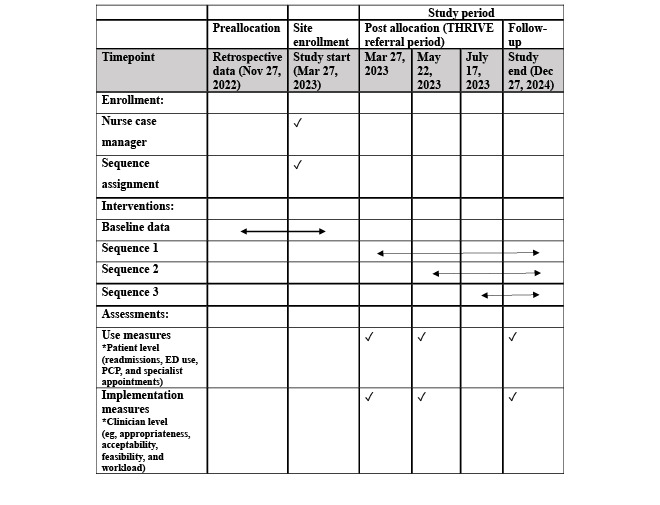
We will perform a sequential randomized rollout of THRIVE to case managers at the study hospital in 3 steps (4 in the first group, 4 in the second, and 5 in the third), and data collection will occur over 18 months. Inclusion criteria for THRIVE participation include (1) being Medicaid insured, dually enrolled in Medicaid and Medicare, or Medicaid eligible; (2) residing in Philadelphia; (3) having experienced a hospitalization at the study hospital for more than 24 hours with a planned discharge to home; (4) agreeing to home care at partner home care settings; and (5) being aged 18 years or older. Qualitative data will include interviews with clinicians involved in THRIVE, and quantitative data on health service use (ie, 30-day readmission, emergency department use, and primary and specialty care) will be derived from the electronic health record.
This project was funded in January 2023 and approved by the institutional review board on March 10, 2023. Data collection will occur from March 2023 to July 2024. Results are expected to be published in 2025.
The THRIVE clinical pathway aims to reduce disparities and improve postdischarge care transitions for Medicaid-insured patients through a system-level intervention that is acceptable for THRIVE participants, clinicians, and their teams in hospitals and home care settings. By using our equity-focused case management services and leveraging the power of the electronic medical record, THRIVE creates efficiencies by identifying high-need patients, improving communication across acute and community-based sectors, and driving evidence-based care coordination. This study will add important findings about how the infusion of equity-focused principles in the design and evaluation of evidence-based interventions contributes to both implementation and effectiveness outcomes.
INTERNATIONAL REGISTERED REPORT IDENTIFIER (IRRID): DERR1-10.2196/54211.
ClinicalTrials.gov NCT05714605; https://clinicaltrials.gov/ct2/show/NCT05714605.
有充分记录表明,患有慢性疾病且由医疗补助计划承保的人群在出院后的治疗结果存在差异,但缺乏减轻这些差异的干预措施。现有的过渡性护理干预措施范围狭窄,仅针对65岁及以上、患有特定疾病的人群,或仅侧重于个人层面的行为改变,如自我护理或症状管理,因此未能充分提供一种整体方法来确保最佳的出院后护理连续性。本研究评估了THRIVE(一项基于证据、注重公平的临床路径)的实施情况,该路径通过关注健康的社会决定因素以及医疗服务提供中的系统和结构障碍,支持患有多种慢性病的医疗补助计划参保者从医院过渡到家庭。THRIVE服务包括协调护理、规范跨学科沟通以及解决出院后未满足的临床和社会需求。
本研究的目的是:(1) 与接受常规护理的参与者相比,检查接受THRIVE支持服务的参与者的转诊模式、30天再入院率和急诊科就诊情况;(2) 评估THRIVE临床路径的实施情况,包括保真度、可行性、适宜性和可接受性。
我们将分三步对研究医院的病例管理人员进行THRIVE的序贯随机推广(第一组4人,第二组4人,第三组5人),数据收集将持续18个月。参与THRIVE的纳入标准包括:(1) 参加医疗补助计划,同时参加医疗补助计划和医疗保险,或符合医疗补助计划资格;(2) 居住在费城;(3) 在研究医院住院超过24小时且计划出院回家;(4) 同意在合作的家庭护理机构接受家庭护理;(5) 年龄在18岁及以上。定性数据将包括对参与THRIVE的临床医生的访谈,关于卫生服务使用的定量数据(即30天再入院率、急诊科就诊情况以及初级和专科护理)将从电子健康记录中获取。
该项目于2023年1月获得资助,并于2023年3月10日获得机构审查委员会批准。数据收集将于2023年3月至2024年7月进行。预计结果将于2025年发表。
THRIVE临床路径旨在通过一种系统层面的干预措施来减少差异并改善医疗补助计划参保患者出院后的护理过渡,该干预措施对于THRIVE参与者、临床医生及其在医院和家庭护理机构的团队来说是可接受的。通过使用我们注重公平的病例管理服务并利用电子病历的力量,THRIVE通过识别高需求患者、改善急性和社区部门之间的沟通以及推动基于证据的护理协调来提高效率。本研究将增加关于在基于证据的干预措施的设计和评估中融入注重公平的原则如何对实施和有效性结果产生影响的重要发现。
国际注册报告识别号(IRRID):DERR1-10.2196/54211。
ClinicalTrials.gov NCT05714605;https://clinicaltrials.gov/ct2/show/NCT05714605