Department of Human Pathology, Kanazawa University Graduate School of Medical Sciences, Kanazawa, 920-8640, Japan.
Division of Pathology, Fukui Saiseikai Hospital, Fukui, Japan.
Virchows Arch. 2024 Jun;484(6):915-923. doi: 10.1007/s00428-024-03792-x. Epub 2024 Mar 27.
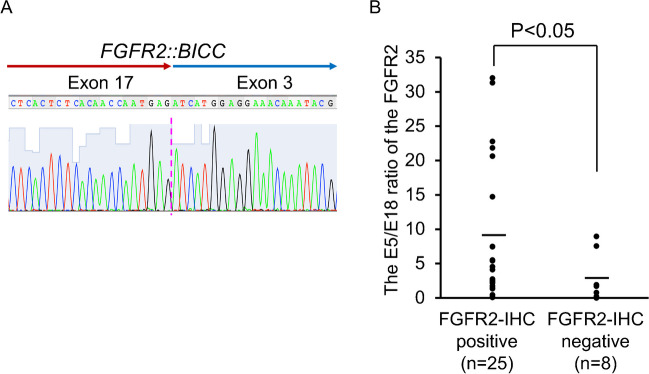
Genetic alterations including fusions in fibroblast growth factor receptor 2 (FGFR2) are detected in 10-20% of intrahepatic cholangiocarcinoma (iCCA), and FGFR2 inhibitors are effective for the treatment of iCCA. We examined a prevalence of FGFR2 genetic alterations and their clinicopathological significance in combined hepatocellular-cholangiocarcinoma (cHCC-CCA). FGFR2 expression, which is a surrogate marker for FGFR2 genetic alterations, was immunohistochemically assessed in the liver sections from 75 patients with cHCC-CCA, 35 with small duct-type iCCA, 30 with large duct-type iCCA, and 35 with hepatocellular carcinoma (HCC). FGFR2 genetic alterations were detected by reverse transcription-PCR and direct sequence. An association of FGFR2 expression with clinicopathological features was investigated in cHCC-CCAs. FGFR2 expression was detected in significantly more patients with cHCC-CCA (21.3%) and small duct-type iCCA (25.7%), compared to those with large duct-type iCCA (3.3%) and HCC (0%) (p < 0.05). FGFR2-positive cHCC-CCAs were significantly smaller size (p < 0.05), with more predominant cholangiolocarcinoma component (p < 0.01) and less nestin expression (p < 0.05). Genetic alterations of ARID1A and BAP1 and multiple genes were significantly more frequent in FGFR2-positive cHCC-CCAs (p < 0.05). 5'/3' imbalance in FGFR2 genes indicating exon18-truncated FGFR2 was significantly more frequently detected in FGFR2-positive cHCC-CCAs and small duct iCCAs, compared to FGFR2-negative ones (p < 0.05). FGFR2::BICC fusion was detected in a case of cHCC-CCAs. FGFR2 genetic alterations may be prevalent in cHCC-CCAs as well as small duct-type iCCAs, which suggest cHCC-CCAs may also be a possible therapeutic target of FGFR2 inhibitors.
在 10-20%的肝内胆管癌(iCCA)中检测到成纤维细胞生长因子受体 2(FGFR2)的遗传改变,包括融合,FGFR2 抑制剂对 iCCA 的治疗有效。我们研究了在合并性肝细胞胆管癌(cHCC-CCA)中 FGFR2 遗传改变的流行率及其临床病理意义。在 75 例 cHCC-CCA、35 例小胆管型 iCCA、30 例大胆管型 iCCA和 35 例肝细胞癌(HCC)的肝组织切片中,通过免疫组织化学评估 FGFR2 表达,FGFR2 表达是 FGFR2 遗传改变的替代标志物。通过逆转录-PCR 和直接序列检测 FGFR2 遗传改变。在 cHCC-CCAs 中研究了 FGFR2 表达与临床病理特征的关联。在 cHCC-CCA(21.3%)和小胆管型 iCCA(25.7%)中检测到 FGFR2 表达的患者明显多于大胆管型 iCCA(3.3%)和 HCC(0%)(p<0.05)。FGFR2 阳性的 cHCC-CCAs 明显较小(p<0.05),具有更明显的胆管腺癌成分(p<0.01)和较少的巢蛋白表达(p<0.05)。在 FGFR2 阳性的 cHCC-CCAs 中,ARID1A 和 BAP1 的基因改变和多个基因的改变明显更为频繁(p<0.05)。在 FGFR2 阳性的 cHCC-CCAs 和小胆管型 iCCA 中,5'/3'不平衡表明 FGFR2 外显子 18 截断的 FGFR2 明显更为频繁,与 FGFR2 阴性者相比(p<0.05)。在 1 例 cHCC-CCAs 中检测到 FGFR2::BICC 融合。FGFR2 遗传改变可能在 cHCC-CCAs 以及小胆管型 iCCA 中普遍存在,这表明 cHCC-CCAs 也可能是 FGFR2 抑制剂的一个潜在治疗靶点。