Casale Thomas B, Corbridge Thomas, Germain Guillaume, Laliberté François, MacKnight Sean D, Boudreau Julien, Duh Mei S, Deb Arijita
Division of Allergy/Immunology, University of South Florida, Tampa, FL, USA.
US Medical Affairs, GSK, Durham, NC, USA.
Allergy Asthma Clin Immunol. 2024 Mar 26;20(1):25. doi: 10.1186/s13223-024-00882-y.
Systemic corticosteroid (SCS) use remains widespread among patients with severe asthma, despite associated complications.
Evaluate the association between cumulative SCS exposure and SCS-related complications in severe asthma.
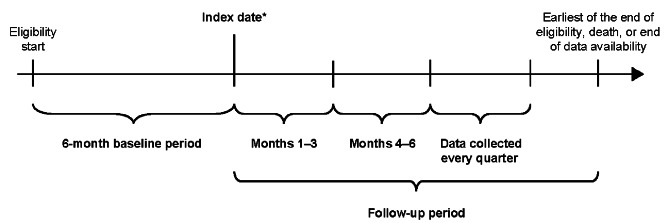
This retrospective, longitudinal study used claims data from the Optum Clinformatics Data Mart database (GSK ID: 214469). Eligible patients (≥ 12 years old) had an asthma diagnosis and were divided into two cohorts: SCS use and non/burst-SCS use. Patients in the SCS use cohort had a claim for a daily prednisone-equivalent dose ≥ 5 mg SCS following ≥ 6 months of continuous SCS use; those in the non/burst-SCS cohort had no evidence of continuous SCS use and had a non-SCS controller/rescue medication initiation claim. For each cohort, the date of the qualifying claim was the index date. SCS users were further stratified by SCS use during each quarter of follow-up: low (≤ 6 mg/day), medium (> 6-12 mg/day), high (> 12 mg/day), and continuous high (≥ 20 mg/day for 90 days). SCS-related complications were evaluated in the quarter following SCS exposure. The adjusted odds ratios (OR) of experiencing SCS-related complications during follow-up in each of the SCS use groups versus the non/burst SCS cohort were calculated using generalized estimating equations models.
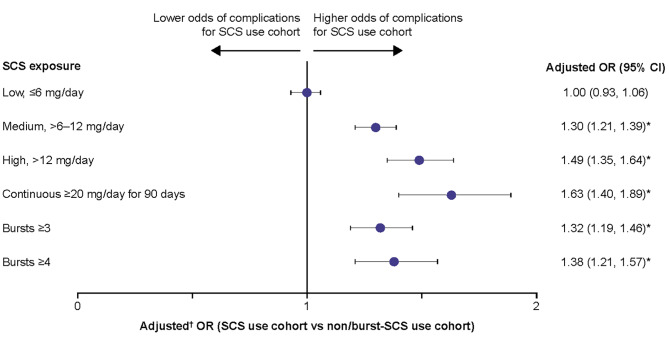
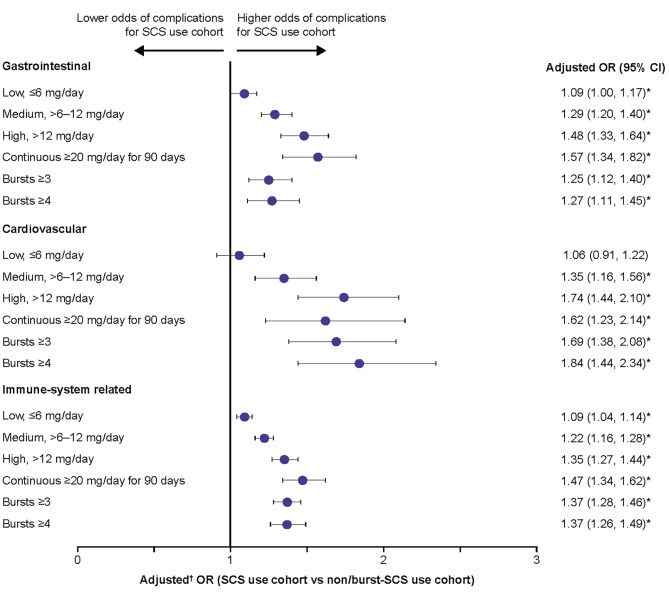
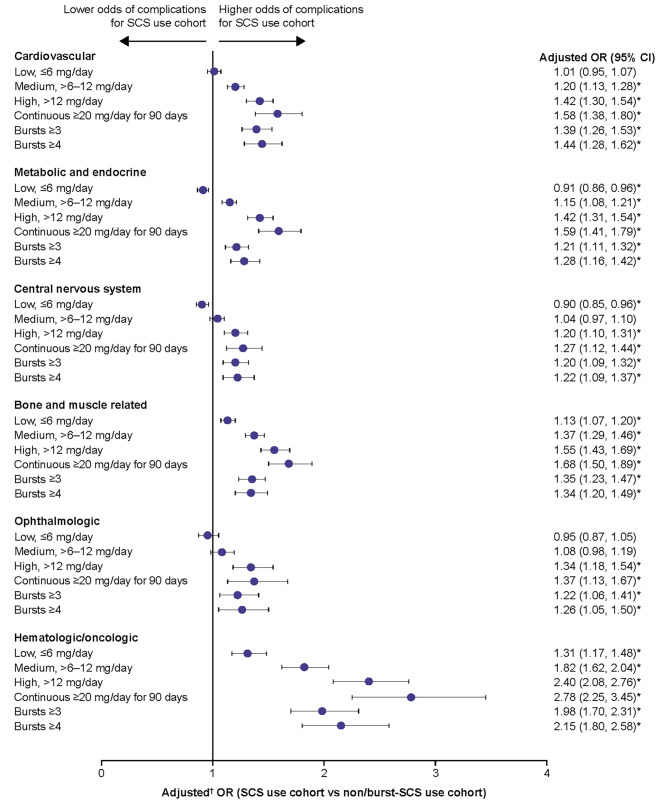
SCS and non/burst-SCS use cohorts included 7473 and 89,281 patients (mean follow-up: 24.6 and 24.2 months), respectively. Compared with the non/burst-SCS use cohort, medium, high, and continuous high SCS use was associated with greater odds of any SCS-related complication (adjusted OR [95% confidence interval]: 1.30 [1.21, 1.39], 1.49 [1.35, 1.64] and 1.63 [1.40, 1.89], respectively) including increased acute gastrointestinal, cardiovascular, and immune system-related complications, and chronic cardiovascular, metabolic/endocrine, central nervous system, bone-/muscle-related, ophthalmologic, and hematologic/oncologic complications. Low-dose SCS use was also associated with significantly increased odds of acute gastrointestinal and immune system-related complications, and chronic bone-/muscle-related and hematologic/oncologic complications versus the non/burst-SCS use cohort.
SCS use, even at low doses, is associated with increased risk of SCS-related complications among patients with severe asthma.
尽管存在相关并发症,但全身用糖皮质激素(SCS)在重度哮喘患者中仍广泛使用。
评估重度哮喘患者中SCS累积暴露与SCS相关并发症之间的关联。
这项回顾性纵向研究使用了Optum临床信息数据集市数据库(GSK ID:214469)中的索赔数据。符合条件的患者(≥12岁)有哮喘诊断,并分为两个队列:使用SCS和未使用/突发使用SCS。使用SCS队列中的患者在连续使用SCS≥6个月后有每日泼尼松等效剂量≥5mg SCS的索赔记录;未使用/突发使用SCS队列中的患者没有连续使用SCS的证据,并有非SCS控制/急救药物起始索赔记录。对于每个队列,符合条件的索赔日期为索引日期。SCS使用者在随访的每个季度中根据SCS使用情况进一步分层:低剂量(≤6mg/天)、中等剂量(>6-12mg/天)、高剂量(>12mg/天)和持续高剂量(≥20mg/天持续90天)。在SCS暴露后的季度中评估SCS相关并发症。使用广义估计方程模型计算每个SCS使用组在随访期间发生SCS相关并发症与未使用/突发使用SCS队列相比的调整后比值比(OR)。
使用SCS和未使用/突发使用SCS队列分别包括7473例和89281例患者(平均随访时间:24.6个月和24.2个月)。与未使用/突发使用SCS队列相比,中等剂量、高剂量和持续高剂量SCS使用与任何SCS相关并发症的更高几率相关(调整后OR[95%置信区间]:分别为1.30[1.21,1.39]、1.49[1.35,1.64]和1.63[1.40,1.89]),包括急性胃肠道、心血管和免疫系统相关并发症增加,以及慢性心血管、代谢/内分泌、中枢神经系统、骨骼/肌肉相关、眼科和血液学/肿瘤学并发症。与未使用/突发使用SCS队列相比,低剂量SCS使用也与急性胃肠道和免疫系统相关并发症以及慢性骨骼/肌肉相关和血液学/肿瘤学并发症的几率显著增加相关。
即使是低剂量使用SCS,也与重度哮喘患者发生SCS相关并发症的风险增加有关。