Purnomo Adi Setyo, Hairunnisa Frida Wahyu, Maria Virda Putri, Rohmah Alya Awinatul, Putra Surya Rosa, Putro Herdayanto Sulistyo, Rizqi Hamdan Dwi
Department of Chemistry, Faculty of Science and Data Analytics, Institut Teknologi Sepuluh Nopember (ITS), Kampus ITS Sukolilo, Surabaya 60111, Indonesia.
Heliyon. 2024 Mar 14;10(6):e27871. doi: 10.1016/j.heliyon.2024.e27871. eCollection 2024 Mar 30.
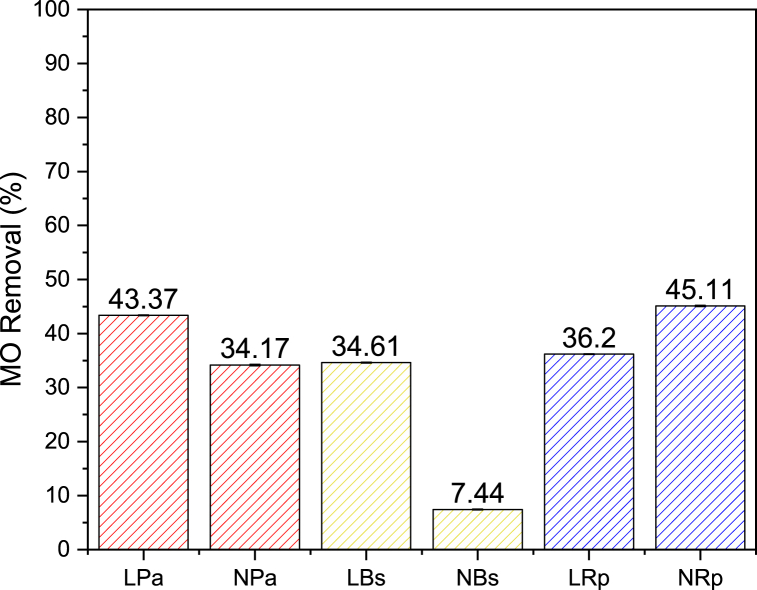
Methyl orange (MO) is commonly used in the textile dyeing industry, posing serious health and environmental hazards due to its carcinogenic, mutagenic properties, and potential for bioaccumulation. Appropriate handling is needed to solve these problems by harnessing the capacity of living microorganisms and the adsorption properties of bentonite clay minerals. Although the conventional approach predominantly depends on free cells, recent study has developed other methods such as immobilization techniques. Therefore, this study aimed to investigate the efficiency of the immobilization matrix comprising sodium alginate (SA), polyvinyl alcohol (PVA), and bentonite by modifying , , and for MO removal of 50 mg/L. In the free cell technique, the results showed that the MO decreased to 43.13, 36.61, and 27.45% for each of the bacteria within 10 days at 35 °C. The bacterial immobilization technique, including live immobilized (LIPa), live immobilized (LIBs), and live immobilized (LIRp) beads also demonstrated significant efficiency, achieving MO removal rates up to 97.15, 95.65, and 66.63% within 10 days. These synthesized beads showed reusability, with LIPa, LIBs, and LIRp being used up to 4, 4, and 2 cycles, respectively. The external and internal surface conditions were observed using SEM instrument and the results showed that all components were agglomerated. Comparisons using dead bacterial biomass indicated that treatment with live bacteria consistently yielded significantly higher removal rates. These results showed the effectiveness of immobilized bacteria in MO removal, offering a promising potential in reducing pollutants.
甲基橙(MO)常用于纺织印染行业,因其具有致癌、致突变特性以及生物累积潜力,对健康和环境构成严重危害。需要通过利用活微生物的能力和膨润土矿物的吸附特性进行适当处理来解决这些问题。尽管传统方法主要依赖游离细胞,但最近的研究开发了其他方法,如固定化技术。因此,本研究旨在通过对海藻酸钠(SA)、聚乙烯醇(PVA)和膨润土组成的固定化基质进行改性,研究其对50mg/L的MO去除效率。在游离细胞技术中,结果表明,在35℃下,10天内每种细菌对MO的去除率分别降至43.13%、36.61%和27.45%。包括活固定化嗜碱芽孢杆菌(LIPa)、活固定化枯草芽孢杆菌(LIBs)和活固定化解磷巨大芽孢杆菌(LIRp)珠在内的细菌固定化技术也显示出显著效率,在10天内实现了高达97.15%、95.65%和66.63%的MO去除率。这些合成珠显示出可重复使用性,LIPa、LIBs和LIRp分别可使用多达4、4和2个循环。使用扫描电子显微镜(SEM)仪器观察了内外表面条件,结果表明所有组分都发生了团聚。使用死细菌生物量的比较表明,活细菌处理始终产生显著更高的去除率。这些结果表明固定化细菌在去除MO方面的有效性,在减少污染物方面具有广阔的潜力。