Cascini Fidelia, Pantovic Ana, Al-Ajlouni Yazan A, Puleo Valeria, De Maio Lucia, Ricciardi Walter
Department of Life Sciences and Public Health, Section of Hygiene and Public Health, Università Cattolica del Sacro Cuore, L. go Francesco Vito 1, Rome, 00168, Italy.
Directorate General for the Digitisation of the Health Information System and Statistics, Ministry of Health, Italy.
EClinicalMedicine. 2024 Mar 18;71:102551. doi: 10.1016/j.eclinm.2024.102551. eCollection 2024 May.
To receive the best care, people share their health data (HD) with their health practitioners (known as sharing HD for primary purposes). However, during the past two decades, sharing for other (i.e., secondary) purposes has become of great importance in numerous fields, including public health, personalized medicine, research, and development. We aimed to conduct the first comprehensive overview of all studies that investigated people's HD sharing attitudes-along with associated barriers/motivators and significant influencing factors-for all data types and across both primary and secondary uses.
We searched PubMed, MEDLINE, PsycINFO, Web of Science, EMBASE, and CINAHL for relevant studies published in English between database inception and February 28, 2023, using a predefined set of keywords. Studies were included, regardless of their design, if they reported outcomes related to attitudes towards sharing HD. We extracted key data from the included studies, including the type of HD involved and findings related to: HD sharing attitudes (either in general or depending on type of data/user); barriers/motivators/benefits/concerns of the study participants; and sociodemographic and other variables that could impact HD sharing behaviour. The qualitative synthesis was conducted by dividing the studies according to the data type (resulting in five subgroups) as well as the purpose the data sharing was focused on (primary, secondary or both). The Newcastle-Ottawa Scale (NOS) was used to assess the quality of non-randomised studies. This work was registered with PROSPERO, CRD42023413822.
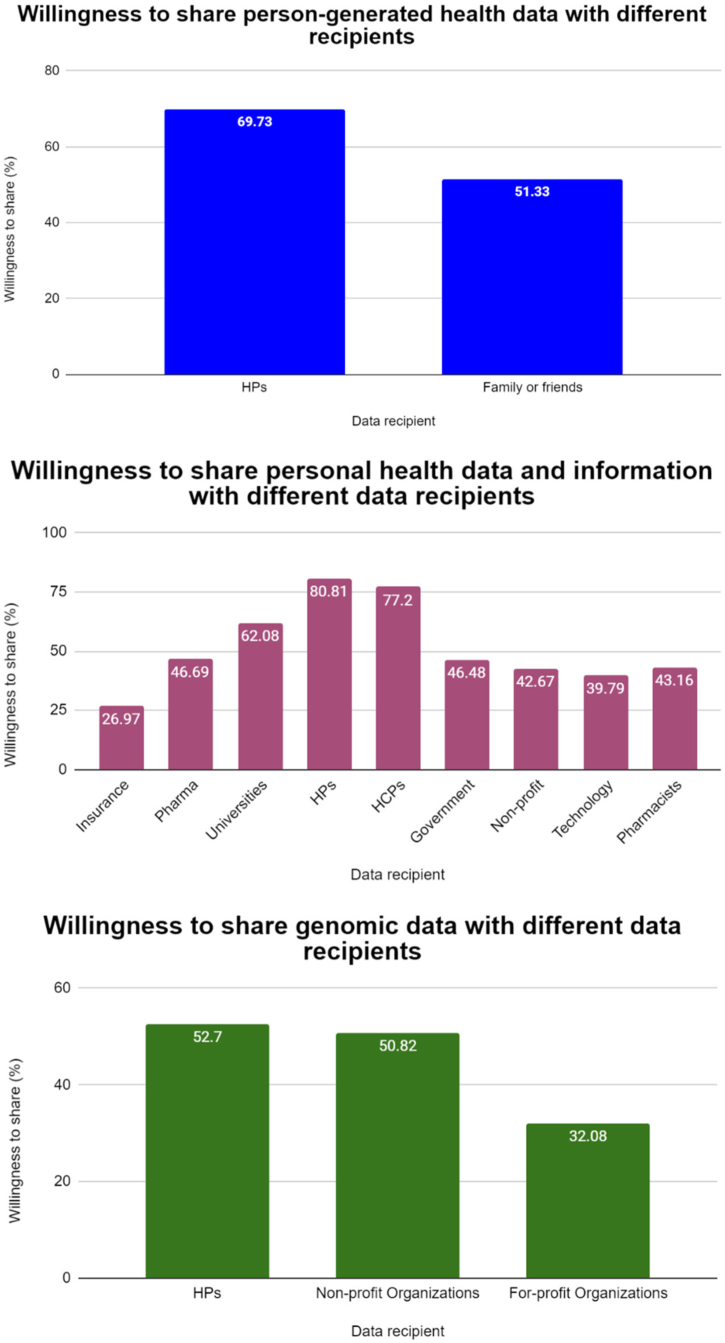
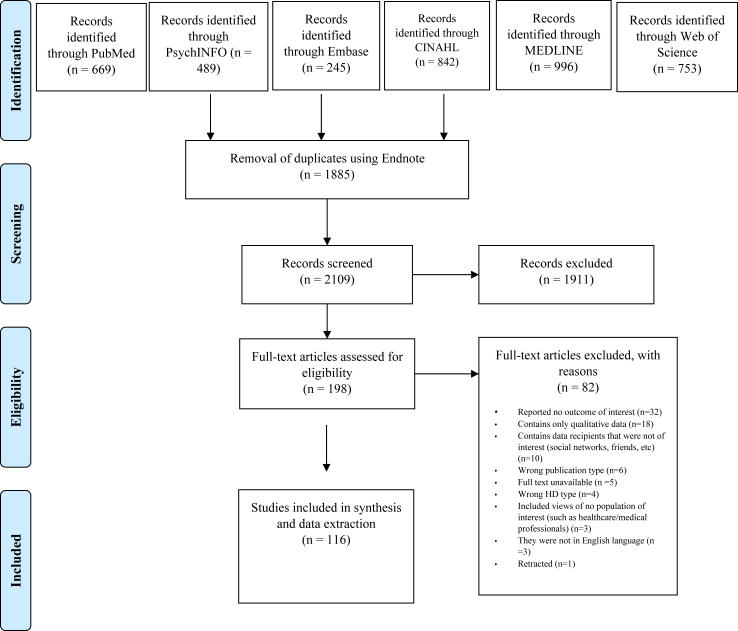
Of 2109 studies identified through our search, 116 were included in the qualitative synthesis, yielding a total of 228,501 participants and various types of HD represented: person-generated HD (n = 17 studies and 10,771 participants), personal HD in general (n = 69 studies and 117,054 participants), Biobank data (n = 7 studies and 27,073 participants), genomic data (n = 13 studies and 54,716 participants), and miscellaneous data (n = 10 studies and 18,887 participants). The majority of studies had a moderate level of quality (83 [71.6%] of 116 studies), but varying levels of quality were observed across the included studies. Overall, studies suggest that sharing intentions for primary purposes were observed to be high regardless of data type, and it was higher than sharing intentions for secondary purposes. Sharing for secondary purposes yielded variable findings, where both the highest and the lowest intention rates were observed in the case of studies that explored sharing biobank data (98% and 10%, respectively). Several influencing factors on sharing intentions were identified, such as the type of data recipient, data, consent. Further, concerns related to data sharing that were found to be mutual for all data types included privacy, security, and data access/control, while the perceived benefits included those related to improvements in healthcare. Findings regarding attitudes towards sharing varied significantly across sociodemographic factors and depended on data type and type of use. In most cases, these findings were derived from single studies and therefore warrant confirmations from additional studies.
Sharing health data is a complex issue that is influenced by various factors (the type of health data, the intended use, the data recipient, among others) and these insights could be used to overcome barriers, address people's concerns, and focus on spreading awareness about the data sharing process and benefits.
None.
为了获得最佳医疗服务,人们会与医疗从业者分享他们的健康数据(即出于主要目的分享健康数据)。然而,在过去二十年中,出于其他(即次要)目的的分享在包括公共卫生、个性化医疗、研究与开发在内的众多领域变得极为重要。我们旨在对所有研究进行首次全面概述,这些研究调查了人们对健康数据分享的态度,以及所有数据类型在主要和次要用途中相关的障碍/动机和重要影响因素。
我们使用一组预定义的关键词,在PubMed、MEDLINE、PsycINFO、科学网、EMBASE和CINAHL中搜索2023年2月28日之前以英文发表的相关研究。无论研究设计如何,只要报告了与健康数据分享态度相关的结果,就将其纳入。我们从纳入的研究中提取关键数据,包括所涉及的健康数据类型以及与以下方面相关的结果:健康数据分享态度(总体或取决于数据/用户类型);研究参与者的障碍/动机/益处/担忧;以及可能影响健康数据分享行为的社会人口统计学和其他变量。定性综合分析是根据数据类型(分为五个亚组)以及数据分享所关注的目的(主要、次要或两者皆有)对研究进行划分来进行 的。使用纽卡斯尔-渥太华量表(NOS)评估非随机研究的质量。这项工作已在PROSPERO注册,注册号为CRD42023413822。
通过我们的搜索确定的2109项研究中,116项被纳入定性综合分析,共有228,501名参与者,涵盖了各种类型的健康数据:个人生成的健康数据(17项研究,10,771名参与者)、一般个人健康数据(69项研究,117,054名参与者)、生物样本库数据(7项研究,27,073名参与者)、基因组数据(13项研究,54,716名参与者)和其他杂项数据(10项研究,18,887名参与者)。大多数研究质量中等(116项研究中的83项[71.6%]),但纳入的研究质量水平各不相同。总体而言,研究表明,无论数据类型如何,主要目的的分享意愿都很高`,且高于次要目的的分享意愿。次要目的的分享产生了不同的结果,在探索生物样本库数据分享的研究中观察到了最高和最低的意愿率(分别为98%和10%)。确定了几个影响分享意愿的因素,如数据接收者类型、数据、同意。此外,发现所有数据类型共同关注的数据分享问题包括隐私、安全和数据访问/控制,而感知到的益处包括与医疗保健改善相关的益处。关于分享态度的结果在社会人口统计学因素中差异很大,并且取决于数据类型和使用类型。在大多数情况下,这些结果来自单一研究,因此需要其他研究进行证实。
分享健康数据是一个复杂的问题,受到多种因素(健康数据类型、预期用途、数据接收者等)的影响,这些见解可用于克服障碍、解决人们的担忧,并专注于提高对数据分享过程和益处的认识。
无。