Narahari Adishesh K, Horgan Taylor M, Chandrabhatla Anirudha S, Gist D Chris, Patel Paranjay D, Lantieri Mark A, Sturek Jeffrey M, Davis Claire L, Jackson Patrick E H, Bell Taison D
Division of Cardiothoracic Surgery, University of Virginia School of Medicine, Charlottesville, Virginia, USA.
School of Medicine, University of Virginia, Charlottesville, Virginia, USA.
Open Forum Infect Dis. 2024 Mar 26;11(3):ofae064. doi: 10.1093/ofid/ofae064. eCollection 2024 Mar.
Evaluating the National Institute's Health's (NIH's) response to the coronavirus disease 2019 (COVID-19) pandemic via grants and clinical trials is crucial to determining the impact they had on aiding US citizens. We determined how the NIH's funding for COVID-19 research was disbursed and used by various institutions across the United States.
We queried NIH RePORTER and isolated COVID-19-related grants from January 2020 to December 2021. We analyzed grant type, geographical location, and awardee institution. Manuscripts published from these grants were quantitatively analyzed. COVID-19 clinical trials were mapped and distances from counties to clinical trial sites were calculated using ArcGis.
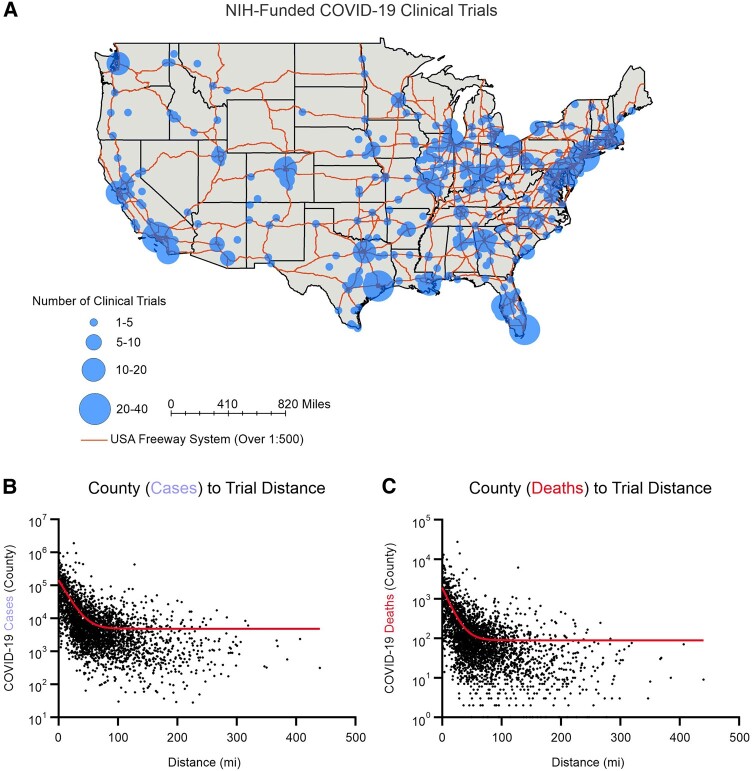
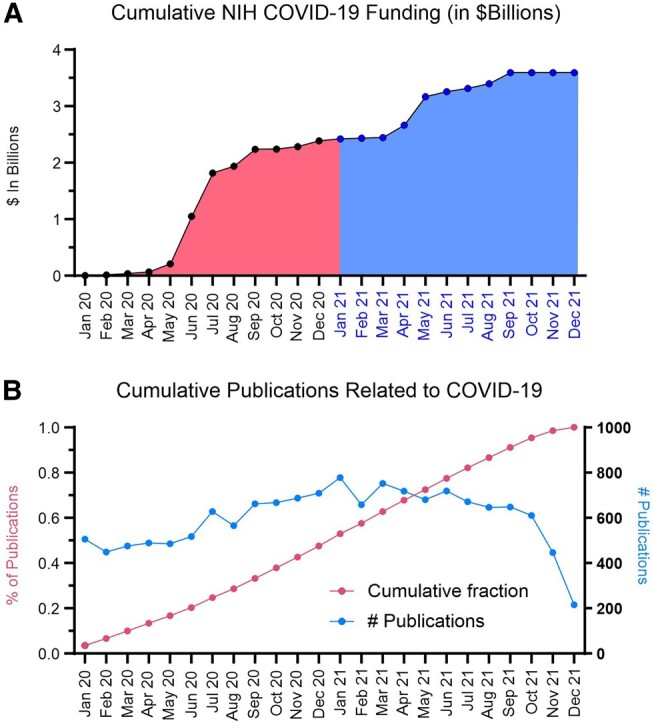
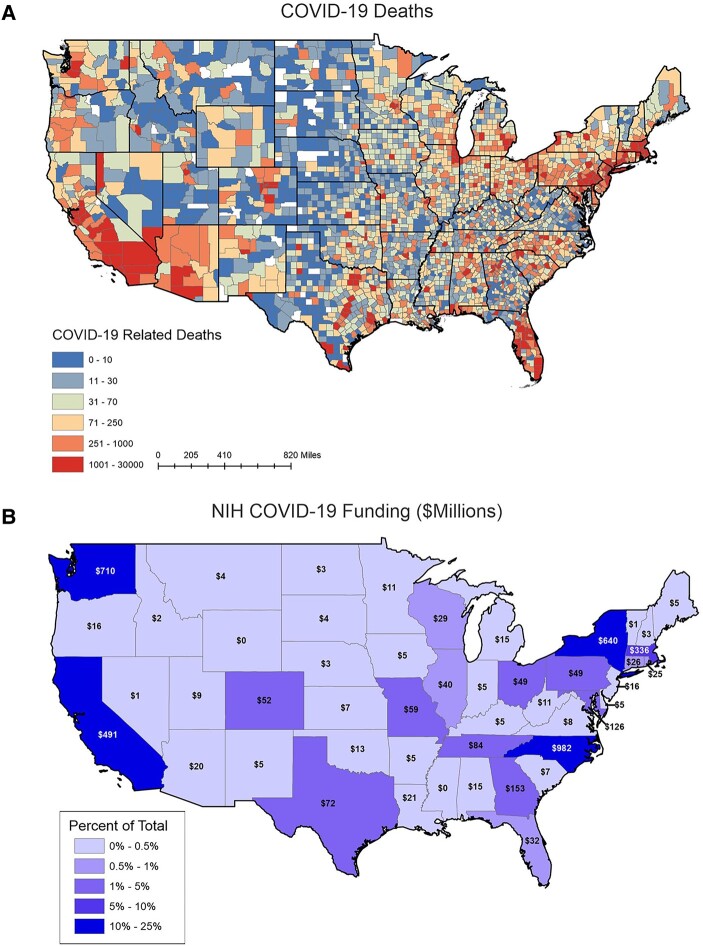
A total of 2401 COVID-19 NIH grants resulted in 14 654 manuscripts from $4.2 billion and generated more than 150 000 citations. R01s make up 32% of grants (763/2401) and 8% of funding ($329 million). UM1 grants account for the majority of funding (30.8%; $1.3 Billion). Five states received 50.6% of funding: North Carolina, Washington, New York, California, and Massachusetts. Finally, of the 1806 clinical trials across 1266 sites in the United States, the majority were in metropolitan areas in close proximity to areas of high COVID-19 disease burden.
Evaluating the outcome of the NIH's response to the COVID-19 pandemic is of interest to the general public. The present study finds that the NIH disbursed more than $4 billion in funding to large consortiums and clinical trials to develop diagnostics, therapeutics, and vaccines. Approximately 8% of funding was used for R01 grants. Clinical trial sites were generally located in areas of high COVID-19 burden.
通过拨款和临床试验评估美国国立卫生研究院(NIH)对2019冠状病毒病(COVID-19)大流行的应对措施,对于确定其对帮助美国公民所产生的影响至关重要。我们确定了NIH用于COVID-19研究的资金是如何在美国各地的不同机构进行分配和使用的。
我们查询了NIH RePORTER,并筛选出2020年1月至2021年12月期间与COVID-19相关的拨款。我们分析了拨款类型、地理位置和受奖机构。对这些拨款所发表的手稿进行了定量分析。绘制了COVID-19临床试验的地图,并使用ArcGis计算了各县到临床试验地点的距离。
NIH共有2401项COVID-19拨款,产生了来自42亿美元的14654篇手稿,并获得了超过150000次引用。R01拨款占拨款总数的32%(763/2401),占资金的8%(3.29亿美元)。UM1拨款占资金的大部分(30.8%;13亿美元)。五个州获得了50.6%的资金:北卡罗来纳州、华盛顿州、纽约州、加利福尼亚州和马萨诸塞州。最后,在美国1266个地点进行的1806项临床试验中,大多数位于与COVID-19疾病负担高的地区相邻的大都市地区。
评估NIH对COVID-19大流行的应对结果是公众所关注的。本研究发现,NIH向大型财团和临床试验发放了超过40亿美元的资金,用于开发诊断方法、治疗方法和疫苗。约8%的资金用于R01拨款。临床试验地点通常位于COVID-19负担高的地区。