Sutton Reed Taylor, Chappell Kaitlyn Delaney, Pincock David, Sadowski Daniel, Baumgart Daniel C, Kroeker Karen Ivy
Division of Gastroenterology, Department of Medicine, University of Alberta, Edmonton, AB, Canada.
Chief Medical Information Office, Alberta Health Services, Edmonton, AB, Canada.
JMIR Med Inform. 2024 Mar 22;12:e55314. doi: 10.2196/55314.
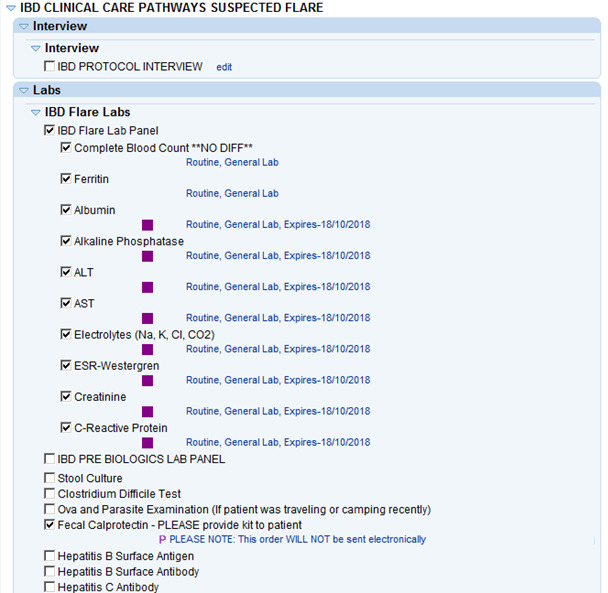
Clinical decision support systems (CDSSs) embedded in electronic medical records (EMRs), also called electronic health records, have the potential to improve the adoption of clinical guidelines. The University of Alberta Inflammatory Bowel Disease (IBD) Group developed a CDSS for patients with IBD who might be experiencing disease flare and deployed it within a clinical information system in 2 continuous time periods.
This study aims to evaluate the impact of the IBD CDSS on the adherence of health care providers (ie, physicians and nurses) to institutionally agreed clinical management protocols.
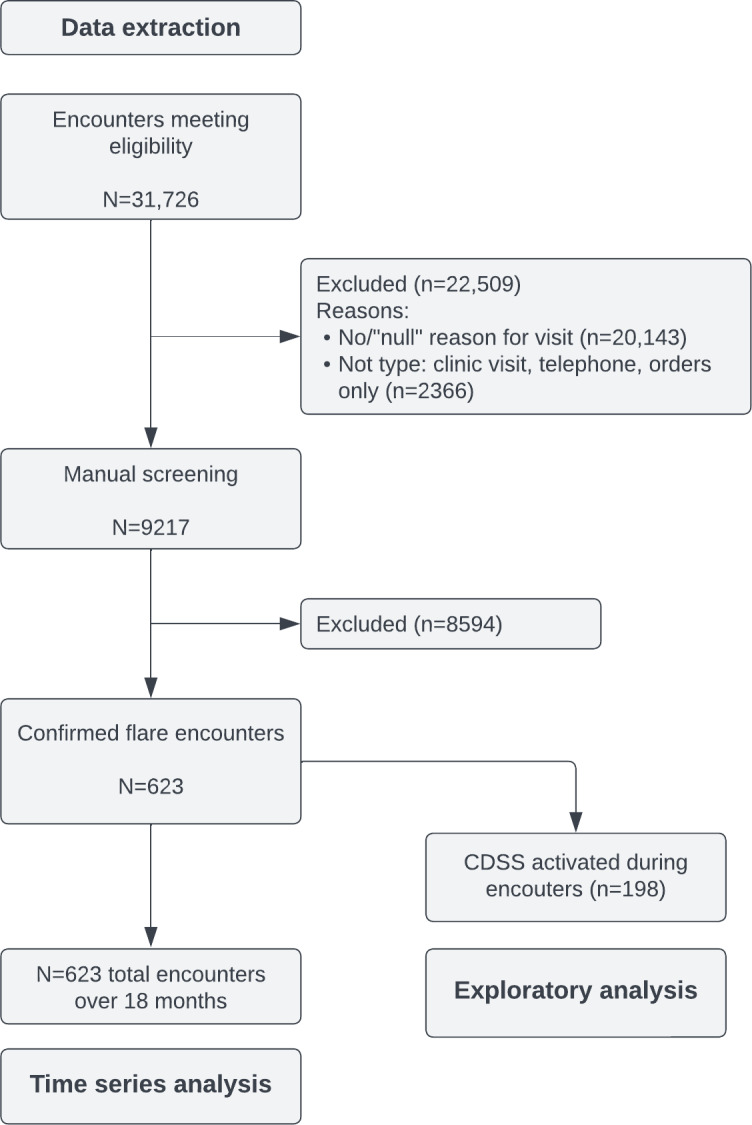
A 2-period interrupted time series (ITS) design, comparing adherence to a clinical flare management protocol during outpatient visits before and after the CDSS implementation, was used. Each interruption was initiated with user training and a memo with instructions for use. A group of 7 physicians, 1 nurse practitioner, and 4 nurses were invited to use the CDSS. In total, 31,726 flare encounters were extracted from the clinical information system database, and 9217 of them were manually screened for inclusion. Each data point in the ITS analysis corresponded to 1 month of individual patient encounters, with a total of 18 months of data (9 before and 9 after interruption) for each period. The study was designed in accordance with the Statement on Reporting of Evaluation Studies in Health Informatics (STARE-HI) guidelines for health informatics evaluations.
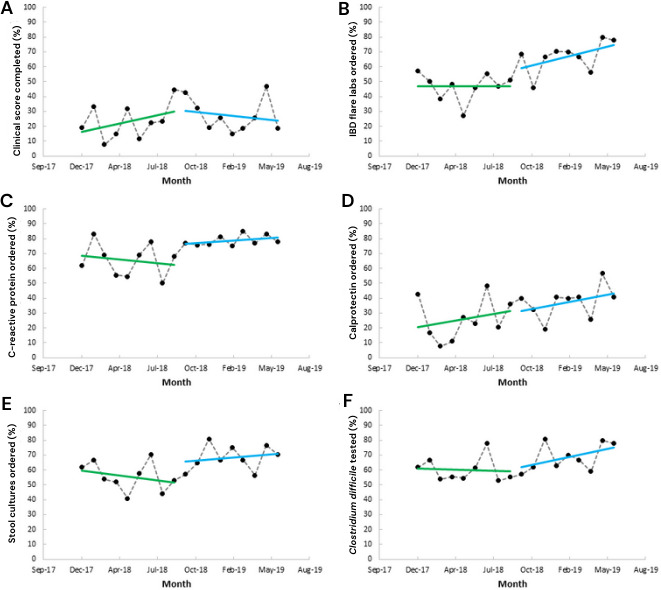
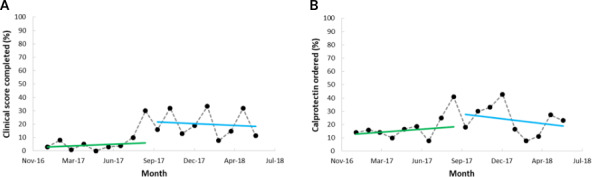
Following manual screening, 623 flare encounters were confirmed and designated for ITS analysis. The CDSS was activated in 198 of 623 encounters, most commonly in cases where the primary visit reason was a suspected IBD flare. In Implementation Period 1, before-and-after analysis demonstrates an increase in documentation of clinical scores from 3.5% to 24.1% (P<.001), with a statistically significant level change in ITS analysis (P=.03). In Implementation Period 2, the before-and-after analysis showed further increases in the ordering of acute disease flare lab tests (47.6% to 65.8%; P<.001), including the biomarker fecal calprotectin (27.9% to 37.3%; P=.03) and stool culture testing (54.6% to 66.9%; P=.005); the latter is a test used to distinguish a flare from an infectious disease. There were no significant slope or level changes in ITS analyses in Implementation Period 2. The overall provider adoption rate was moderate at approximately 25%, with greater adoption by nurse providers (used in 30.5% of flare encounters) compared to physicians (used in 6.7% of flare encounters).
This is one of the first studies to investigate the implementation of a CDSS for IBD, designed with a leading EMR software (Epic Systems), providing initial evidence of an improvement over routine care. Several areas for future research were identified, notably the effect of CDSSs on outcomes and how to design a CDSS with greater utility for physicians. CDSSs for IBD should also be evaluated on a larger scale; this can be facilitated by regional and national centralized EMR systems.
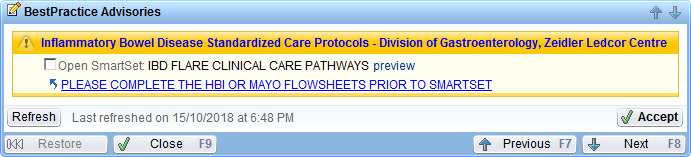
嵌入电子病历(EMR,也称为电子健康记录)中的临床决策支持系统(CDSS)有潜力促进临床指南的应用。阿尔伯塔大学炎症性肠病(IBD)研究小组为可能出现疾病发作的IBD患者开发了一个CDSS,并在两个连续时间段内将其部署在临床信息系统中。
本研究旨在评估IBD CDSS对医疗保健提供者(即医生和护士)遵守机构认可的临床管理方案的影响。
采用两阶段中断时间序列(ITS)设计,比较CDSS实施前后门诊就诊期间对临床发作管理方案的遵守情况。每次中断都始于用户培训和一份使用说明备忘录。邀请了7名医生、1名执业护士和4名护士使用CDSS。总共从临床信息系统数据库中提取了31726次发作病例,其中9217次经过人工筛选以纳入研究。ITS分析中的每个数据点对应1个月的个体患者病例,每个时间段共有18个月的数据(中断前9个月和中断后9个月)。该研究是根据健康信息学评估的《健康信息学评估研究报告声明》(STARE-HI)指南设计的。
经过人工筛选,确认了623次发作病例并指定用于ITS分析。在623次病例中有198次激活了CDSS,最常见于主要就诊原因是疑似IBD发作的病例。在实施期1,前后分析显示临床评分记录从3.5%增加到24.1%(P<.001),ITS分析中有统计学显著的水平变化(P=.03)。在实施期2,前后分析显示急性疾病发作实验室检查的医嘱进一步增加(从47.6%增至65.8%;P<.001),包括生物标志物粪便钙卫蛋白(从27.9%增至37.3%;P=.03)和粪便培养检测(从54.6%增至66.9%;P=.005);后者是用于区分发作与传染病的检测。在实施期2的ITS分析中没有显著的斜率或水平变化。总体提供者采用率适中,约为25%,护士提供者(在30.5%的发作病例中使用)的采用率高于医生(在6.7%的发作病例中使用)。
这是首批研究为IBD设计的CDSS实施情况的研究之一,该CDSS采用领先的EMR软件(Epic Systems)设计,提供了优于常规护理的初步证据。确定了几个未来研究领域,特别是CDSS对结局的影响以及如何设计对医生更有用的CDSS。IBD的CDSS也应在更大规模上进行评估;区域和国家集中式EMR系统可促进这一点。