Nguyên Uyên Châu, Rijks Jesse H J, Plesinger Filip, Rademakers Leonard M, Luermans Justin, Smits Karin C, van Stipdonk Antonius M W, Prinzen Frits W, Vernooy Kevin, Halamek Josef, Curila Karol, Jurak Pavel
Department of Cardiology, Maastricht University Medical Center+, Cardiovascular Research Institute Maastricht (CARIM), 6229 HX Maastricht, The Netherlands.
Department of Physiology, Maastricht University Medical Center+, Cardiovascular Research Institute Maastricht (CARIM), 6229 HX Maastricht, The Netherlands.
J Cardiovasc Dev Dis. 2024 Feb 23;11(3):76. doi: 10.3390/jcdd11030076.
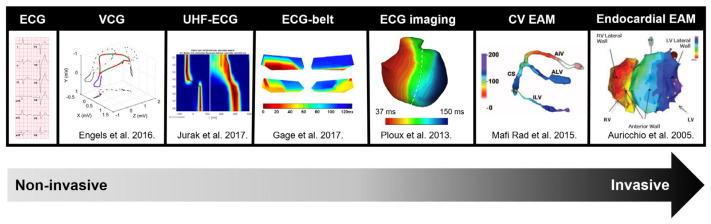
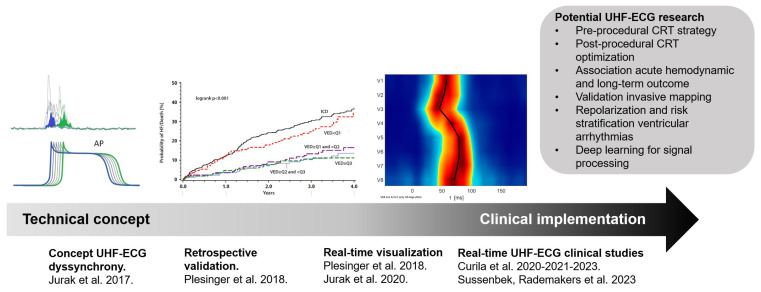
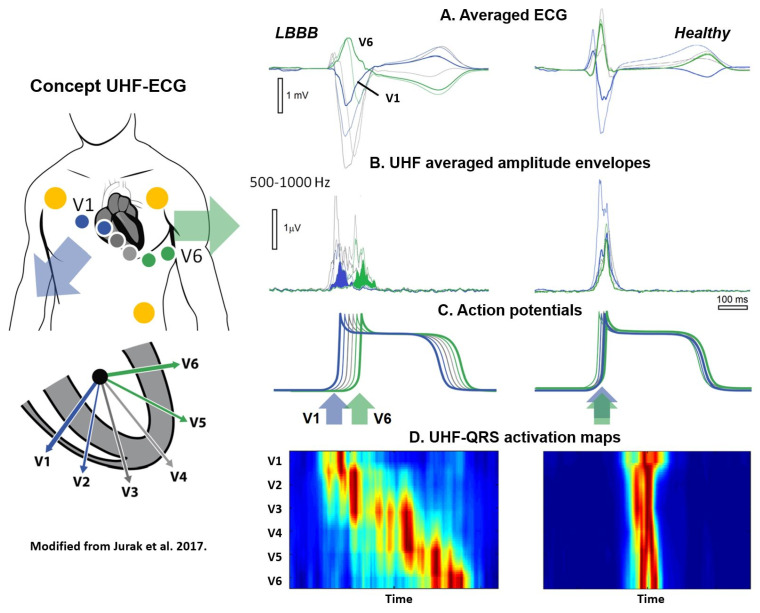
Identifying electrical dyssynchrony is crucial for cardiac pacing and cardiac resynchronization therapy (CRT). The ultra-high-frequency electrocardiography (UHF-ECG) technique allows instantaneous dyssynchrony analyses with real-time visualization. This review explores the physiological background of higher frequencies in ventricular conduction and the translational evolution of UHF-ECG in cardiac pacing and CRT. Although high-frequency components were studied half a century ago, their exploration in the dyssynchrony context is rare. UHF-ECG records ECG signals from eight precordial leads over multiple beats in time. After initial conceptual studies, the implementation of an instant visualization of ventricular activation led to clinical implementation with minimal patient burden. UHF-ECG aids patient selection in biventricular CRT and evaluates ventricular activation during various forms of conduction system pacing (CSP). UHF-ECG ventricular electrical dyssynchrony has been associated with clinical outcomes in a large retrospective CRT cohort and has been used to study the electrophysiological differences between CSP methods, including His bundle pacing, left bundle branch (area) pacing, left ventricular septal pacing and conventional biventricular pacing. UHF-ECG can potentially be used to determine a tailored resynchronization approach (CRT through biventricular pacing or CSP) based on the electrical substrate (true LBBB vs. non-specified intraventricular conduction delay with more distal left ventricular conduction disease), for the optimization of CRT and holds promise beyond CRT for the risk stratification of ventricular arrhythmias.
识别电活动不同步对于心脏起搏和心脏再同步治疗(CRT)至关重要。超高频心电图(UHF-ECG)技术可以进行即时不同步分析并实时可视化。本文综述探讨了心室传导中高频成分的生理背景以及UHF-ECG在心脏起搏和CRT中的转化进展。尽管高频成分在半个世纪前就已被研究,但在不同步背景下对其的探索却很少见。UHF-ECG可及时记录来自八个胸前导联多个心搏的心电图信号。在经过初步的概念性研究后,心室激活即时可视化的实现使得其能在对患者负担最小的情况下应用于临床。UHF-ECG有助于双心室CRT患者的选择,并评估各种形式的传导系统起搏(CSP)期间的心室激活情况。在一个大型回顾性CRT队列中,UHF-ECG心室电活动不同步与临床结局相关,并已被用于研究CSP方法之间的电生理差异,包括希氏束起搏、左束支(区域)起搏、左心室间隔起搏和传统双心室起搏。UHF-ECG有可能用于根据电基质(真正的左束支传导阻滞与伴有更远处左心室传导疾病的未明确的室内传导延迟)确定个性化的再同步方法(通过双心室起搏或CSP进行CRT),以优化CRT,并且在CRT之外,有望用于室性心律失常的风险分层。