Department of Neurology, University Hospital Frankfurt, Goethe University Frankfurt, Schleusenweg 2-16, 60528, Frankfurt, Germany.
Practice for Neurology and Psychiatry Eltville, 65343, Eltville, Germany.
J Neurol. 2024 Jun;271(6):3512-3526. doi: 10.1007/s00415-024-12299-z. Epub 2024 Mar 27.
Definitions of aggressive MS employ clinical and MR imaging criteria to identify highly active, rapidly progressing disease courses. However, the degree of overlap between clinical and radiological parameters and biochemical markers of CNS injury is not fully understood. Aim of this cross-sectional study was to match clinical and MR imaging hallmarks of aggressive MS to serum/CSF markers of neuroaxonal and astroglial injury (neurofilament light chain (sNfL, cNfL), and glial fibrillary acidic protein (sGFAP, cGFAP)).
We recruited 77 patients with relapsing-remitting MS (RRMS) and 22 patients with clinically isolated syndrome. NfL and GFAP levels in serum and CSF were assessed using a single-molecule-array HD-1-analyzer. A general linear model with each biomarker as a dependent variable was computed. Clinical and imaging criteria of aggressive MS, as recently proposed by the ECTRIMS Consensus Group, were modeled as independent variables. Other demographic, clinical or laboratory parameters, were modeled as covariates. Analyses were repeated in a homogenous subgroup, consisting only of newly diagnosed, treatment-naïve RRMS patients presenting with an acute relapse.
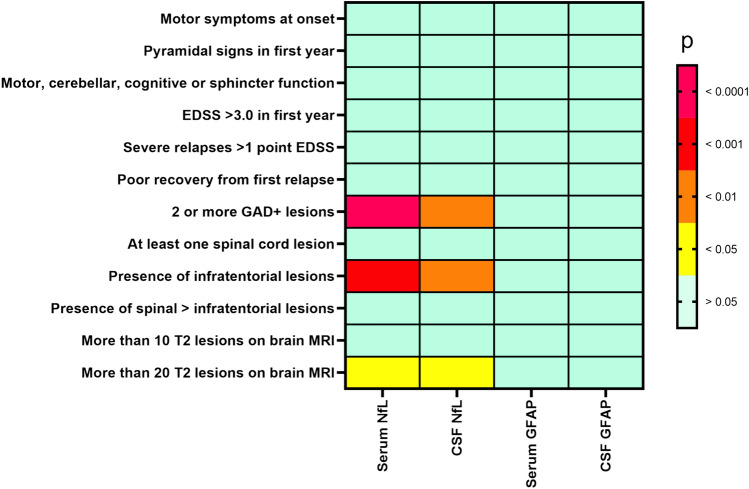
After adjusting for covariates and multiplicity of testing, sNfL and cNfL concentrations were strongly associated with the presence of ≥2 gadolinium-enhancing lesions (p = 0.00008; p = 0.004) as well as the presence of infratentorial lesions on MRI (p = 0.0003; p < 0.004). No other clinical and imaging criteria of aggressive MS correlated significantly with NfL or GFAP in serum and CSF. In the more homogeneous subgroup, sNfL still was associated with the presence of ≥2 gadolinium-enhancing lesions (p = 0.001), presence of more than 20 T2-lesions (p = 0.049) as well as the presence of infratentorial lesions on MRI (p = 0.034), while cNfL was associated with the presence of ≥2 gadolinium-enhancing lesions (p = 0.011) and presence of more than 20 T2-lesions (p = 0.029).
Among proposed risk factors for an aggressive disease course, MRI findings but not clinical characteristics correlated with sNfL and cNfL as a marker of neuroaxonal injury and should be given appropriate weight considering MS prognosis and therapy. No significant correlation was detected for GFAP alone.
使用临床和磁共振成像标准来定义侵袭性 MS,以识别高度活跃、快速进展的疾病过程。然而,临床和影像学参数以及中枢神经系统损伤的生化标志物之间的重叠程度尚不清楚。本横断面研究的目的是将侵袭性 MS 的临床和磁共振成像特征与血清/CSF 神经轴索和星形胶质损伤的标志物(神经丝轻链(sNfL、cNfL)和胶质纤维酸性蛋白(sGFAP、cGFAP))相匹配。
我们招募了 77 例复发缓解型多发性硬化症(RRMS)患者和 22 例临床孤立综合征患者。使用单分子阵列 HD-1 分析仪评估血清和 CSF 中的 NfL 和 GFAP 水平。使用广义线性模型,将每个生物标志物作为因变量进行计算。采用最近由 ECTRIMS 共识小组提出的侵袭性 MS 的临床和成像标准作为独立变量进行建模。其他人口统计学、临床或实验室参数作为协变量进行建模。在仅由新诊断、未经治疗的 RRMS 患者组成的同质亚组中,对出现急性复发的患者进行了重复分析。
在调整了协变量和多重检验后,sNfL 和 cNfL 浓度与存在≥2 个钆增强病变(p=0.00008;p=0.004)以及 MRI 上存在小脑下病变(p=0.0003;p<0.004)密切相关。侵袭性 MS 的其他临床和成像标准与血清和 CSF 中的 NfL 或 GFAP 无显著相关性。在更同质的亚组中,sNfL 仍与存在≥2 个钆增强病变(p=0.001)、存在超过 20 个 T2 病变(p=0.049)以及 MRI 上存在小脑下病变(p=0.034)相关,而 cNfL 与存在≥2 个钆增强病变(p=0.011)和存在超过 20 个 T2 病变(p=0.029)相关。
在侵袭性疾病过程的拟议危险因素中,MRI 发现而不是临床特征与 sNfL 和 cNfL 作为神经轴索损伤的标志物相关,应根据 MS 的预后和治疗给予适当的重视。单独检测 GFAP 未发现显著相关性。