Bioinformatics Group, Department of Plant Science, Wageningen University & Research, Droevendaalsesteeg 1, 6708PB Wageningen, The Netherlands.
Department of Microbial Ecology, Netherlands Institute of Ecology (NIOO-KNAW), Droevendaalsesteeg 10, 6708 PB Wageningen, The Netherlands.
ISME J. 2024 Jan 8;18(1). doi: 10.1093/ismejo/wrae049.
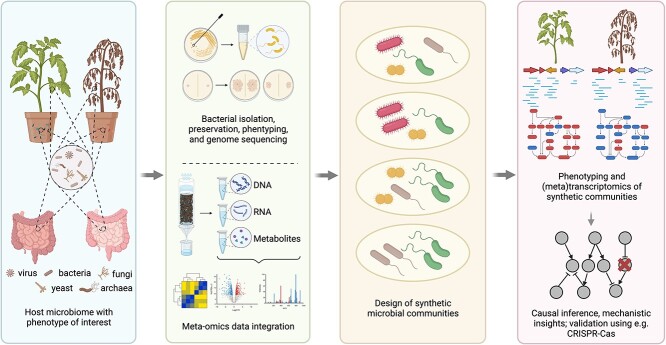
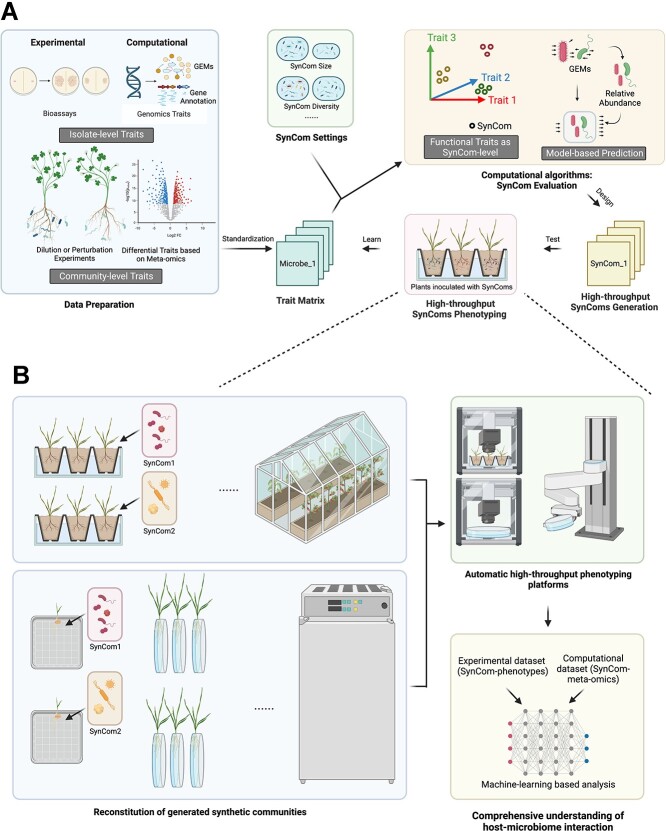
Natural ecosystems harbor a huge reservoir of taxonomically diverse microbes that are important for plant growth and health. The vast diversity of soil microorganisms and their complex interactions make it challenging to pinpoint the main players important for the life support functions microbes can provide to plants, including enhanced tolerance to (a)biotic stress factors. Designing simplified microbial synthetic communities (SynComs) helps reduce this complexity to unravel the molecular and chemical basis and interplay of specific microbiome functions. While SynComs have been successfully employed to dissect microbial interactions or reproduce microbiome-associated phenotypes, the assembly and reconstitution of these communities have often been based on generic abundance patterns or taxonomic identities and co-occurrences but have only rarely been informed by functional traits. Here, we review recent studies on designing functional SynComs to reveal common principles and discuss multidimensional approaches for community design. We propose a strategy for tailoring the design of functional SynComs based on integration of high-throughput experimental assays with microbial strains and computational genomic analyses of their functional capabilities.
自然生态系统蕴藏着大量具有不同分类学特征的微生物,这些微生物对植物的生长和健康至关重要。土壤微生物的多样性及其复杂的相互作用使得确定对植物生命支持功能至关重要的主要参与者变得具有挑战性,这些功能包括增强对(非)生物胁迫因素的耐受性。设计简化的微生物合成群落(SynComs)有助于降低这种复杂性,以揭示特定微生物组功能的分子和化学基础及其相互作用。虽然 SynComs 已成功用于剖析微生物相互作用或再现与微生物组相关的表型,但这些群落的组装和重建通常基于通用的丰度模式或分类学身份和共存,但很少基于功能特征。在这里,我们回顾了最近关于设计功能性 SynComs 以揭示共同原理的研究,并讨论了群落设计的多维方法。我们提出了一种基于整合高通量实验测定、微生物菌株以及对其功能能力的计算基因组分析的功能性 SynComs 设计策略。