The Kirby Institute, University of New South Wales, Sydney, New South Wales, Australia
School of Population Health, University of New South Wales, Sydney, New South Wales, Australia.
BMJ Ment Health. 2024 Mar 27;27(1):e300958. doi: 10.1136/bmjment-2023-300958.
Mental health services are available for young people involved with the criminal justice system. However, they have unmet mental health needs after the expiration of criminal justice supervision.
To determine the incidence rate and identify predictors of psychiatric hospitalisations within 24 months after the expiration of criminal justice supervision among young people involved with the New South Wales (NSW) criminal justice system.
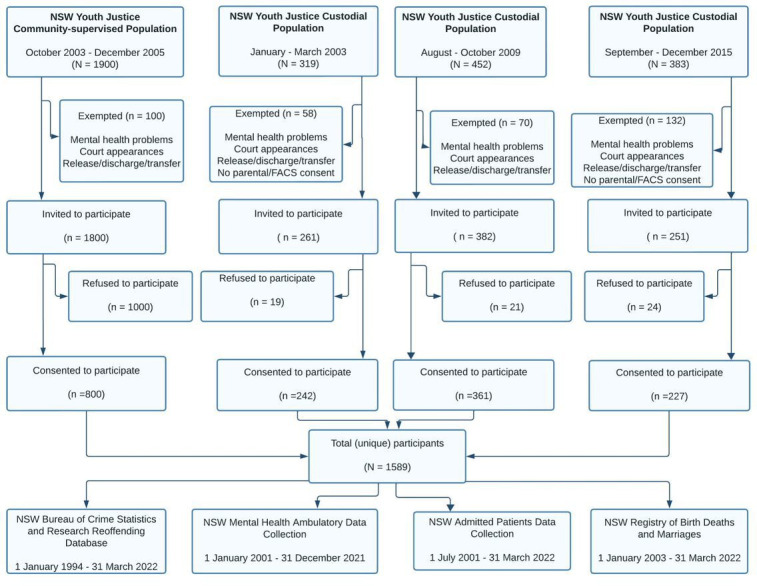
Retrospective data from 1556 individuals aged 14-22 years who participated in four surveys of justice-involved young people in NSW were harmonised and linked to four NSW data collections. We calculated the incidence rates of psychiatric hospitalisations within 24 months postsupervision and identified predictors of these hospitalisations using a competing risks regression analysis.
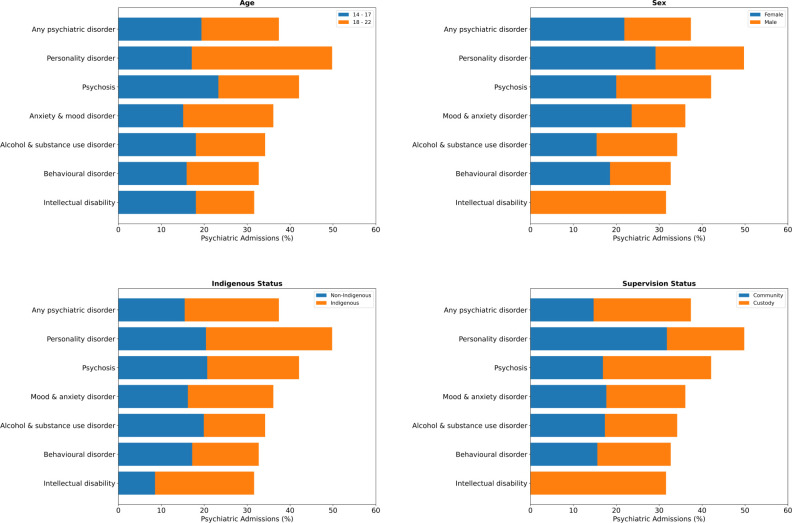
Within 24 months postsupervision, 11.4% had a psychiatric hospitalisation compared with 3.5% during supervision. 20.7% of those admitted had a known history of mental illness and engaged with community-based and outpatient mental health services postsupervision. Predictors of psychiatric hospitalisations were: female sex (adjusted subdistribution HR (asHR) 1.84, 95% CI 1.24 to 2.73); previous incarceration (highest asHR for ≥4 episodes 1.67, 95% CI 1.01 to 2.78); head injury (asHR 1.63, 95% CI 1.20 to 2.21); personality disorder (asHR 3.66, 95% CI 2.06 to 6.48) and alcohol and substance use disorder (asHR 1.89, 95% CI 1.29 to 2.77).
Justice-involved youth have higher rates of psychiatric admissions after criminal justice supervision. Engagement with mental health services postsupervision is important in addressing emerging or persisting mental health needs.
针对涉及刑事司法系统的年轻人,现已有心理健康服务。然而,在刑事司法监督期满后,他们仍有未满足的心理健康需求。
确定新南威尔士州(NSW)刑事司法系统中涉及的年轻人在刑事司法监督期满后 24 个月内精神病住院的发生率,并确定其预测因素。
对参加新南威尔士州四项涉及司法的年轻人调查的 1556 名年龄在 14-22 岁的个体进行回顾性数据分析,并对这些数据进行协调,以与新南威尔士州的四项数据进行链接。我们计算了监督期满后 24 个月内精神病住院的发生率,并使用竞争风险回归分析确定这些住院的预测因素。
监督期满后 24 个月内,有 11.4%的人住院治疗,而监督期间为 3.5%。入院的 20.7%的人有已知的精神病史,并在监督后接受了基于社区的和门诊精神卫生服务。精神病住院的预测因素包括:女性(调整后的亚分布风险比(asHR)为 1.84,95%CI 为 1.24 至 2.73);先前监禁(asHR 最高为≥4 次,为 1.67,95%CI 为 1.01 至 2.78);头部受伤(asHR 为 1.63,95%CI 为 1.20 至 2.21);人格障碍(asHR 为 3.66,95%CI 为 2.06 至 6.48)和酒精和物质使用障碍(asHR 为 1.89,95%CI 为 1.29 至 2.77)。
刑事司法监督期满后,涉及司法的年轻人精神病住院率较高。监督后接受精神卫生服务对解决新出现或持续存在的精神卫生需求很重要。