Division of General Internal Medicine, Department of Medicine, Hennepin Healthcare, Minneapolis, Minnesota.
Center for Patient and Provider Experience, Minneapolis Medical Research Foundation, Minneapolis, Minnesota.
JAMA Netw Open. 2018 Jul 6;1(3):e180558. doi: 10.1001/jamanetworkopen.2018.0558.
Health profiles and patterns of involvement in the criminal justice system among people with various levels of opioid use are poorly defined. Data are needed to inform a public health approach to the opioid epidemic.
To examine the association between various levels of opioid use in the past year and physical and mental health, co-occurring substance use, and involvement in the criminal justice system.
DESIGN, SETTING, AND PARTICIPANTS: This retrospective, cross-sectional analysis used the 2015-2016 National Survey on Drug Use and Health to assess the independent association of intensity of opioid use with health, co-occurring substance use, and involvement in the criminal justice system among US adults aged 18 to 64 years using multivariable logistic regression.
No opioid use vs prescription opioid use, misuse, or use disorder or heroin use.
Self-reported physical and mental health, disability, co-occurring substance use, and past year and lifetime involvement in the criminal justice system.
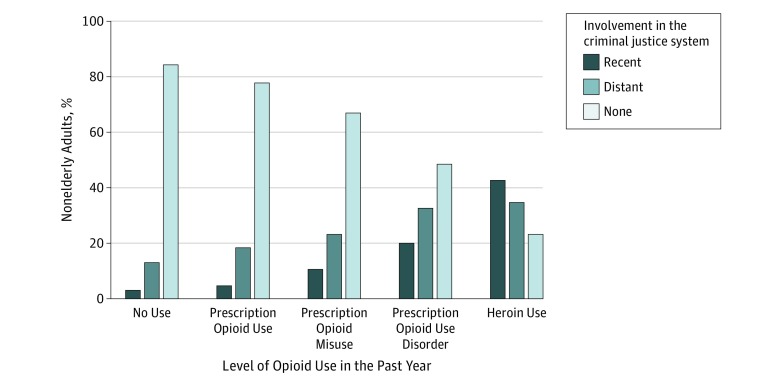
The sample consisted of 78 976 respondents (42 495 women and 36 481 men), representative of 196 280 447 US adults. In the weighted sample, 124 026 842 adults reported no opioid use in the past year (63.2%; 95% CI, 62.6%-63.7%), 61 462 897 reported prescription opioid use in the past year (31.3%; 95% CI, 30.8%-31.8%), 8 439 889 reported prescription opioid misuse in the past year (4.3%; 95% CI, 4.1%-4.5%), 1 475 433 reported prescription opioid use disorder in the past year (0.8%; 95% CI, 0.7%-0.8%), and 875 386 reported heroin use in the past year (0.4%; 95% CI, 0.4%-0.5%). Individuals who reported any level of opioid use were significantly more likely than individuals who reported no opioid use to be white, have a low income, and report a chronic condition, disability, severe mental illness, or co-occurring drug use. History of involvement in the criminal justice system increased as intensity of opioid use increased (no use, 15.9% [19 562 158 of 123 319 911]; 95% CI, 15.4%-16.4%; prescription opioid use, 22.4% [13 712 162 of 61 204 541]; 95% CI, 21.7%-23.1%; prescription opioid misuse, 33.2% [2 793 391 of 8 410 638]; 95% CI, 30.9%-35.6%; prescription opioid use disorder, 51.7% [762 189 of 1 473 552]; 95% CI, 45.4%-58.0%; and heroin use, 76.8% [668 453 of 870 250]; 95% CI, 70.6%-82.1%). In adjusted models, any level of opioid use was associated with involvement in the criminal justice system in the past year compared with no opioid use.
Individuals who use opioids have complicated health profiles and high levels of involvement in the criminal justice system. Combating the opioid epidemic will require public health interventions that involve criminal justice systems, as well as policies that reduce involvement in the criminal justice system among individuals with substance use disorders.
在不同程度使用阿片类药物的人群中,他们的健康状况和参与刑事司法系统的模式尚不清楚。需要这些数据来为阿片类药物流行提供公共卫生方面的指导。
调查过去一年中不同程度的阿片类药物使用与身心健康、同时存在的物质使用以及参与刑事司法系统之间的关联。
设计、地点和参与者:本回顾性、横断面分析使用了 2015-2016 年全国药物使用与健康调查,通过多变量逻辑回归,评估了美国 18 至 64 岁成年人中阿片类药物使用强度与健康、同时存在的物质使用以及参与刑事司法系统之间的独立关联。
无阿片类药物使用与处方阿片类药物使用、滥用或使用障碍或海洛因使用。
自我报告的身心健康、残疾、同时存在的物质使用以及过去一年和终身参与刑事司法系统的情况。
样本包括 78976 名受访者(42495 名女性和 36481 名男性),代表了 196280447 名美国成年人。在加权样本中,124026842 名成年人报告过去一年无阿片类药物使用(63.2%;95%CI,62.6%-63.7%),61462897 名成年人报告过去一年有处方阿片类药物使用(31.3%;95%CI,30.8%-31.8%),8439889 名成年人报告过去一年有处方阿片类药物滥用(4.3%;95%CI,4.1%-4.5%),1475433 名成年人报告过去一年有处方阿片类药物使用障碍(0.8%;95%CI,0.7%-0.8%),875386 名成年人报告过去一年有海洛因使用(0.4%;95%CI,0.4%-0.5%)。与报告无阿片类药物使用的个体相比,报告任何程度阿片类药物使用的个体更有可能是白人、收入较低、报告有慢性疾病、残疾、严重精神疾病或同时存在药物使用情况。随着阿片类药物使用强度的增加,过去一年中涉及刑事司法系统的情况也随之增加(无使用,15.9%[123319911 人,占 12331911/124026842];95%CI,15.4%-16.4%;处方阿片类药物使用,22.4%[13712162 人,占 13712162/61204541];95%CI,21.7%-23.1%;处方阿片类药物滥用,33.2%[2793391 人,占 2793391/8410638];95%CI,30.9%-35.6%;处方阿片类药物使用障碍,51.7%[762189 人,占 762189/1473552];95%CI,45.4%-58.0%;海洛因使用,76.8%[668453 人,占 668453/870250];95%CI,70.6%-82.1%)。在调整后的模型中,与无阿片类药物使用相比,任何程度的阿片类药物使用都与过去一年中涉及刑事司法系统的情况相关。
使用阿片类药物的个体具有复杂的健康状况和高度参与刑事司法系统的情况。打击阿片类药物流行需要公共卫生干预措施涉及刑事司法系统,以及减少有物质使用障碍个体参与刑事司法系统的政策。
