Department of Developmental, Molecular & Chemical Biology, Tufts University School of Medicine, Boston, MA, 02111, USA.
J Mammary Gland Biol Neoplasia. 2024 Mar 28;29(1):7. doi: 10.1007/s10911-024-09559-z.
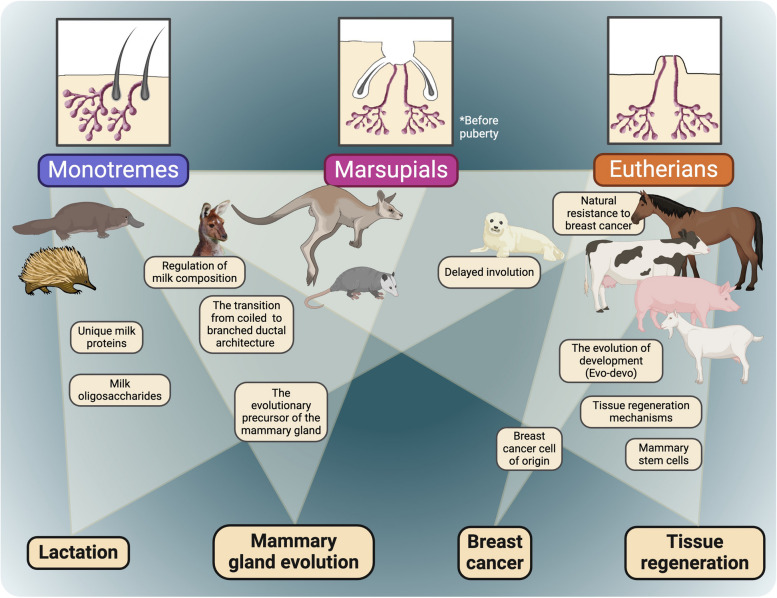
This article offers a comprehensive perspective on the transformative role of organoid technology on mammary gland biology research across a diverse array of mammalian species.The mammary gland's unique development and regenerative capabilities render this organ an ideal model for studying developmental evolution, stem cell behavior, and regenerative processes. The discussion extends to the use of cross-species mammary organoids to address key biological inquiries in evolution, tissue regeneration, cancer research, and lactation, highlighting the limitations of traditional mouse models and the benefits of incorporating a more diverse range of animal models.Advances in organoid biology have been critical in overcoming ethical and practical constraints of in-vivo studies, especially in human research. The generation of human and mouse mammary organoids that faithfully recapitulate in-vivo tissues marks a significant stride in this field. Parallel capabilities are now emerging for other mammals, as well.Utilizing mammary organoids from various species has the potential to make invaluable contributions to our understanding of mammary gland biology, with implications for regenerative medicine, cancer research, and lactation studies, thereby contributing to advancements in human health, agriculture, and nutrition science.
本文全面探讨了类器官技术在哺乳动物多种物种的乳腺生物学研究中的变革作用。乳腺独特的发育和再生能力使其成为研究发育进化、干细胞行为和再生过程的理想模型。讨论还扩展到使用跨物种乳腺类器官来解决进化、组织再生、癌症研究和哺乳等关键生物学问题,强调了传统小鼠模型的局限性和纳入更多种类动物模型的益处。类器官生物学的进展对于克服体内研究的伦理和实际限制至关重要,尤其是在人类研究中。生成忠实再现体内组织的人和小鼠乳腺类器官标志着该领域的重大进展。现在,其他哺乳动物也出现了类似的能力。利用来自不同物种的乳腺类器官有可能为我们理解乳腺生物学做出非常宝贵的贡献,对再生医学、癌症研究和哺乳研究具有重要意义,从而促进人类健康、农业和营养科学的进步。