Medtronic, Plc, Minneapolis, MN, USA.
BMC Med Res Methodol. 2024 Mar 28;24(1):79. doi: 10.1186/s12874-024-02196-4.
The E-value, a measure that has received recent attention in the comparative effectiveness literature, reports the minimum strength of association between an unmeasured confounder and the treatment and outcome that would explain away the estimated treatment effect. This study contributes to the literature on the applications and interpretations of E-values by examining how the E-value is impacted by data with varying levels of association of unobserved covariates with the treatment and outcome measure when covariate adjustment is applied. We calculate the E-value after using regression and propensity score methods (PSMs) to adjust for differences in observed covariates. Propensity score methods are a common observational research method used to balance observed covariates between treatment groups. In practice, researchers may assume propensity score methods that balance treatment groups across observed characteristics will extend to balance of unobserved characteristics. However, that assumption is not testable and has been shown to not hold in realistic data settings. We assess the E-value when covariate adjustment affects the imbalance in unobserved covariates.
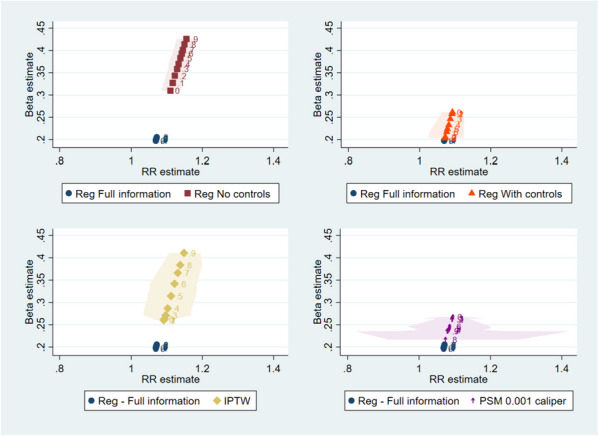
Our study uses Monte Carlo simulations to evaluate the impact of unobserved confounders on the treatment effect estimates and to evaluate the performance of the E-Value sensitivity test with the application of regression and propensity score methods under varying levels of unobserved confounding. Specifically, we compare observed and unobserved confounder balance, odds ratios of treatment vs. control, and E-Value sensitivity test statistics from generalized linear model (GLM) regression models, inverse-probability weighted models, and propensity score matching models, over correlations of increasing strength between observed and unobserved confounders.
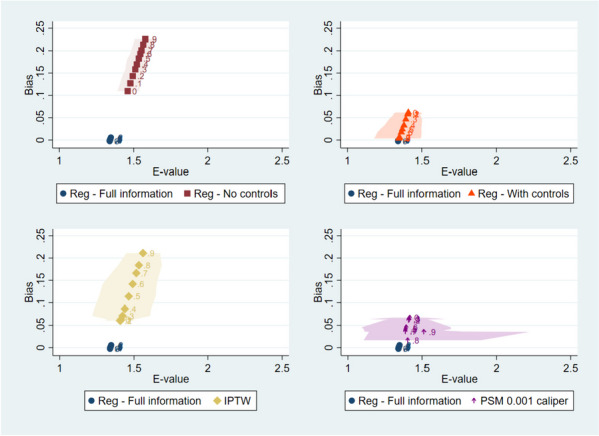
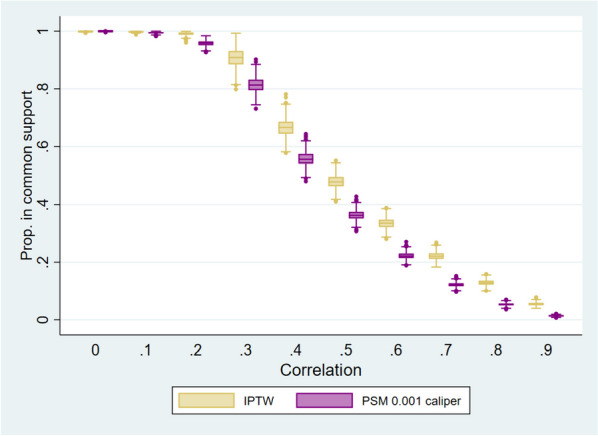
We confirm previous findings that propensity score methods - matching or weighting - may increase the imbalance in unobserved confounders. The magnitude of the effect depends on the strength of correlation between the confounder, treatment, and outcomes. We find that E-values calculated after applying propensity score methods tend to be larger when unobserved confounders result in more biased treatment effect estimates.
The E-Value may misrepresent the size of the unobserved effect needed to change the magnitude of the association between treatment and outcome when propensity score methods are used. Thus, caution is warranted when interpreting the E-Value in the context of propensity score methods.
E 值是一种最近在比较效果文献中受到关注的衡量标准,它报告了未测量混杂因素与治疗和结局之间的关联强度的最小值,这种关联强度足以说明估计的治疗效果。本研究通过检查在应用协变量调整时,当未观察到的协变量与治疗和结局测量值的关联程度不同时,E 值如何受到数据的影响,为 E 值的应用和解释文献做出了贡献。我们使用回归和倾向评分方法(PSM)来调整观察到的协变量的差异后,计算 E 值。倾向评分方法是一种常用的观察性研究方法,用于在治疗组之间平衡观察到的协变量。在实践中,研究人员可能假设,平衡治疗组在观察到的特征上的倾向评分方法将扩展到平衡未观察到的特征。然而,该假设是不可检验的,并且在现实数据设置中并不成立。我们评估了当协变量调整影响未观察到的协变量不平衡时的 E 值。
我们的研究使用蒙特卡罗模拟来评估未观察到的混杂因素对治疗效果估计的影响,并评估在不同程度的未观察到的混杂情况下,应用回归和倾向评分方法对 E 值敏感性测试的性能。具体来说,我们比较了观察到的和未观察到的混杂因素平衡、治疗与对照的比值比,以及来自广义线性模型(GLM)回归模型、逆概率加权模型和倾向评分匹配模型的 E 值敏感性测试统计量,这些模型在观察到的和未观察到的混杂因素之间的相关性逐渐增强的情况下。
我们证实了以前的发现,即倾向评分方法(匹配或加权)可能会增加未观察到的混杂因素的不平衡。这种影响的大小取决于混杂因素、治疗和结局之间的相关性强度。我们发现,当未观察到的混杂因素导致治疗效果估计更偏倚时,应用倾向评分方法后计算的 E 值往往更大。
当使用倾向评分方法时,E 值可能无法准确反映改变治疗与结局之间关联强度所需的未观察到的效应大小。因此,在解释倾向评分方法背景下的 E 值时,需要谨慎。