School of Public Health, Peking University, Beijing, China.
China Center for Health Development Studies, Peking University, Beijing, China.
BMC Geriatr. 2024 Mar 27;24(1):288. doi: 10.1186/s12877-024-04746-3.
This study aimed to explore the associations between household air pollution (HAP), measured by cooking fuel use, sensory impairments (SI), and their transitions in Chinese middle-aged and older adults.
Participants were recruited from the 2011 China Health and Retirement Longitudinal Study (CHARLS) and were subsequently followed up until 2018. Data on SI were collected by self-reported hearing and vision impairments, which were divided into three categories: non-SI, single SI (hearing or vision impairment), and dual SI (DSI). Cooking fuels, including solid and clean fuels, are proxies for HAP. The transitions of cooking fuels and SI refer to the switching of the fuel type or SI status from baseline to follow-up. Cox proportional hazard regression models were used to explore associations, and hazard ratios (HRs) and 95% confidence intervals (CI) were used to evaluate the strength of the association.
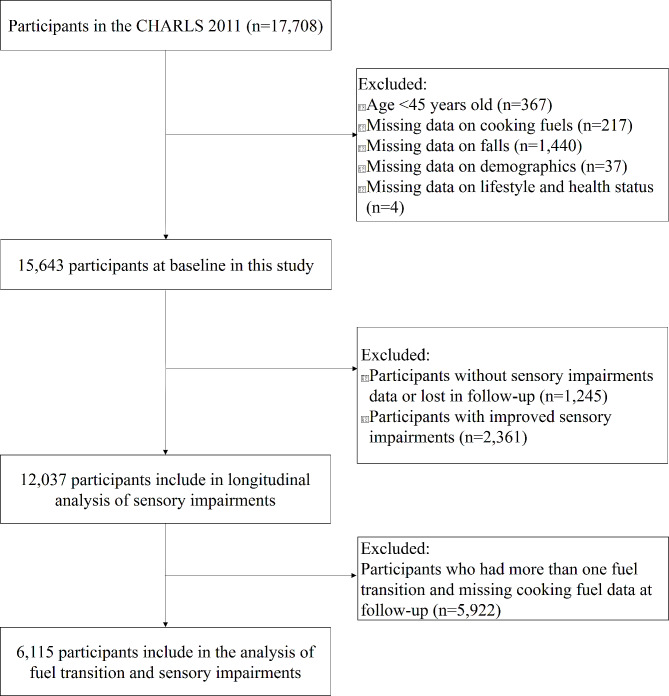
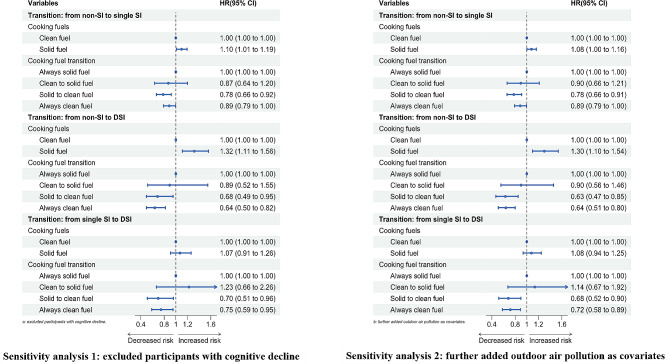
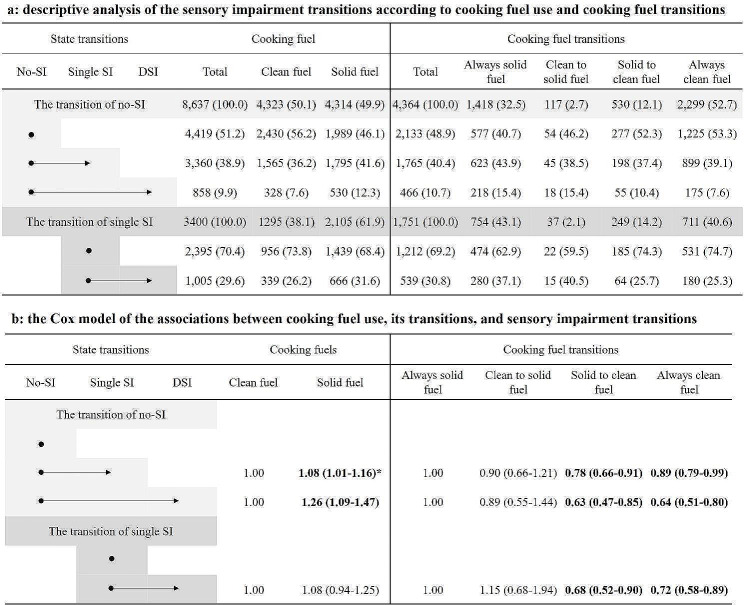
The prevalence of non-SI, single SI, and DSI was 59.6%, 31.8%, and 8.6%, respectively, among the 15,643 participants at baseline in this study. Over a median follow-up of 7.0 years, 5,223 worsening SI transitions were observed. In the fully adjusted model, solid fuel use for cooking was associated with a higher risk of worsening SI transitions, including from non-SI to single SI (HR = 1.08, 95% CI = 1.01-1.16) and from non-SI to DSI (HR = 1.26, 95% CI = 1.09-1.47), but not from single SI to DSI. In addition, compared to those who always used solid fuels, participants who switched from solid to clean fuel for cooking appeared to have attenuated the risk of worsening SI transitions. The statistical significance of the associations remained in the set of sensitivity analyses.
Solid fuel use was associated with higher risks of worsening SI transitions, while converting the type of cooking fuel from solid to clean fuels may reduce the risk of worsening SI transitions. Our study suggests that tailored clean fuel interventions, especially in developing countries, should be implemented to prevent sensory impairments and hence reduce the burden of sensory impairment-related disability.
本研究旨在探讨家庭空气污染(HAP)与感觉障碍(SI)及其在中国中老年人群中的转变之间的关联,HAP 通过烹饪燃料使用来衡量。
参与者来自 2011 年中国健康与退休纵向研究(CHARLS),随后随访至 2018 年。SI 数据通过自我报告的听力和视力障碍收集,分为三类:非 SI、单 SI(听力或视力障碍)和双 SI(DSI)。烹饪燃料包括固体和清洁燃料,是 HAP 的替代品。烹饪燃料和 SI 的转变是指从基线到随访时燃料类型或 SI 状态的转换。采用 Cox 比例风险回归模型探讨相关性,使用风险比(HR)和 95%置信区间(CI)评估相关性的强度。
在这项研究的 15643 名基线参与者中,非 SI、单 SI 和 DSI 的患病率分别为 59.6%、31.8%和 8.6%。在中位随访 7.0 年期间,观察到 5223 例 SI 恶化的转变。在完全调整的模型中,固体燃料用于烹饪与 SI 恶化转变的风险增加相关,包括从不 SI 转变为单 SI(HR=1.08,95%CI=1.01-1.16)和从不 SI 转变为 DSI(HR=1.26,95%CI=1.09-1.47),但从不 SI 转变为 DSI 则不然。此外,与始终使用固体燃料的参与者相比,那些将烹饪燃料从固体转换为清洁燃料的参与者似乎降低了 SI 恶化转变的风险。在敏感性分析中,这些关联仍然具有统计学意义。
固体燃料的使用与 SI 恶化转变的风险增加相关,而将烹饪燃料类型从固体转换为清洁燃料可能会降低 SI 恶化转变的风险。我们的研究表明,应在发展中国家实施针对特定人群的清洁燃料干预措施,以预防感觉障碍,从而减轻与感觉障碍相关的残疾负担。