Biselli Maurizio, Reggidori Nicola, Iavarone Massimo, Renzulli Matteo, Lani Lorenzo, Granito Alessandro, Piscaglia Fabio, Lorenzini Stefania, Alimenti Eleonora, Vara Giulio, Caraceni Paolo, Sangiovanni Angelo, Marignani Massimo, Gigante Elia, Brandi Nicolò, Gramenzi Annagiulia, Trevisani Franco
Unit of Semeiotics, Liver and Alcohol-Related Diseases, IRCCS Azienda Ospedaliero-Universitaria di Bologna, 40124 Bologna, Italy.
Department of Medical and Surgical Sciences, University of Bologna, 40124 Bologna, Italy.
Cancers (Basel). 2024 Mar 7;16(6):1080. doi: 10.3390/cancers16061080.
Sarcopenia has been associated with poor outcomes in patients with cirrhosis and hepatocellular carcinoma. We investigated the impact of sarcopenia on survival in patients with advanced hepatocellular carcinoma treated with Sorafenib.
A total of 328 patients were retrospectively analyzed. All patients had an abdominal CT scan within 8 weeks prior to the start of treatment. Two cohorts of patients were analyzed: the "Training Group" (215 patients) and the "Validation Group" (113 patients). Sarcopenia was defined by reduced skeletal muscle index, calculated from an L3 section CT image.
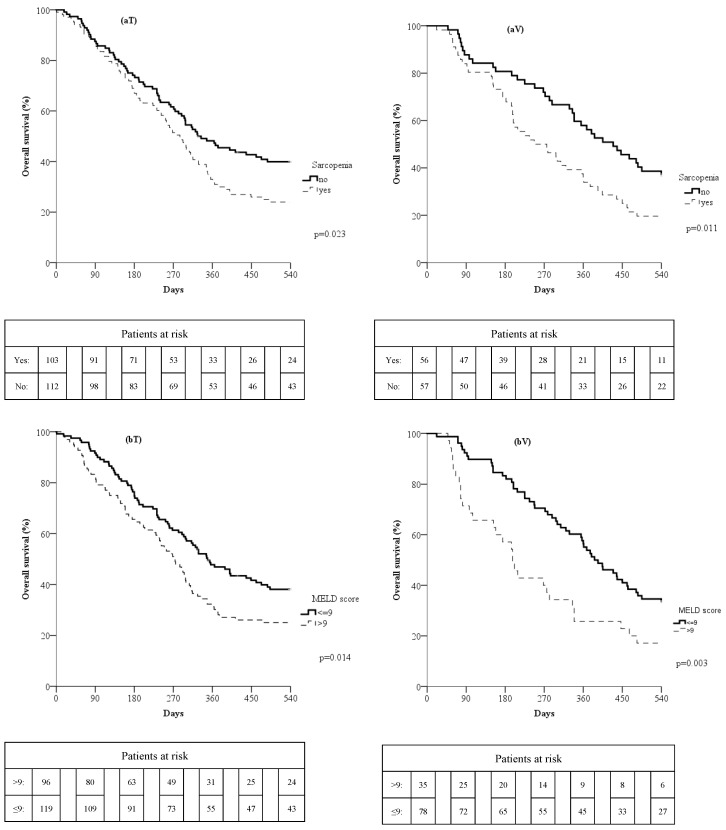
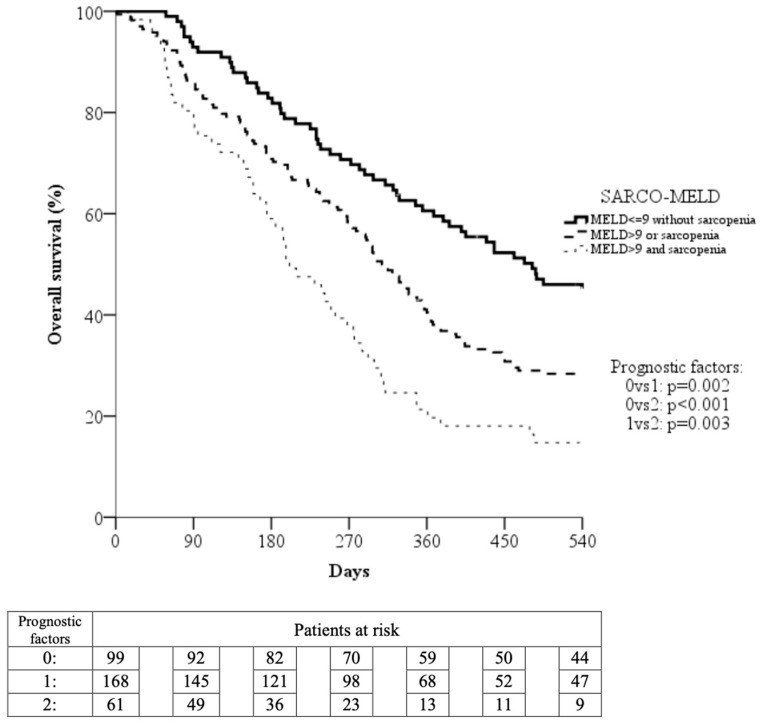
Sarcopenia was present in 48% of the training group and 50% of the validation group. At multivariate analysis, sarcopenia (HR: 1.47, = 0.026 in training; HR 1.99, = 0.033 in validation) and MELD > 9 (HR: 1.37, = 0.037 in training; HR 1.78, = 0.035 in validation) emerged as independent prognostic factors in both groups. We assembled a prognostic indicator named "SARCO-MELD" based on the two independent prognostic factors, creating three groups: group 1 (0 prognostic factors), group 2 (1 factor) and group 3 (2 factors), the latter with significantly worse survival and shorter time receiving treatment.
肌肉减少症与肝硬化和肝细胞癌患者的不良预后相关。我们研究了肌肉减少症对接受索拉非尼治疗的晚期肝细胞癌患者生存的影响。
对328例患者进行回顾性分析。所有患者在治疗开始前8周内均进行了腹部CT扫描。分析了两组患者:“训练组”(215例患者)和“验证组”(113例患者)。肌肉减少症通过从L3节段CT图像计算得出的骨骼肌指数降低来定义。
训练组48%的患者和验证组50%的患者存在肌肉减少症。多因素分析显示,肌肉减少症(训练组:HR = 1.47,P = 0.026;验证组:HR = 1.99,P = 0.033)和终末期肝病模型(MELD)评分> 9(训练组:HR = 1.37,P = 0.037;验证组:HR = 1.78,P = 0.035)在两组中均为独立的预后因素。我们基于这两个独立的预后因素构建了一个名为“SARCO - MELD”的预后指标,分为三组:1组(0个预后因素)、2组(1个因素)和3组(2个因素),3组患者的生存情况明显更差,接受治疗的时间更短。