
用于通过快速扫描循环伏安法电化学检测镉的金纳米粒子修饰碳纤维微电极。
Gold Nanoparticle-Modified Carbon-Fiber Microelectrodes for the Electrochemical Detection of Cd via Fast-Scan Cyclic Voltammetry.
作者信息
Manring Noel, Strini Miriam, Koifman Gene, Smeltz Jessica L, Pathirathna Pavithra
机构信息
Department of Chemistry and Chemical Engineering, Florida Institute of Technology, 150 W. University Blvd, Melbourne, FL 32901, USA.
出版信息
Micromachines (Basel). 2024 Feb 21;15(3):294. doi: 10.3390/mi15030294.
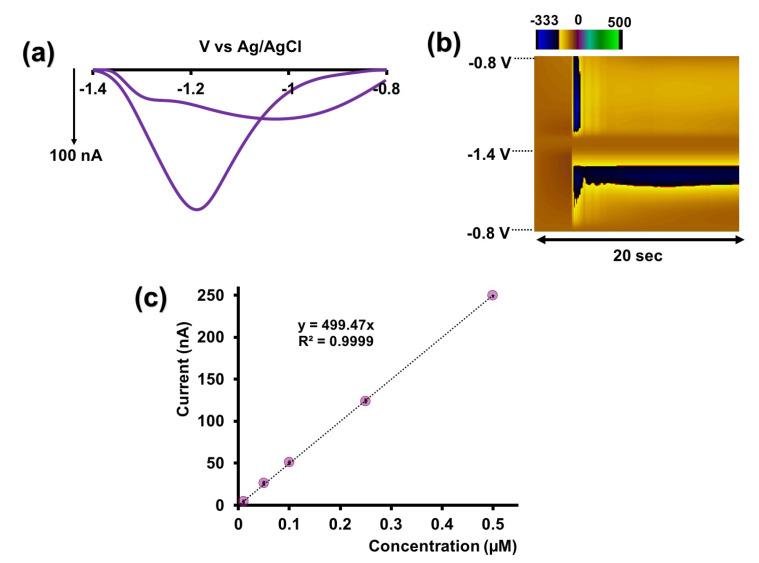
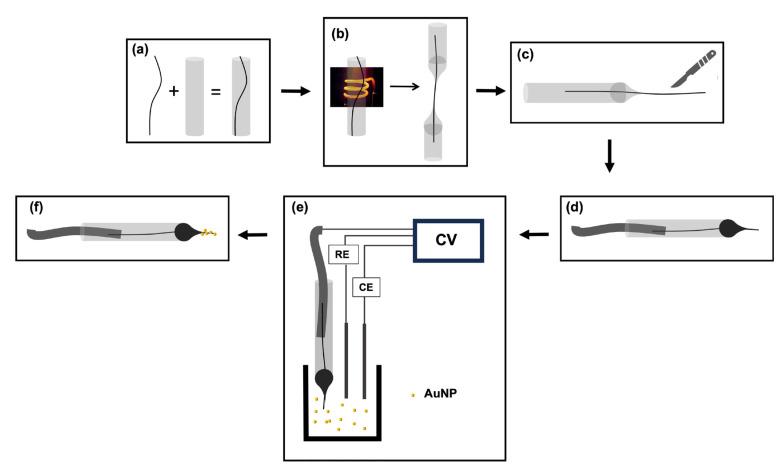
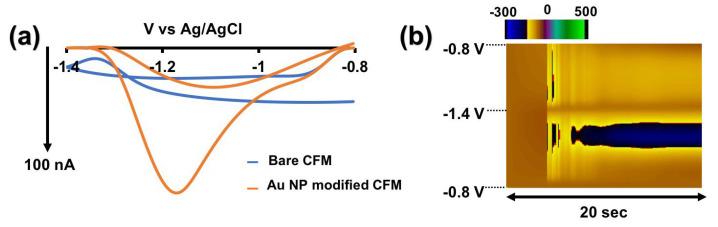
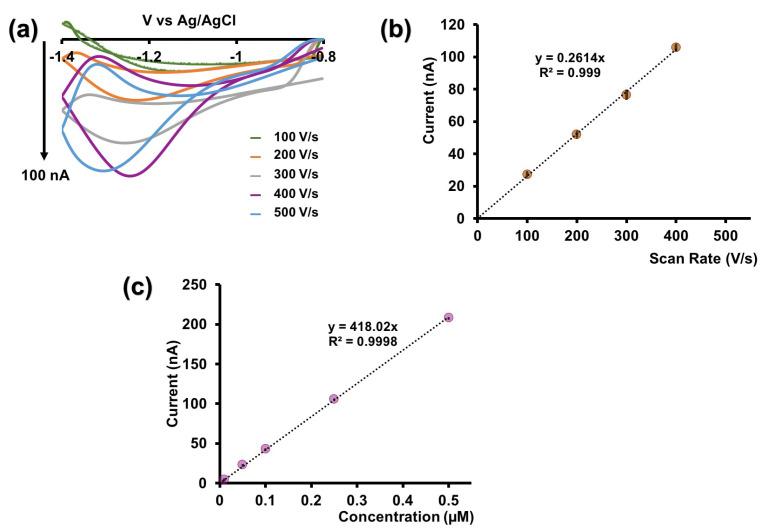
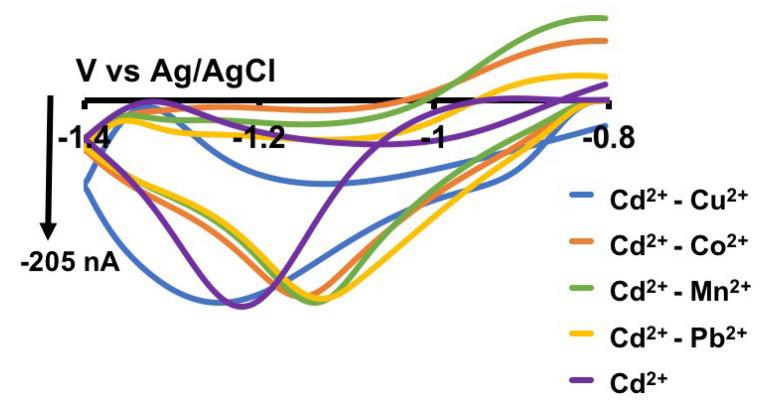
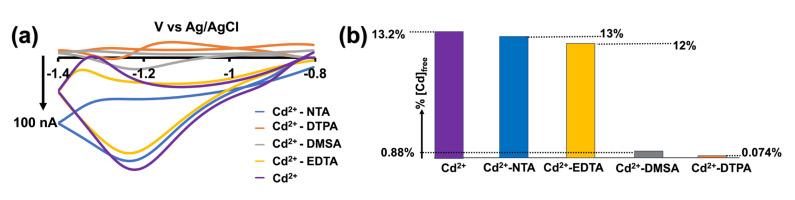
Neurotoxic heavy metals, such as Cd, pose a significant global health concern due to their increased environmental contamination and subsequent detrimental health hazards they pose to human beings. These metal ions can breach the blood-brain barrierblood-brain barrier, leading to severe and often irreversible damage to the central nervous system and other vital organs. Therefore, developing a highly sensitive, robust, and rapid in vivo detection method for these hazardous heavy metal ions is of the utmost importance for early detection, thus initiating timely therapeutics. Detecting ultra-low levels of toxic metal ions in vivo and obtaining accurate speciation information remains a challenge with conventional analytical techniques. In this study, we fabricated a novel carbon carbon-fiber microelectrode (CFM)-based sensor that can detect Cd ions using fast-scan cyclic voltammetry by electrodepositing gold nanoparticles (AuNP). We optimized electrochemical parameters that generate a unique cyclic voltammogram (CV) of Cd at a temporal resolution of 100 ms with our novel sensor. All our experiments were performed in tris buffer that mimics the artificial cerebellum fluid. We established a calibration curve resulting in a limit of detection (LOD) of 0.01 µM with a corresponding sensitivity of 418.02 nA/ µM. The sensor's selectivity was evaluated in the presence of other metal ions, and it was noteworthy to observe that the sensor retained its ability to produce the distinctive Cd CV, even when the concentration of other metal ions was 200 times higher than that of Cd. We also found that our sensor could detect free Cd ions in the presence of complexing agents. Furthermore, we analyzed the solution chemistry of each of those Cd-ligand solutions using a geochemical model, PHREEQC. The concentrations of free Cd ions determined through our electrochemical data align well with geochemical modeling data, thus validating the response of our novel sensor. Furthermore, we reassessed our sensor's LOD in tris buffer based on the concentration of free Cd ions determined through PHREEQC analysis, revealing an LOD of 0.00132 µM. We also demonstrated the capability of our sensor to detect Cd ions in artificial urine samples, showcasing its potential for application in actual biological samples. To the best of our knowledge, this is the first AuNP-modified, CFM-based Cd sensor capable of detecting ultra-low concentrations of free Cd ions in different complex matrices, including artificial urine at a temporal resolution of 100 ms, making it an excellent analytical tool for future real-time, in vivo detection, particularly in the brain.
神经毒性重金属,如镉(Cd),因其在环境中的污染日益严重以及随后对人类健康造成的有害危害,成为全球重大的健康问题。这些金属离子能够突破血脑屏障,对中枢神经系统和其他重要器官造成严重且往往不可逆的损害。因此,开发一种用于检测这些有害重金属离子的高灵敏度、稳健且快速的体内检测方法对于早期检测至关重要,从而能够及时启动治疗。利用传统分析技术在体内检测超低水平的有毒金属离子并获得准确的形态信息仍然是一项挑战。在本研究中,我们制备了一种基于新型碳 - 碳纤维微电极(CFM)的传感器,该传感器通过电沉积金纳米颗粒(AuNP),利用快速扫描循环伏安法检测镉离子。我们优化了电化学参数,使我们的新型传感器能够以100毫秒的时间分辨率生成镉的独特循环伏安图(CV)。我们所有的实验均在模拟人工脑脊液的三羟甲基氨基甲烷缓冲液中进行。我们建立了校准曲线,检测限(LOD)为0.01 μM,相应灵敏度为418.02 nA/μM。在存在其他金属离子的情况下评估了该传感器的选择性,值得注意的是,即使其他金属离子的浓度比镉高200倍,该传感器仍能保持产生独特镉CV的能力。我们还发现我们的传感器能够在存在络合剂的情况下检测游离镉离子。此外,我们使用地球化学模型PHREEQC分析了每种镉 - 配体溶液的溶液化学性质。通过我们的电化学数据确定的游离镉离子浓度与地球化学建模数据吻合良好,从而验证了我们新型传感器的响应。此外,我们根据通过PHREEQC分析确定的游离镉离子浓度重新评估了我们的传感器在三羟甲基氨基甲烷缓冲液中的检测限,结果显示检测限为0.00132 μM。我们还展示了我们的传感器检测人工尿液样本中镉离子的能力,证明了其在实际生物样本中的应用潜力。据我们所知,这是首个基于AuNP修饰的CFM的镉传感器,能够在不同复杂基质中,包括人工尿液中,以100毫秒的时间分辨率检测超低浓度的游离镉离子,使其成为未来实时体内检测,特别是脑部检测的优秀分析工具。
 Zotero 插件