Bernal Anastasia, Bechler Alivia Jane, Mohan Kabhilan, Rizzino Angie, Mathew Grinu
Eppley Institute for Research in Cancer and Allied Diseases, University of Nebraska Medical Center, Omaha, NE 68106, USA.
Fred and Pamela Buffett Cancer Center, University of Nebraska Medical Center, Omaha, NE 68106, USA.
Pharmaceuticals (Basel). 2024 Mar 8;17(3):351. doi: 10.3390/ph17030351.
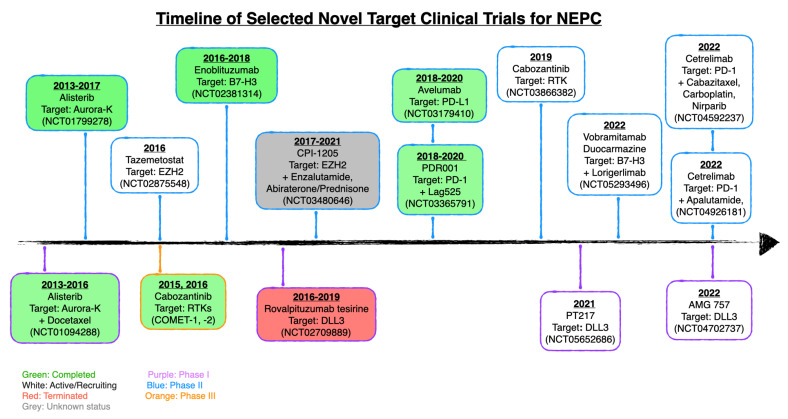
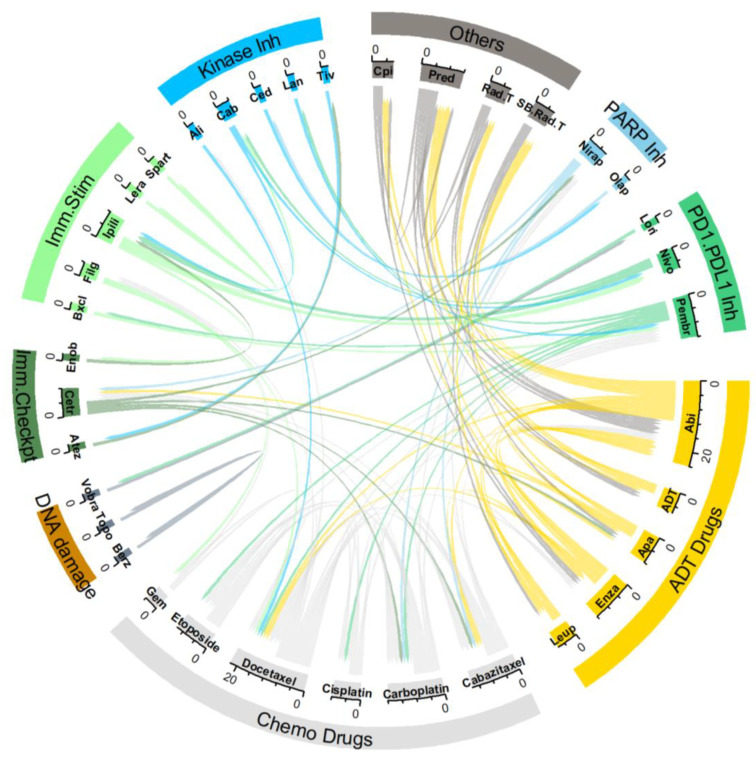
In 2024, there will be an estimated 1,466,718 cases of prostate cancer (PC) diagnosed globally, of which 299,010 cases are estimated to be from the US. The typical clinical approach for PC involves routine screening, diagnosis, and standard lines of treatment. However, not all patients respond to therapy and are subsequently diagnosed with treatment emergent neuroendocrine prostate cancer (NEPC). There are currently no approved treatments for this form of aggressive PC. In this review, a compilation of the clinical trials regimen to treat late-stage NEPC using novel targets and/or a combination approach is presented. The novel targets assessed include DLL3, EZH2, B7-H3, Aurora-kinase-A (AURKA), receptor tyrosine kinases, PD-L1, and PD-1. Among these, the trials administering drugs Alisertib or Cabozantinib, which target AURKA or receptor tyrosine kinases, respectively, appear to have promising results. The least effective trials appear to be ones that target the immune checkpoint pathways PD-1/PD-L1. Many promising clinical trials are currently in progress. Consequently, the landscape of successful treatment regimens for NEPC is extremely limited. These trial results and the literature on the topic emphasize the need for new preventative measures, diagnostics, disease specific biomarkers, and a thorough clinical understanding of NEPC.
2024年,全球预计将有1466718例前列腺癌(PC)被诊断出来,其中估计有299010例来自美国。PC的典型临床方法包括常规筛查、诊断和标准治疗方案。然而,并非所有患者对治疗都有反应,随后被诊断为治疗后出现的神经内分泌前列腺癌(NEPC)。目前尚无针对这种侵袭性PC的获批治疗方法。在本综述中,介绍了使用新靶点和/或联合方法治疗晚期NEPC的临床试验方案汇编。评估的新靶点包括DLL3、EZH2、B7-H3、极光激酶A(AURKA)、受体酪氨酸激酶、PD-L1和PD-1。其中,分别靶向AURKA或受体酪氨酸激酶的使用药物阿利塞替尼或卡博替尼的试验似乎有很有前景的结果。最无效的试验似乎是那些靶向免疫检查点通路PD-1/PD-L1的试验。目前许多有前景的临床试验正在进行中。因此,NEPC成功治疗方案的情况极为有限。这些试验结果以及关于该主题的文献强调了需要新的预防措施、诊断方法、疾病特异性生物标志物以及对NEPC的全面临床认识。