Liu Mengyang, Svirskis Darren, Proft Thomas, Loh Jacelyn, Huang Yuan, Wen Jingyuan
School of Pharmacy, Faculty of Medical and Health Sciences, The University of Auckland, 95 Park Road, Grafton, Auckland 1010, New Zealand.
Department of Molecular Medicine and Pathology, Faculty of Medical and Health Sciences, The University of Auckland, Auckland 1010, New Zealand.
Pharmaceutics. 2024 Mar 14;16(3):397. doi: 10.3390/pharmaceutics16030397.
Although its immunomodulatory properties make thymopentin (TP5) appealing, its rapid metabolism and inactivation in the digestive system pose significant challenges for global scientists. PEGylated niosomal nanocarriers are hypothesized to improve the physicochemical stability of TP5, and to enhance its intestinal permeability for oral administration.
TP5-loaded PEGylated niosomes were fabricated using the thin film hydration method. Co-cultured Caco-2 and HT29 cells with different ratios were screened as in vitro intestinal models. The cytotoxicity of TP5 and its formulations were evaluated using an MTT assay. The cellular uptake and transport studies were investigated in the absence or presence of variable inhibitors or enhancers, and their mechanisms were explored.
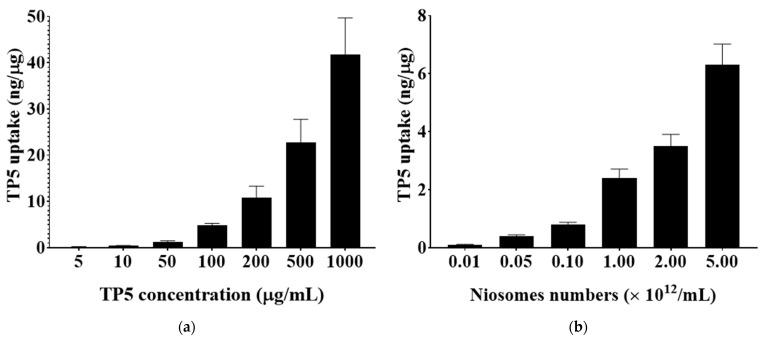
All TP5 solutions and their niosomal formulations were nontoxic to Caco-2 and HT-29 cells. The uptake of TP5-PEG-niosomes by cells relied on active endocytosis, exhibiting dependence on time, energy, and concentration, which has the potential to significantly enhance its cellular uptake compared to TP5 in solution. Nevertheless, cellular transport rates were similar between TP5 in solution and its niosomal groups. The cellular transport of TP5 in solution was carried out mainly through MRP5 endocytosis and a passive pathway and effluxed by MRP5 transporters, while that of TP5-niosomes and TP5-PEG-niosomes was carried out through adsorptive- and clathrin-mediated endocytosis requiring energy. The permeability and transport rate was further enhanced when EDTA and sodium taurocholate were used as the penetration enhancers.
This research has illustrated that PEG-niosomes were able to enhance the cellular uptake and maintain the cellular transport of TP5. This study also shows this formulation's potential to serve as an effective carrier for improving the oral delivery of peptides.
尽管胸腺五肽(TP5)的免疫调节特性颇具吸引力,但其在消化系统中的快速代谢和失活给全球科学家带来了重大挑战。聚乙二醇化脂质体纳米载体被认为可提高TP5的物理化学稳定性,并增强其口服时的肠道通透性。
采用薄膜水化法制备负载TP5的聚乙二醇化脂质体。筛选不同比例共培养的Caco-2和HT29细胞作为体外肠道模型。采用MTT法评估TP5及其制剂的细胞毒性。在有无可变抑制剂或增强剂的情况下研究细胞摄取和转运,并探讨其机制。
所有TP5溶液及其脂质体制剂对Caco-2和HT-29细胞均无毒性。细胞对TP5-聚乙二醇脂质体的摄取依赖于主动内吞作用,表现出对时间、能量和浓度的依赖性,与溶液中的TP5相比,这有可能显著提高其细胞摄取量。然而,溶液中的TP5与其脂质体组之间的细胞转运速率相似。溶液中TP5的细胞转运主要通过MRP5内吞作用和被动途径进行,并由MRP5转运蛋白外排,而TP5脂质体和TP5-聚乙二醇脂质体的细胞转运则通过需要能量的吸附性和网格蛋白介导的内吞作用进行。当使用EDTA和牛磺胆酸钠作为渗透增强剂时,通透性和转运速率进一步提高。
本研究表明聚乙二醇脂质体能够增强TP5的细胞摄取并维持其细胞转运。该研究还表明这种制剂有潜力作为一种有效的载体来改善肽类药物的口服递送。