Mahdi Ahmed E, Azouz Ahmed, Noureldin Aboelmagd, Abosekeen Ashraf
Electrical Engineering Branch, Military Technical College (MTC), Cairo 11766, Egypt.
Electrical and Computer Engineering, Royal Military College of Canada (RMCC), Kingston, ON K7K 7B4, Canada.
Sensors (Basel). 2024 Mar 20;24(6):1985. doi: 10.3390/s24061985.
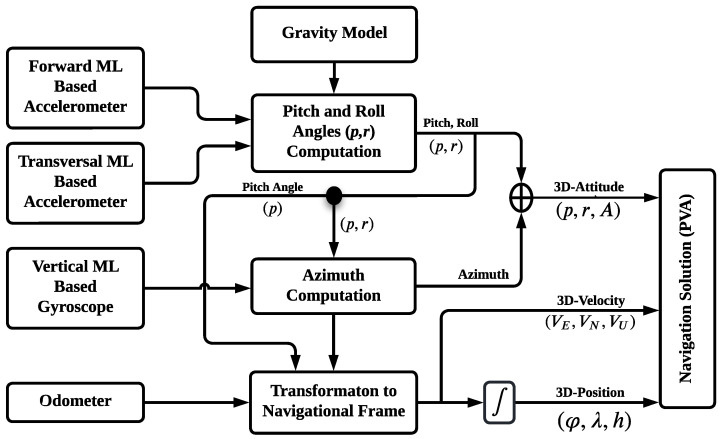
Autonomous vehicles (AVs) require accurate navigation, but the reliability of Global Navigation Satellite Systems (GNSS) can be degraded by signal blockage and multipath interference in urban areas. Therefore, a navigation system that integrates a calibrated Reduced Inertial Sensors System (RISS) with GNSS is proposed. The system employs a machine-learning-based Adaptive Neuro-Fuzzy Inference System (ANFIS) as a novel calibration technique to improve the accuracy and reliability of the RISS. The ANFIS-based RISS/GNSS integration provides a more precise navigation solution in such environments. The effectiveness of the proposed integration scheme was validated by conducting tests using real road trajectory and simulated GNSS outages ranging from 50 to 150 s. The results demonstrate a significant improvement in 2D position Root Mean Square Error (RMSE) of 43.8% and 28% compared to the traditional RISS/GNSS and the frequency modulated continuous wave (FMCW) Radar (Rad)/RISS/GNSS integrated navigation systems, respectively. Moreover, an improvement of 47.5% and 23.4% in 2D position maximum errors is achieved compared to the RISS/GNSS and the Rad/RISS/GNSS integrated navigation systems, respectively. These results reveal significant improvements in positioning accuracy, which is essential for safe and efficient navigation. The long-term stability of the proposed system makes it suitable for various navigation applications, particularly those requiring continuous and precise positioning information. The ANFIS-based approach used in the proposed system is extendable to other low-end IMUs, making it an attractive option for a wide range of applications.
自动驾驶车辆(AV)需要精确导航,但全球导航卫星系统(GNSS)的可靠性可能会因城市地区的信号遮挡和多径干扰而降低。因此,提出了一种将校准后的简化惯性传感器系统(RISS)与GNSS集成的导航系统。该系统采用基于机器学习的自适应神经模糊推理系统(ANFIS)作为一种新颖的校准技术,以提高RISS的准确性和可靠性。基于ANFIS的RISS/GNSS集成在这种环境下提供了更精确的导航解决方案。通过使用真实道路轨迹和50至150秒的模拟GNSS中断进行测试,验证了所提出集成方案的有效性。结果表明,与传统RISS/GNSS和调频连续波(FMCW)雷达(Rad)/RISS/GNSS集成导航系统相比,二维位置均方根误差(RMSE)分别显著提高了43.8%和28%。此外,与RISS/GNSS和Rad/RISS/GNSS集成导航系统相比,二维位置最大误差分别提高了47.5%和23.4%。这些结果表明定位精度有显著提高,这对于安全高效的导航至关重要。所提出系统的长期稳定性使其适用于各种导航应用,特别是那些需要连续精确位置信息的应用。所提出系统中使用的基于ANFIS的方法可扩展到其他低端惯性测量单元(IMU),使其成为广泛应用的有吸引力的选择。