Jensen Simon Birk Kjær, Blond Martin Bæk, Sandsdal Rasmus Michael, Olsen Lisa Møller, Juhl Christian Rimer, Lundgren Julie Rehné, Janus Charlotte, Stallknecht Bente Merete, Holst Jens Juul, Madsbad Sten, Torekov Signe Sørensen
Department of Biomedical Sciences, University of Copenhagen, Copenhagen, Denmark.
Steno Diabetes Center Copenhagen, Herlev, Denmark.
EClinicalMedicine. 2024 Feb 19;69:102475. doi: 10.1016/j.eclinm.2024.102475. eCollection 2024 Mar.
New obesity medications result in large weight losses. However, long-term adherence in a real-world setting is challenging, and termination of obesity medication results in weight regain towards pre-treatment body weight. Therefore, we investigated whether weight loss and improved body composition are sustained better at 1 year after termination of active treatment with glucagon-like peptide-1 (GLP-1) receptor agonist, supervised exercise program, or both combined for 1 year.
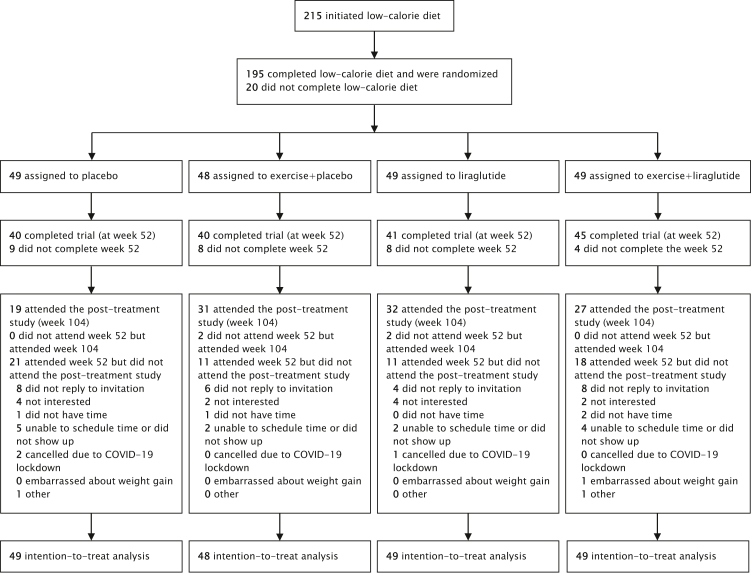
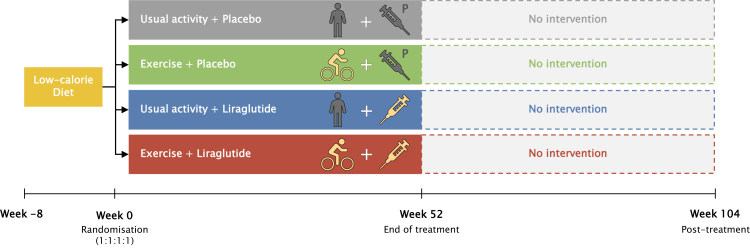
We conducted a post-treatment study in extension of a randomised, controlled trial in Copenhagen. Adults with obesity (aged 18-65 years and initial body mass index 32-43 kg/m) completed an eight-week low-calorie diet-induced weight loss of 13.1 kg (week -8 to 0) and were randomly allocated (1:1:1:1) to one-year weight loss maintenance (week 0-52) with either supervised exercise, the GLP-1 receptor agonist once-daily subcutaneous liraglutide 3.0 mg, the combination of exercise and liraglutide, or placebo. 166 Participants completed the weight loss maintenance phase. All randomised participants were invited to participate in the post-treatment study with outcome assessments one year after treatment termination, at week 104. The primary outcome of the post-treatment assessment was change in body weight from after the initial weight loss (at randomisation, week 0) to one year after treatment termination (week 104) in the intention-to-treat population. The secondary outcome was change in body-fat percentage (week 0-104). The study is registered with EudraCT, 2015-005585-32, and with ClinicalTrials.gov, NCT04122716.
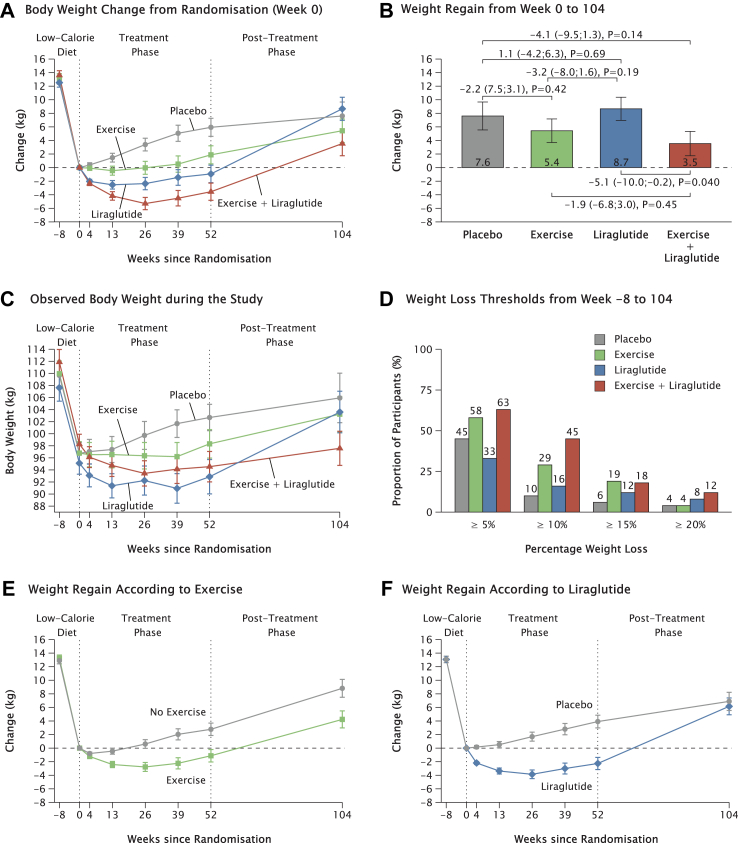
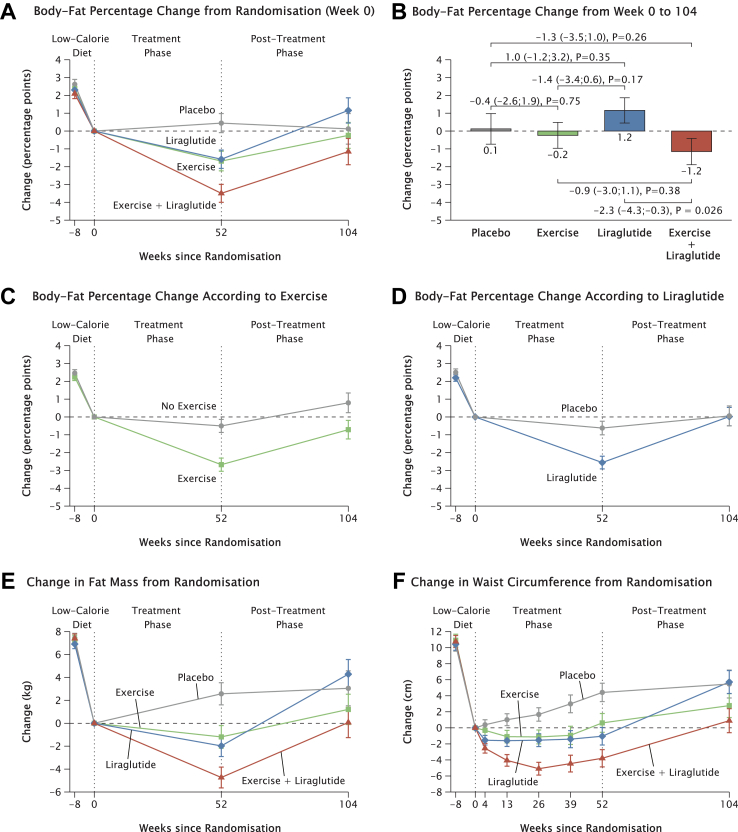
Between Dec 17, 2018, and Dec 17, 2020, 109 participants attended the post-treatment study. From randomisation to one year after termination of combined exercise and liraglutide treatment (week 0-104), participants had reduced body weight (-5.1 kg [95% CI -10.0; -0.2]; P = 0.040) and body-fat percentage (-2.3%-points [-4.3 to -0.3]; P = 0.026) compared with after termination of liraglutide alone. More participants who had previously received combination treatment maintained a weight loss of at least 10% of initial body weight one year after treatment termination (week -8 to 104) compared with participants who had previously received placebo (odds ratio [OR] 7.2 [2.4; 21.3]) and liraglutide (OR 4.2 [1.6; 10.8]). More participants who had previously received supervised exercise maintained a weight loss of at least 10% compared with placebo (OR 3.7 [1.2; 11.1]). During the year after termination of treatment (week 52-104), weight regain was 6.0 kg [2.1; 10.0] larger after termination of liraglutide compared with after termination of supervised exercise and 2.5 kg [-1.5 to 6.5] compared with after termination of combination treatment.
The addition of supervised exercise to obesity pharmacotherapy seems to improve healthy weight maintenance after treatment termination compared with treatment termination of obesity pharmacotherapy alone. Body weight and body composition were maintained one year after termination of supervised exercise, in contrast to weight regain after termination of treatment with obesity pharmacotherapy alone.
Helsefonden and the Novo Nordisk Foundation.
新型肥胖症药物可带来显著的体重减轻。然而,在现实环境中,长期坚持用药具有挑战性,停用肥胖症药物后体重会反弹至治疗前水平。因此,我们研究了在使用胰高血糖素样肽-1(GLP-1)受体激动剂、监督性运动计划或两者联合进行1年积极治疗后停药1年时,体重减轻和身体成分改善的情况是否能得到更好的维持。
我们在哥本哈根一项随机对照试验的基础上进行了一项治疗后研究。肥胖成人(年龄18 - 65岁,初始体重指数32 - 43kg/m²)通过八周低热量饮食实现了13.1kg的体重减轻(第-8周到0周),并被随机分配(1:1:1:1)至为期一年的体重维持阶段(第0周到52周),分别接受监督性运动、每日一次皮下注射3.0mg利拉鲁肽这种GLP-1受体激动剂、运动与利拉鲁肽联合治疗或安慰剂治疗。166名参与者完成了体重维持阶段。所有随机分组的参与者均被邀请参加治疗后研究,在治疗终止一年后的第104周进行结果评估。治疗后评估的主要结局是意向性治疗人群从初始体重减轻后(随机分组时,第0周)到治疗终止一年后(第104周)的体重变化。次要结局是体脂百分比的变化(第0周到104周)。该研究已在欧盟临床试验注册数据库(EudraCT,2015 - 005585 - 32)和美国国立医学图书馆临床试验数据库(ClinicalTrials.gov,NCT04122716)注册。
在2018年12月17日至2020年12月17日期间,109名参与者参加了治疗后研究。从随机分组到联合运动和利拉鲁肽治疗终止后一年(第0周到104周),与仅停用利拉鲁肽相比,参与者的体重减轻了(-5.1kg [95%置信区间-10.0;-0.2];P = 0.040),体脂百分比降低了(-2.3个百分点 [-4.3至-0.3];P = 0.026)。与先前接受安慰剂(优势比[OR] 7.2 [2.4;21.3])和利拉鲁肽(OR 4.2 [1.6;10.8])治疗的参与者相比,更多先前接受联合治疗的参与者在治疗终止一年后(第-8周到104周)维持了至少初始体重10%的体重减轻。与安慰剂相比,更多先前接受监督性运动的参与者维持了至少10%的体重减轻(OR 3.7 [1.2;11.1])。在治疗终止后的一年(第52周到104周),与监督性运动终止后相比,利拉鲁肽终止后体重反弹多6.0kg [2.1;10.0],与联合治疗终止后相比多2.5kg [-1.5至6.5]。
与单纯停用肥胖症药物治疗相比,在肥胖症药物治疗中加入监督性运动似乎能在治疗终止后更好地维持健康体重。与单纯停用肥胖症药物治疗后体重反弹不同,监督性运动终止后一年体重和身体成分得以维持。
丹麦卫生基金会和诺和诺德基金会。