Groh Annekatrin, Bahlmann Lydia, Colic Lejla, Schulz Alexandra, Kastner Ulrich W, Polzer Udo, Walter Martin, Sobanski Thomas, Wagner Gerd
Department of Psychiatry and Psychotherapy, Jena Center for Mental Health, Jena University Hospital, Jena, Germany.
Network for Suicide Prevention in Thuringia (NeST), Department of Psychiatry and Psychotherapy, Jena University Hospital, Jena, Germany.
Front Psychiatry. 2024 Mar 8;15:1366191. doi: 10.3389/fpsyt.2024.1366191. eCollection 2024.
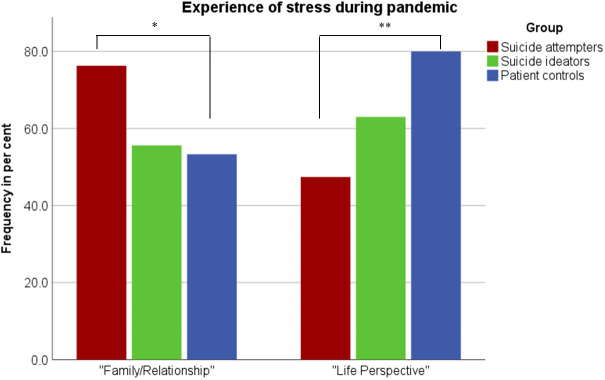
The COVID-19 pandemic and related restrictions may have led to increased stress, particularly in people with mental health problems. Since stress factors play important role in the emergence of suicide attempts (SA) and suicidal ideation (SI), they may have been exacerbated by the pandemic, which could have led to an increased number of suicide attempts. Thus, we first investigated whether the pandemic affected personal stress experiences and appraisal of coping potential in individuals with and without SA and SI. In a second step, we analyzed the frequency and dynamics of SAs by patients admitted to a psychiatric university clinic over a period of four years.
We examined stress experiences and appraisal of coping resources of inpatients recruited between March 2021 and February 2022 with SA (n=38), SI (n=27), and with mood disorder without SA or SI (n=45). In the second study, we investigated the time course of prospectively recorded patients with a suicide attempt (n=399) between January 1 2018 and December 31 2021 using interrupted time-series Poisson regression models.
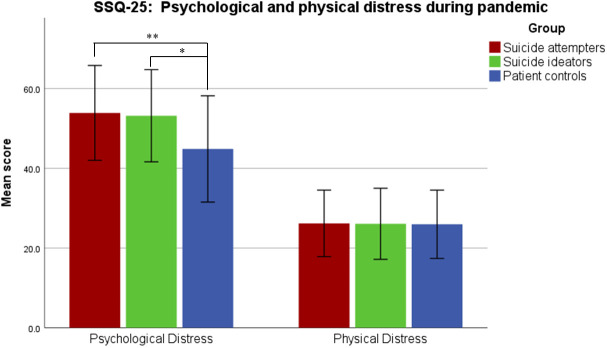
There was a significant main effect of group (F[2,107]=6.58, p=0.002) regarding psychological stress levels, which was significantly higher in the SA and SI groups than in the psychiatric control group. No significant differences were found in the appraisal of coping resources or in the frequency of SAs before and during pandemic. However, the pandemic had a significant impact on the seasonal pattern of SAs.
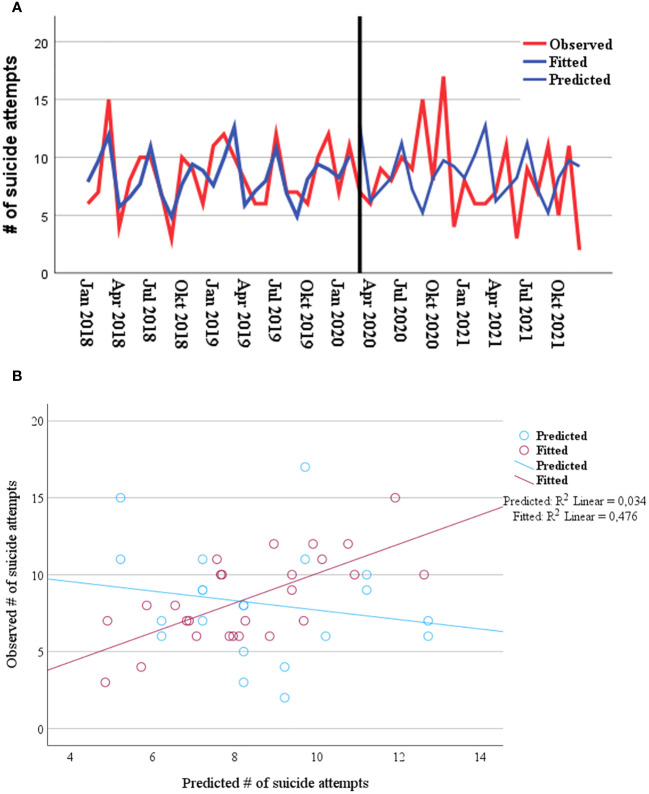
The pandemic increased psychological stress levels in individuals with SA and SI, which may be related to SI and do not necessarily result in SA. The pandemic did not affect the overall frequency of SA between March 2020 and December 2021, but interfered with the seasonal pattern of SA occurrence. Effective intervention strategies during a pandemic should include programs to strengthen the psychological resilience of people who are susceptible to mental health problems.
新冠疫情及相关限制措施可能导致压力增加,尤其是对有心理健康问题的人群。由于压力因素在自杀未遂(SA)和自杀意念(SI)的出现中起着重要作用,疫情可能使其加剧,进而导致自杀未遂事件增多。因此,我们首先调查了疫情是否影响了有或无自杀未遂及自杀意念的个体的个人压力体验和应对潜力评估。第二步,我们分析了一所大学精神病诊所四年间收治患者的自杀未遂频率和动态情况。
我们研究了2021年3月至2022年2月期间收治的有自杀未遂(n = 38)、有自杀意念(n = 27)以及有情绪障碍但无自杀未遂或自杀意念(n = 45)的住院患者的压力体验和应对资源评估。在第二项研究中,我们使用中断时间序列泊松回归模型,调查了2018年1月1日至2021年12月31日期间前瞻性记录的有自杀未遂(n = 399)患者的时间进程。
关于心理压力水平,组间存在显著的主效应(F[2,107] = 6.58,p = 0.002),自杀未遂组和有自杀意念组的心理压力水平显著高于精神科对照组。在应对资源评估或疫情前及疫情期间的自杀未遂频率方面未发现显著差异。然而,疫情对自杀未遂的季节性模式有显著影响。
疫情增加了有自杀未遂和自杀意念个体的心理压力水平,这可能与自杀意念有关,但不一定导致自杀未遂。2020年3月至2021年12月期间,疫情并未影响自杀未遂的总体频率,但干扰了自杀未遂发生的季节性模式。疫情期间的有效干预策略应包括加强易患心理健康问题人群心理韧性的项目。