Takeda Pharmaceutical Company Limited, Cambridge, Massachusetts, USA.
Currently at Alkermes Inc., Waltham, Massachusetts, USA.
Clin Transl Sci. 2024 Apr;17(4):e13776. doi: 10.1111/cts.13776.
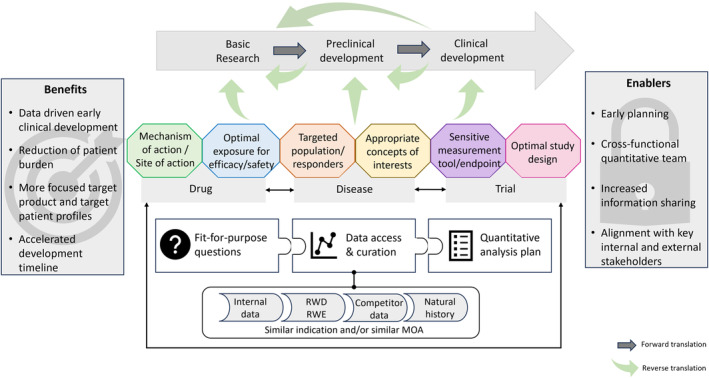
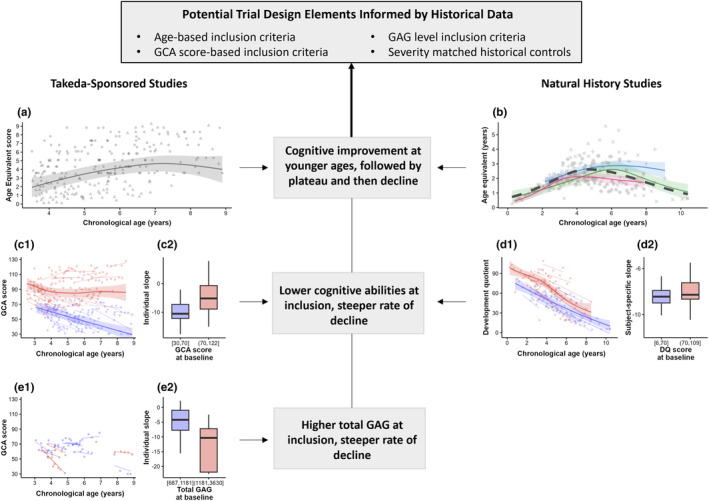
A quantitatively-driven evaluation of existing clinical data and associated knowledge to accelerate drug discovery and development is a highly valuable approach across therapeutic areas, but remains underutilized. This is especially the case for rare diseases for which development is particularly challenging. The current work outlines an organizational framework to support a quantitatively-based reverse translation approach to clinical development. This approach was applied to characterize predictors of the trajectory of cognition in Hunter syndrome (Mucopolysaccharidosis Type II; MPS-II), a rare X-linked lysosomal storage disorder, highly heterogeneous in its course. Specifically, we considered ways to refine target populations based on age, cognitive status, and biomarkers, that is, cerebrospinal fluid glycosaminoglycans (GAG), at trial entry. Data from a total of 138 subjects (age range 2.5 to 10.1 years) from Takeda-sponsored internal studies and external natural history studies in MPS-II were included. Quantitative analyses using mixed-effects models were performed to characterize the relationships between neurocognitive outcomes and potential indicators of disease progression. Results revealed a specific trajectory in cognitive development across age with an initial progressive phase, followed by a plateau between 4 and 8 years and then a variable declining phase. Additionally, results suggest a faster decline in cognition among subjects with lower cognitive scores or with higher cerebrospinal fluid GAG at enrollment. These results support differences in the neurocognitive course of MPS-II between distinct groups of patients based on age, cognitive function, and biomarker status at enrollment. These differences should be considered when designing future clinical trials.
定量评估现有临床数据和相关知识,以加速药物发现和开发,这是一种在治疗领域极具价值的方法,但尚未得到充分利用。对于开发特别具有挑战性的罕见病来说,尤其如此。目前的工作概述了一个组织框架,以支持基于定量的临床开发反向翻译方法。该方法应用于描述亨特综合征(黏多糖贮积症 II 型;MPS-II)认知轨迹的预测因子,这种罕见的 X 连锁溶酶体贮积症在其病程中高度异质。具体而言,我们考虑了根据年龄、认知状态和生物标志物(即脑脊液糖胺聚糖 (GAG))在试验入组时细化目标人群的方法。共纳入了来自武田赞助的内部研究和 MPS-II 外部自然史研究的 138 名受试者的数据(年龄范围为 2.5 至 10.1 岁)。使用混合效应模型进行定量分析,以描述神经认知结果与潜在疾病进展指标之间的关系。结果显示,认知发展在整个年龄范围内呈现出特定的轨迹,具有初始的进展阶段,随后在 4 至 8 岁之间达到平台期,然后是可变的下降阶段。此外,结果表明,在入组时认知评分较低或脑脊液 GAG 较高的受试者中,认知能力下降较快。这些结果支持基于年龄、认知功能和入组时生物标志物状态,在不同患者群体中,MPS-II 的神经认知过程存在差异。在设计未来的临床试验时,应该考虑这些差异。