Seo Joo-Hyun, Okuyama Torayuki, Shapiro Elsa, Fukuhara Yasuyuki, Kosuga Motomichi
Clinical Laboratory Medicine, National Center for Child Health and Development, 2-10-1 Okura, Setagaya-ku, Tokyo 157-8535, Japan.
Center for Lysosomal Storage Diseases, National Center for Child Health and Development, 2-10-1 Okura, Setagaya-ku, Tokyo 157-8535, Japan.
Mol Genet Metab Rep. 2020 Jul 29;24:100630. doi: 10.1016/j.ymgmr.2020.100630. eCollection 2020 Sep.
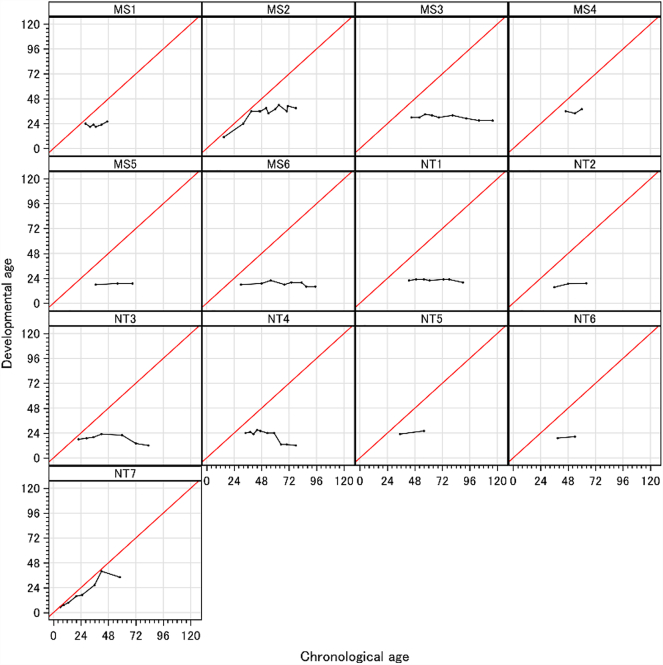
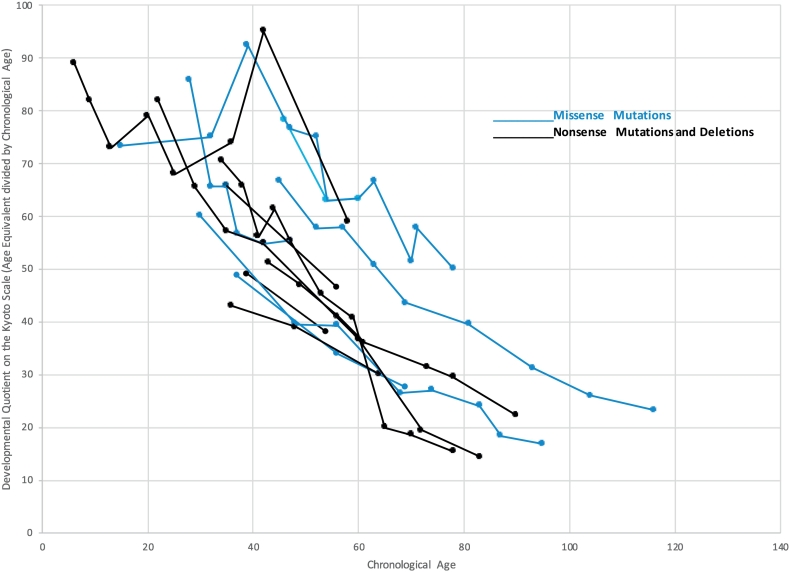
The natural history of cognitive growth in the neuronopathic form of Mucopolysaccharidosis type II (MPS II) is not well defined especially their patterns of development and decline. The ability to predict the developmental course of the neurologically impaired patient is necessary to assess treatment outcomes aimed at the brain. Thirteen intravenous enzyme replacement therapy-treated Japanese patients with neuronopathic MPSII who had mutation analysis were followed on one standard measure of cognitive development over time. Six children in Group MS had missense mutations and 7 children in Group NT had null type mutations such as deletions, recombination with the pseudogene, and nonsense mutations. The patients as a whole demonstrated cognitive growth until about 36-42 months of age, followed by a plateau in development. The mean age equivalent score at age 3 was similar to that at age 6. While the decline was slow for the entire group, the patients in Group NT showed a more rapid decline than those in Group MS. Two patients with deletions showed decline to a very low level by age 5. The long plateau in cognitive development in patents with MPS II was substantiated and was consistent with other studies. This is the first demonstration that different mutation types within the neuronopathic MPS II patients are associated with different rates of decline. We also were able to identify the chronological age before which a trial would need to start in order to maintain cognitive growth and a ceiling beyond which a relatively normal outcome would not be likely.
II型黏多糖贮积症(MPS II)神经病变型认知发展的自然史尚未明确界定,尤其是其发展和衰退模式。预测神经受损患者的发育进程对于评估针对大脑的治疗效果很有必要。对13例接受静脉内酶替代疗法治疗且进行了突变分析的日本神经病变型MPSII患者,采用一项认知发展的标准测量方法进行长期跟踪。MS组有6名儿童存在错义突变,NT组有7名儿童存在无效型突变,如缺失、与假基因重组和无义突变。总体而言,患者在约36 - 42个月龄之前表现出认知发展,随后进入发育平稳期。3岁时的平均年龄等效分数与6岁时相似。虽然整个组的衰退缓慢,但NT组患者的衰退速度比MS组更快。两名缺失突变患者在5岁时衰退至极低水平。MPS II患者认知发展的长期平稳期得到证实,且与其他研究一致。这首次证明神经病变型MPS II患者中不同的突变类型与不同的衰退速度相关。我们还能够确定为维持认知发展需要开始试验的年龄,以及超过该年龄不太可能获得相对正常结果的上限。