Hinney Jakob, Kim Seunghwi, Flatt Graydon J K, Datta Ipshita, Alù Andrea, Lipson Michal
Department of Electrical Engineering, Columbia University, New York, NY, 10027, USA.
Photonics Initiative, Advanced Science Research Center, City University of New York, New York, NY, 10031, USA.
Nat Commun. 2024 Mar 28;15(1):2741. doi: 10.1038/s41467-024-46908-2.
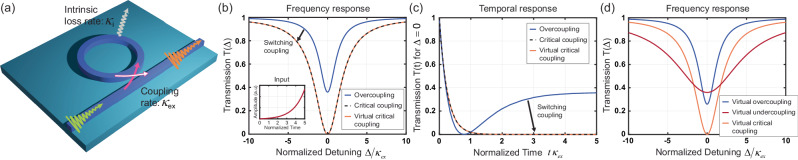
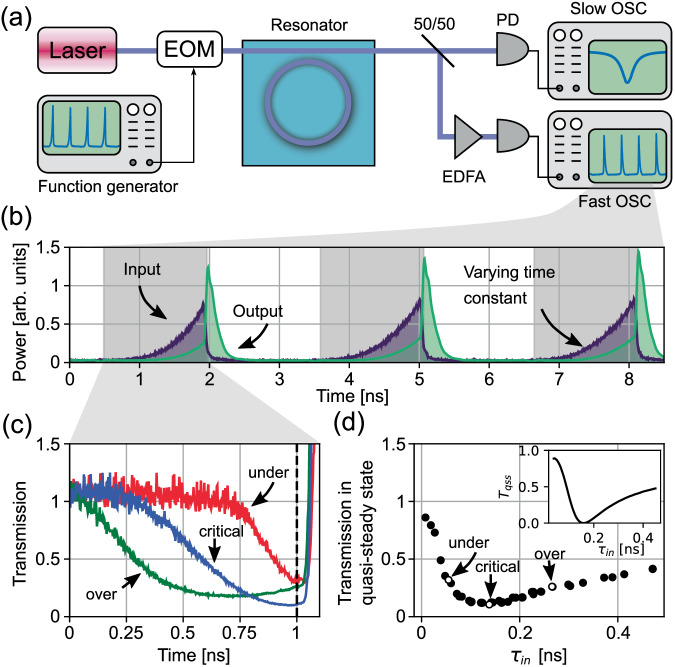
Critical coupling in integrated photonic devices enables the efficient transfer of energy from a waveguide to a resonator, a key operation for many applications. This condition is achieved when the resonator loss rate is equal to the coupling rate to the bus waveguide. Carefully matching these quantities is challenging in practice, due to variations in the resonator properties resulting from fabrication and external conditions. Here, we demonstrate that efficient energy transfer to a non-critically coupled resonator can be achieved by tailoring the excitation signal in time. We rely on excitations oscillating at complex frequencies to load an otherwise overcoupled resonator, demonstrating that a virtual critical coupling condition is achieved if the imaginary part of the complex frequency equals the mismatch between loss and coupling rate. We probe a microring resonator with tailored pulses and observe a minimum intensity transmission in contrast to a continuous-wave transmission , corresponding to 8 times enhancement of intracavity intensity. Our technique opens opportunities for enhancing and controlling on-demand light-matter interactions for linear and nonlinear photonic platforms.
集成光子器件中的临界耦合能够实现能量从波导到谐振器的高效传输,这是许多应用中的关键操作。当谐振器的损耗率等于与总线波导的耦合率时,就实现了这种条件。由于制造过程和外部条件导致谐振器特性的变化,在实践中精确匹配这些量具有挑战性。在这里,我们证明了通过及时调整激励信号,可以实现向非临界耦合谐振器的高效能量传输。我们依靠以复频率振荡的激励来加载原本过耦合的谐振器,表明如果复频率的虚部等于损耗与耦合率之间的失配,就会实现虚拟临界耦合条件。我们用定制脉冲探测微环谐振器,并观察到与连续波传输相比的最小强度传输,对应于腔内强度增强8倍。我们的技术为增强和控制线性和非线性光子平台上按需的光与物质相互作用开辟了机会。