
量化新冠长期症状对感染后个体健康的不良影响:一项倾向得分匹配设计研究。
Quantifying the Adverse Effects of Long COVID on Individuals' Health After Infection: A Propensity Score Matching Design Study.
作者信息
Miao Yudong, Ren Ruizhe, Shen Zhanlei, Li Yi, Zhang Wanliang, Bai Junwen, Zhu Dongfang, Zhang Jingbao, Guo Dan, Tarimo Clifford Silver, Liu Rongmei, Zhao Qiuping, Hu Jianping, Zhou Xue, Dong Wenyong
机构信息
College of Public Health, Zhengzhou University, Zhengzhou, People's Republic of China.
Department of Neurology, Henan Provincial People's Hospital, Zhengzhou, People's Republic of China.
出版信息
Risk Manag Healthc Policy. 2024 Mar 24;17:701-713. doi: 10.2147/RMHP.S446321. eCollection 2024.
OBJECTIVE
To evaluate the prevalence and influencing factors of long COVID, and measure the difference in health status between long COVID and non-long COVID cases.
METHODS
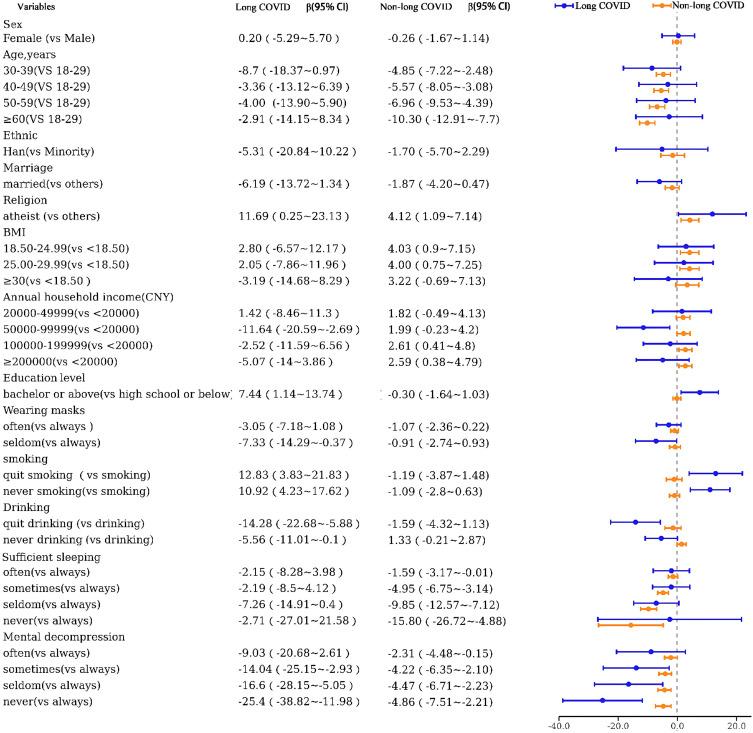
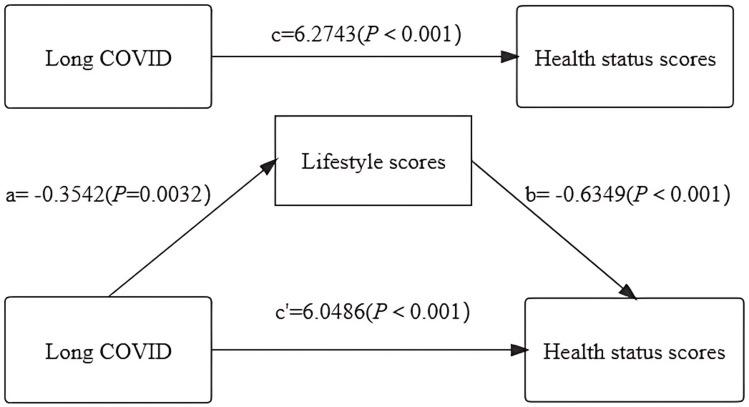
A cross-sectional survey was conducted from February 1 to 8, 2023, using a stratified random sampling method in four regions (eastern [Changzhou], central [Zhengzhou], western [Xining] and northeastern [Mudanjiang]) of China. The survey collected COVID-19 patients' socio-demographic characteristics and lifestyles information. The scores of lifestyles and health status range from 5 to 21 and 0 to 100 points, respectively. The criteria of "persistent health problems after 4 weeks of COVID-19 infection" issued by the US Centers for Disease Control and Prevention was used to assess long COVID. Multiple linear regression was used to analyze the influencing factors of the health. The bootstrap method was used to analyze the lifestyles' mediating effect. Propensity score matching (PSM) was used to evaluate the net difference in health scores between long COVID and non-long COVID cases.
RESULTS
The study included 3165 COVID-19 patients, with 308 (9.73%) long COVID cases. The health score of the long COVID cases (74.79) was lower than that of the non-long COVID cases (81.06). After adjusting for potential confounding variables, we found that never focused on mental decompression was a common risk factor for the health of both groups. Lifestyles was the mediating factor on individuals' health. After PSM, the non-long COVID cases' health scores remained higher than that of long COVID cases.
CONCLUSION
The proportion of long COVID cases was low, but they were worse off in health. Given the positive moderating effect of healthy lifestyles on improving the health of long COVID cases, healthy lifestyles including mental decompression should be considered as the core strategy of primary prevention when the epidemic of COVID-19 is still at a low level.
目的
评估新冠后长期症状的患病率及影响因素,并测量新冠后长期症状患者与非新冠后长期症状患者的健康状况差异。
方法
于2023年2月1日至8日采用分层随机抽样方法在中国四个地区(东部[常州]、中部[郑州]、西部[西宁]和东北部[牡丹江])进行横断面调查。该调查收集了新冠患者的社会人口学特征和生活方式信息。生活方式和健康状况得分范围分别为5至21分和0至100分。采用美国疾病控制与预防中心发布的“新冠感染4周后持续存在健康问题”标准评估新冠后长期症状。采用多元线性回归分析健康的影响因素。采用Bootstrap法分析生活方式的中介效应。采用倾向得分匹配法(PSM)评估新冠后长期症状患者与非新冠后长期症状患者健康得分的净差异。
结果
该研究纳入了3165例新冠患者,其中308例(9.73%)为新冠后长期症状患者。新冠后长期症状患者的健康得分(74.79)低于非新冠后长期症状患者(81.06)。在调整潜在混杂变量后,我们发现从不关注心理减压是两组健康的共同危险因素。生活方式是个体健康的中介因素。PSM后,非新冠后长期症状患者的健康得分仍高于新冠后长期症状患者。
结论
新冠后长期症状患者比例较低,但健康状况较差。鉴于健康生活方式对改善新冠后长期症状患者健康具有积极的调节作用,在新冠疫情仍处于低水平时,包括心理减压在内的健康生活方式应被视为一级预防的核心策略。



 Zotero 插件