Jockey Club School of Public Health & Primary Care, The Chinese University of Hong Kong, Sha Tin, China.
Centre for Health Education and Health Promotion, Faculty of Medicine, The Chinese University of Hong Kong, Sha Tin, China.
JMIR Public Health Surveill. 2023 Mar 7;9:e42315. doi: 10.2196/42315.
Long COVID induces a substantial global burden of disease. The pathogenesis, complications, and epidemiological and clinical characteristics of patients with COVID-19 in the acute phase have been evaluated, while few studies have characterized the epidemiology, symptomatology, and risk factors of long COVID symptoms. Its characteristics among patients with COVID-19 in the general population remain unaddressed.
We examined the prevalence of long COVID symptoms, its symptom patterns, and its risk factors in 4 major Chinese cities in order to fill the knowledge gap.
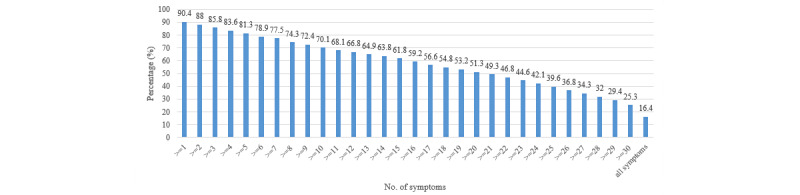
We performed a population-based, multicenter survey using a representative sampling strategy via the Qualtrics platform in Beijing, Shanghai, Guangzhou, and Hong Kong in June 2022. We included 2712 community-dwelling patients with COVID-19 and measured the prevalence of long COVID symptoms defined by the World Health Organization (WHO), and their risk factors. The primary outcomes were the symptoms of long COVID, with various levels of impact. A descriptive analysis of the prevalence and distribution of long COVID symptoms according to disease severity was conducted. A sensitivity analysis of increasing the number of long COVID symptoms was also conducted. Univariate and multivariate regression analyses were performed to examine the risk factors of severe long COVID symptoms, including age, gender, marital status, current occupation, educational level, living status, smoking habits, monthly household income, self-perceived health status, the presence of chronic diseases, the use of chronic medication, COVID-19 vaccination status, and the severity of COVID-19.
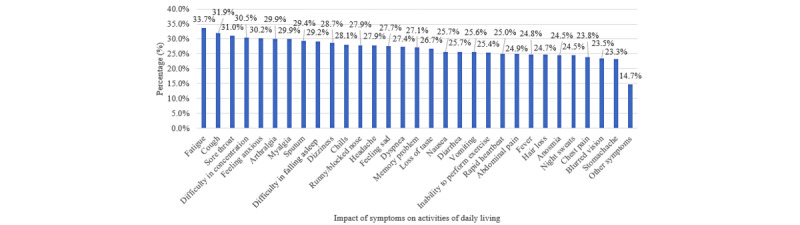
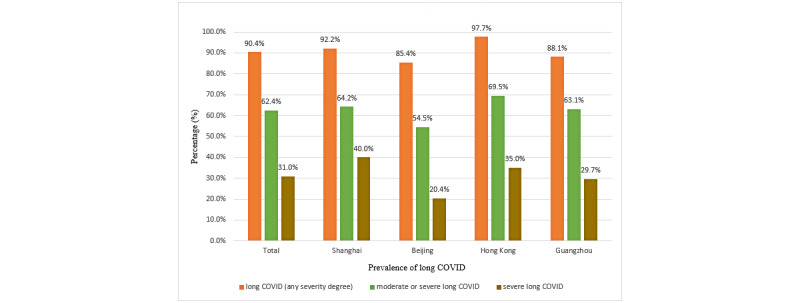
The response rate was 63.6% (n=2712). The prevalence of long COVID, moderate or severe long COVID, and severe long COVID was 90.4% (n=2452), 62.4% (n=1692), and 31.0% (n=841), respectively. Fatigue (n=914, 33.7%), cough (n=865, 31.9%), sore throat (n=841, 31.0%), difficulty in concentrating (n=828, 30.5%), feeling of anxiety (n=817, 30.2%), myalgia (n=811, 29.9%), and arthralgia (n=811, 29.9%) were the most common severe long COVID symptoms. From multivariate regression analysis, female gender (adjusted odds ratio [aOR]=1.49, 95% CI 1.13-1.95); engagement in transportation, logistics, or the discipline workforce (aOR=2.52, 95% CI 1.58-4.03); living with domestic workers (aOR=2.37, 95% CI 1.39-4.03); smoking (aOR=1.55, 95% CI 1.17-2.05); poor or very poor self-perceived health status (aOR=15.4, 95% CI 7.88-30.00); ≥3 chronic diseases (aOR=2.71, 95% CI 1.54-4.79); chronic medication use (aOR=4.38, 95% CI 1.66-11.53); and critical severity of COVID-19 (aOR=1.52, 95% CI 1.07-2.15) were associated with severe long COVID. Prior vaccination with ≥2 doses of COVID-19 vaccines was a protective factor (aOR=0.35-0.22, 95% CI 0.08-0.90).
We examined the prevalence of long COVID symptoms in 4 Chinese cities according to the severity of COVID-19. We also evaluated the pattern of long COVID symptoms and their risk factors. These findings may inform early identification of patients with COVID-19 at risk of long COVID and planning of rehabilitative services.
长新冠导致了巨大的全球疾病负担。新冠病毒急性阶段的发病机制、并发症以及流行病学和临床特征已经得到了评估,而关于新冠病毒患者的流行病学、症状和长新冠症状的风险因素则知之甚少。其在普通人群中的特征仍未得到解决。
我们通过使用代表性抽样策略,在 2022 年 6 月于北京、上海、广州和香港的 Qualtrics 平台上进行了一项基于人群的多中心调查,以填补知识空白。
我们纳入了 2712 名社区居民新冠病毒患者,并测量了世界卫生组织(WHO)定义的长新冠症状的流行率及其风险因素。主要结局是长新冠症状的出现及其严重程度。根据疾病严重程度,对长新冠症状的流行率和分布进行了描述性分析。还进行了增加长新冠症状数量的敏感性分析。使用单变量和多变量回归分析来研究严重长新冠症状的风险因素,包括年龄、性别、婚姻状况、当前职业、教育程度、居住状况、吸烟习惯、月家庭收入、自我感知健康状况、慢性疾病、使用慢性药物、新冠病毒疫苗接种状况以及新冠病毒的严重程度。
应答率为 63.6%(n=2712)。长新冠、中重度长新冠和重度长新冠的流行率分别为 90.4%(n=2452)、62.4%(n=1692)和 31.0%(n=841)。疲劳(n=914,33.7%)、咳嗽(n=865,31.9%)、喉咙痛(n=841,31.0%)、注意力不集中(n=828,30.5%)、焦虑感(n=817,30.2%)、肌痛(n=811,29.9%)和关节痛(n=811,29.9%)是最常见的重度长新冠症状。多变量回归分析表明,女性(调整后的优势比[aOR]=1.49,95%置信区间[CI]1.13-1.95);从事交通、物流或纪律部队工作(aOR=2.52,95%CI 1.58-4.03);与家政工人一起生活(aOR=2.37,95%CI 1.39-4.03);吸烟(aOR=1.55,95%CI 1.17-2.05);自我感知健康状况差或极差(aOR=15.4,95%CI 7.88-30.00);≥3 种慢性疾病(aOR=2.71,95%CI 1.54-4.79);慢性药物使用(aOR=4.38,95%CI 1.66-11.53);以及新冠病毒的重症程度(aOR=1.52,95%CI 1.07-2.15)与重度长新冠相关。接种≥2 剂新冠病毒疫苗是一个保护因素(aOR=0.35-0.22,95%CI 0.08-0.90)。
我们根据新冠病毒的严重程度,在 4 个中国城市检查了长新冠症状的流行率。我们还评估了长新冠症状的模式及其风险因素。这些发现可能有助于早期识别有长新冠风险的新冠病毒患者,并规划康复服务。