Department of Internal Medicine III (Cardiology, Angiology and Intensive Care Medicine), University Clinical Centre Schleswig-Holstein (UKSH), Arnold-Heller Strasse 3, Haus K3, Kiel 24105, Germany.
Department of Internal Medicine III (Cardiology, Angiology and Intensive Care Medicine), German Centre for Cardiovascular Research, partner site Hamburg/Kiel/Lübeck, Arnold-Heller Strasse 3, Haus K3, Kiel 24105, Germany.
Eur Heart J. 2024 Jun 1;45(21):1904-1916. doi: 10.1093/eurheartj/ehae147.
There is significant potential to streamline the clinical pathway for patients undergoing transcatheter aortic valve implantation (TAVI). The purpose of this study was to evaluate the effect of implementing BENCHMARK best practices on the efficiency and safety of TAVI in 28 sites in 7 European countries.
This was a study of patients with severe symptomatic aortic stenosis (AS) undergoing TAVI with balloon-expandable valves before and after implementation of BENCHMARK best practices. Principal objectives were to reduce hospital length of stay (LoS) and duration of intensive care stay. Secondary objective was to document patient safety.
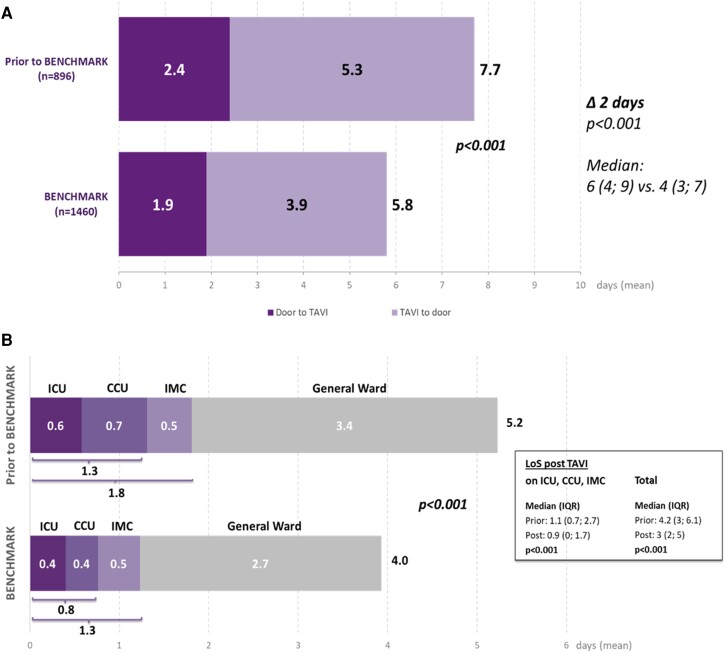
Between January 2020 and March 2023, 897 patients were documented prior to and 1491 patients after the implementation of BENCHMARK practices. Patient characteristics were consistent with a known older TAVI population and only minor differences. Mean LoS was reduced from 7.7 ± 7.0 to 5.8 ± 5.6 days (median 6 vs. 4 days; P < .001). Duration of intensive care was reduced from 1.8 to 1.3 days (median 1.1 vs. 0.9 days; P < .001). Adoption of peri-procedure best practices led to increased use of local anaesthesia (96.1% vs. 84.3%; P < .001) and decreased procedure (median 47 vs. 60 min; P < .001) and intervention times (85 vs. 95 min; P < .001). Thirty-day patient safety did not appear to be compromised with no differences in all-cause mortality (0.6% in both groups combined), stroke/transient ischaemic attack (1.4%), life-threatening bleeding (1.3%), stage 2/3 acute kidney injury (0.7%), and valve-related readmission (1.2%).
Broad implementation of BENCHMARK practices contributes to improving efficiency of TAVI pathway reducing LoS and costs without compromising patient safety.
经导管主动脉瓣植入术(TAVI)的临床路径有很大的简化潜力。本研究的目的是评估在 7 个欧洲国家的 28 个地点实施 BENCHMARK 最佳实践对 TAVI 的效率和安全性的影响。
这是一项在实施 BENCHMARK 最佳实践前后接受球囊扩张瓣膜 TAVI 的严重症状性主动脉瓣狭窄(AS)患者的研究。主要目标是减少住院时间(LoS)和重症监护停留时间。次要目标是记录患者安全性。
2020 年 1 月至 2023 年 3 月,在实施 BENCHMARK 实践之前记录了 897 例患者,之后记录了 1491 例患者。患者特征与已知的老年 TAVI 人群一致,仅存在微小差异。LoS 从 7.7±7.0 天减少至 5.8±5.6 天(中位数 6 天比 4 天;P<0.001)。重症监护停留时间从 1.8 天减少至 1.3 天(中位数 1.1 天比 0.9 天;P<0.001)。采用围手术期最佳实践导致局部麻醉使用率增加(96.1%比 84.3%;P<0.001),手术时间(中位数 47 分钟比 60 分钟;P<0.001)和介入时间(85 分钟比 95 分钟;P<0.001)减少。30 天患者安全性似乎没有受到影响,两组的全因死亡率(0.6%)、卒中和短暂性脑缺血发作(1.4%)、威胁生命的出血(1.3%)、2/3 级急性肾损伤(0.7%)和瓣膜相关再入院(1.2%)无差异。
广泛实施 BENCHMARK 实践有助于提高 TAVI 路径的效率,减少 LOS 和成本,同时不影响患者安全性。