School of Pharmacy, Jiangxi University of Chinese Medicine, Nanchang, 330006, Jiangxi, China.
National Pharmaceutical Engineering Center for Solid Preparation of Chinese Herbal Medicine, Jiangxi University of Chinese Medicine, Nanchang, 330006, Jiangxi, China.
Cancer Immunol Immunother. 2024 Mar 30;73(5):83. doi: 10.1007/s00262-024-03662-0.
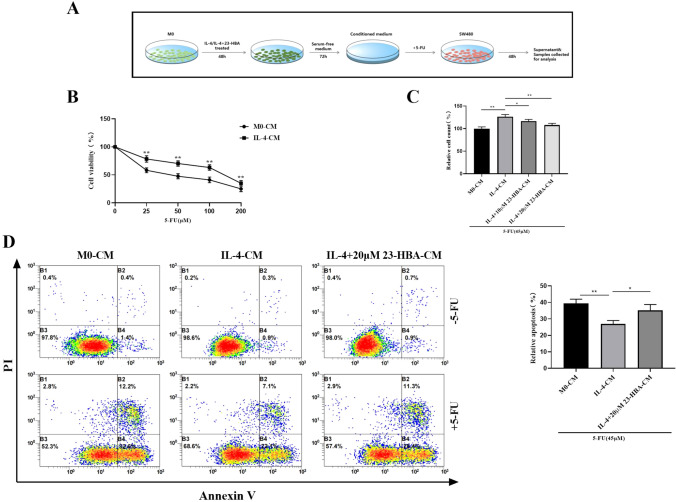
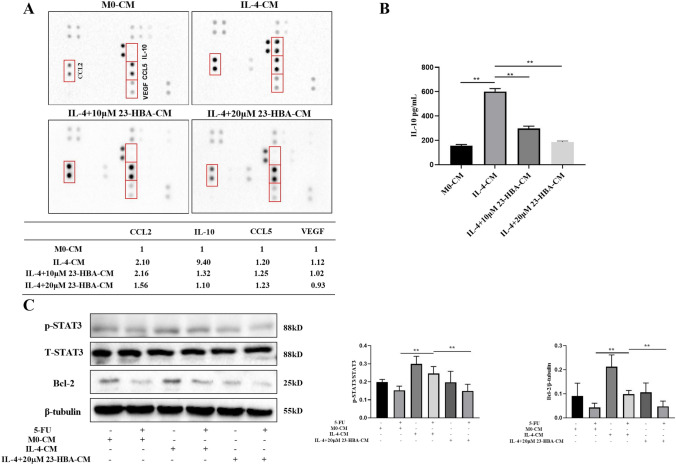
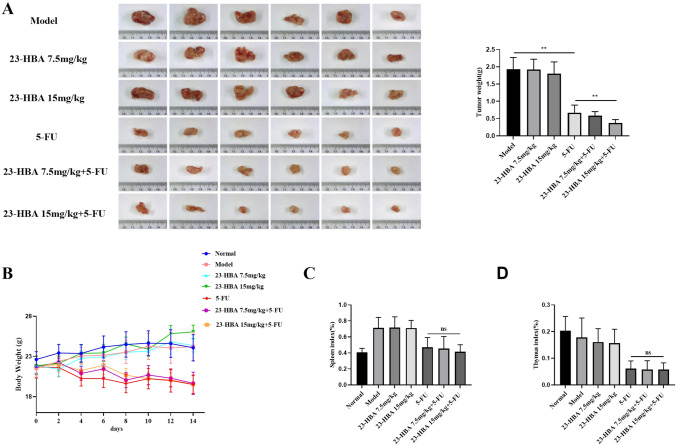
Macrophage polarization is closely associated with the inflammatory processes involved in the development and chemoresistance of colorectal cancer (CRC). M2 macrophages, the predominant subtype of tumor-associated macrophages (TAMs) in a wide variety of malignancies, have been demonstrated to promote the resistance of CRC to multiple chemotherapeutic drugs, such as 5-fluorouracil (5-FU). In our study, we investigated the potential of 23-Hydroxybetulinic Acid (23-HBA), a significant active component of Pulsatilla chinensis (P. chinensis), to inhibit the polarization of M2 macrophages induced by IL-4. Our results showed that 23-HBA reduced the expression of M2 specific marker CD206, while downregulating the mRNA levels of M2 related genes (CD206, Arg1, IL-10, and CCL2). Additionally, 23-HBA effectively attenuated the inhibitory effects of the conditioned medium from M2 macrophages on apoptosis in colorectal cancer SW480 cells. Mechanistically, 23-HBA prevented the phosphorylation and nuclear translocation of the STAT6 protein, resulting in the inhibition of IL-10 release in M2 macrophages. Moreover, it interfered with the activation of the IL-10/STAT3/Bcl-2 signaling pathway in SW480 cells, ultimately reducing M2 macrophage-induced resistance to 5-FU. Importantly, depleting STAT6 expression in macrophages abolished the suppressive effect of 23-HBA on M2 macrophage polarization, while also eliminating its ability to decrease M2 macrophage-induced 5-FU resistance in cancer cells. Furthermore, 23-HBA significantly diminished the proportion of M2 macrophages in the tumor tissues of colorectal cancer mice, simultaneously enhancing the anti-cancer efficacy of 5-FU. The findings presented in this study highlight the capacity of 23-HBA to inhibit M2 macrophage polarization, a process that contributes to reduced 5-FU resistance in colorectal cancer.
巨噬细胞极化与结直肠癌(CRC)发展和化疗耐药相关的炎症过程密切相关。M2 巨噬细胞是多种恶性肿瘤中肿瘤相关巨噬细胞(TAMs)的主要亚型,已被证明可促进 CRC 对多种化疗药物(如 5-氟尿嘧啶(5-FU))的耐药性。在我们的研究中,我们研究了白头翁酸(23-HBA)的潜力,23-HBA 是白头翁(Pulsatilla chinensis)的一种重要活性成分,可抑制 IL-4 诱导的 M2 巨噬细胞极化。我们的结果表明,23-HBA 降低了 M2 特异性标志物 CD206 的表达,同时下调了 M2 相关基因(CD206、Arg1、IL-10 和 CCL2)的 mRNA 水平。此外,23-HBA 有效减弱了 M2 巨噬细胞条件培养基对结直肠癌细胞 SW480 凋亡的抑制作用。在机制上,23-HBA 阻止了 STAT6 蛋白的磷酸化和核转位,从而抑制了 M2 巨噬细胞中 IL-10 的释放。此外,它干扰了 SW480 细胞中 IL-10/STAT3/Bcl-2 信号通路的激活,最终降低了 M2 巨噬细胞诱导的 5-FU 耐药性。重要的是,巨噬细胞中 STAT6 表达的耗竭消除了 23-HBA 对 M2 巨噬细胞极化的抑制作用,同时消除了其降低 M2 巨噬细胞诱导的癌细胞 5-FU 耐药性的能力。此外,23-HBA 显著减少了结直肠癌小鼠肿瘤组织中 M2 巨噬细胞的比例,同时增强了 5-FU 的抗癌疗效。本研究的结果强调了 23-HBA 抑制 M2 巨噬细胞极化的能力,这一过程有助于降低结直肠癌的 5-FU 耐药性。