Department of Clinical Oncology, Harbin Medical University Cancer Hospital, 150 Haping Road, Harbin, 150040, China.
Clin Transl Oncol. 2024 Sep;26(9):2240-2249. doi: 10.1007/s12094-024-03438-z. Epub 2024 Mar 30.
Metabolic syndrome (MetS), characterized by insulin resistance, is closely associated with the prognosis of various cancer types, but has not been reported in diffuse large B-cell lymphoma (DLBCL). The aim of this study is to examine how other clinicopathological variables and the MetS influence the prognosis of DLBCL.
Clinical and pathological data were collected from 319 patients with DLBCL who were admitted to our hospital between January 2012 and December 2020. The data accessible with SPSS 27.0 enables the utilization of various statistical methods for clinical data analysis, including independent sample t test and univariate and multivariate COX regression.
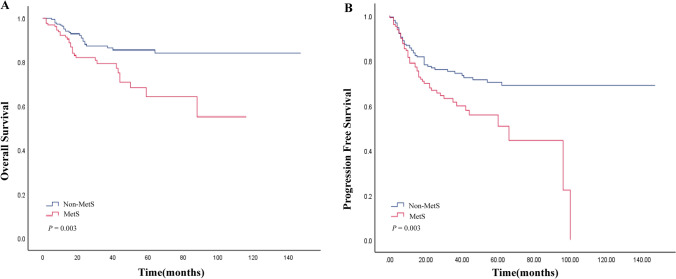
The presence of MetS was linked to both overall survival (OS) and progression-free survival (PFS), in addition to other clinicopathological characteristics as age, IPI score, rituximab usage, and Ki-67 expression level. This link with OS and PFS indicated a poor prognosis, as shown by survival analysis. Subsequent univariate analysis identified IPI score, Ki-67 expression level, tumor staging, rituximab usage, lactate dehydrogenase expression level, and the presence or absence of MetS as factors linked with OS and PFS. Furthermore, multivariate Cox regression analysis confirmed the independent risk factor status of IPI score, Ki-67 expression level, rituximab usage, and the presence of MetS in evaluating the prognosis of patients with DLBCL.
This study's findings indicate that patients with pre-treatment MetS had a poor prognosis, with relatively shorter OS and PFS compared to those without pre-treatment MetS. Furthermore, the presence of MetS, IPI score, Ki-67 expression level, and rituximab usage were identified as independent risk factors significantly affecting the prognosis of DLBCL.
代谢综合征(MetS)以胰岛素抵抗为特征,与多种癌症类型的预后密切相关,但尚未在弥漫性大 B 细胞淋巴瘤(DLBCL)中报道。本研究旨在研究其他临床病理变量和 MetS 如何影响 DLBCL 的预后。
收集了 2012 年 1 月至 2020 年 12 月期间在我院就诊的 319 例 DLBCL 患者的临床和病理数据。SPSS 27.0 中可用的数据可用于临床数据分析的各种统计方法,包括独立样本 t 检验和单变量和多变量 COX 回归。
除了其他临床病理特征(如年龄、IPI 评分、利妥昔单抗使用和 Ki-67 表达水平)外,MetS 的存在与总生存期(OS)和无进展生存期(PFS)均相关。与 OS 和 PFS 的这种联系表明预后不良,这可以通过生存分析来证明。随后的单变量分析确定 IPI 评分、Ki-67 表达水平、肿瘤分期、利妥昔单抗使用、乳酸脱氢酶表达水平和 MetS 的存在或不存在是与 OS 和 PFS 相关的因素。此外,多变量 Cox 回归分析证实了 IPI 评分、Ki-67 表达水平、利妥昔单抗使用和 MetS 的存在是评估 DLBCL 患者预后的独立危险因素。
本研究结果表明,治疗前存在 MetS 的患者预后较差,与无治疗前 MetS 的患者相比,其 OS 和 PFS 相对较短。此外,MetS 的存在、IPI 评分、Ki-67 表达水平和利妥昔单抗的使用被确定为显著影响 DLBCL 预后的独立危险因素。