Ministry of Ecology and Environment of China, Nanjing Institute of Environmental Sciences, Nanjing, 210042, China.
State Environmental Protection Key Laboratory of Soil Environmental Management and Pollution Control, Nanjing, 210042, China.
Sci Rep. 2024 Mar 30;14(1):7552. doi: 10.1038/s41598-024-58117-4.
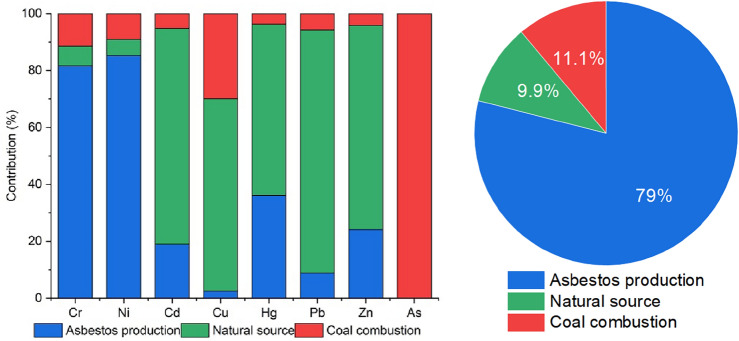
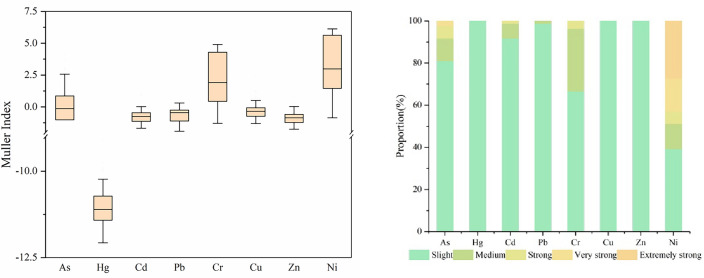
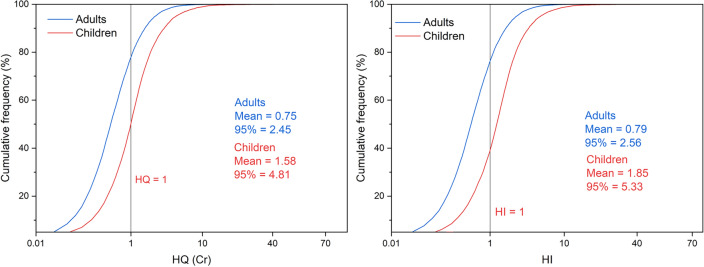
Asbestos is widely used in construction, manufacturing, and other common industrial fields. Human activities such as mining, processing, and transportation can release heavy metals from asbestos into the surrounding soil environment, posing a health hazard to the mining area's environment and its surrounding residents. The purpose of the present study was to determine the extent of ecological and human health damage caused by asbestos pollution, as well as the primary contributors to the contamination, by examining a large asbestos mine and the surrounding soil in China. The level of heavy metal pollution in soil and sources were analyzed using methods such as the geo-accumulation index (I), potential ecological risk index (RI), and positive matrix factorization (PMF) model. A Monte Carlo simulation-based health risk model was employed to assess the health risks of heavy metals in the study area's soil to human beings. The results showed that the concentrations of As, Pb, Cr, Cu, and Ni in the soil were 1.74, 0.13, 13.31, 0.33, and 33.37 times higher than the local soil background values, respectively. The I assessment indicated significant accumulation effects for Ni, Cr, and As. The RI evaluation revealed extremely high comprehensive ecological risks (RI ≥ 444) in the vicinity of the waste residue heap and beneficiation area, with Ni exhibiting strong individual potential ecological risk (Eir ≥ 320). The soil health risk assessment demonstrated that As and Cr posed carcinogenic risks to adults, with mean carcinogenic indices (CR) of 1.56E - 05 and 4.14E - 06, respectively. As, Cr, and Cd posed carcinogenic risks to children, with mean CRs of 1.08E - 04, 1.61E - 05, and 2.68E - 06, respectively. Cr also posed certain non-carcinogenic risks to both adults and children. The PMF model identified asbestos contamination as the primary source of heavy metals in the soil surrounding the asbestos mining area, contributing to 79.0%. According to this study, it is recommended that management exercise oversight and regulation over the concentrations of Ni, Cr, Cd, and As in the soil adjacent to asbestos mines, establish a designated control zone to restrict population activities, and locate residential zones at a safe distance from the asbestos mine production zone.
石棉广泛应用于建筑、制造和其他常见工业领域。人类活动,如采矿、加工和运输,会将石棉中的重金属释放到周围土壤环境中,对矿区及其周边居民的健康构成威胁。本研究的目的是通过考察中国的一个大型石棉矿及其周边土壤,确定石棉污染对生态和人类健康的破坏程度以及主要污染源。采用地积累指数(I)、潜在生态风险指数(RI)和正矩阵因子分解(PMF)模型等方法,分析土壤重金属污染水平和来源。采用基于蒙特卡罗模拟的健康风险模型评估研究区土壤重金属对人体的健康风险。结果表明,土壤中 As、Pb、Cr、Cu 和 Ni 的浓度分别比当地土壤背景值高出 1.74、0.13、13.31、0.33 和 33.37 倍。I 评价表明 Ni、Cr 和 As 具有明显的积累效应。RI 评价表明,在尾矿堆和选矿区附近存在极高的综合生态风险(RI≥444),Ni 具有很强的个体潜在生态风险(Eir≥320)。土壤健康风险评估表明,As 和 Cr 对成人具有致癌风险,成人的平均致癌指数(CR)分别为 1.56E-05 和 4.14E-06。As、Cr 和 Cd 对儿童具有致癌风险,儿童的平均 CR 分别为 1.08E-04、1.61E-05 和 2.68E-06。Cr 对成人和儿童也存在一定的非致癌风险。PMF 模型将石棉污染确定为石棉矿区土壤中重金属的主要来源,贡献率为 79.0%。根据本研究,建议对石棉矿区周边土壤中 Ni、Cr、Cd 和 As 浓度进行管理和监管,建立指定的控制区,限制人口活动,并将居民区设在远离石棉矿生产区的安全距离内。