School of Resources and Environment and Key Laboratory of Poyang Lake Environment and Resource Utilization of Ministry of Education, Nanchang University, Nanchang, China.
College of Ecology and Environment, Yuzhang Normal University, Nanchang, China.
PeerJ. 2024 Apr 1;12:e17200. doi: 10.7717/peerj.17200. eCollection 2024.
Dayu County, a major tungsten producer in China, experiences severe heavy metal pollution. This study evaluated the pollution status, the accumulation characteristics in paddy rice, and the potential ecological risks of heavy metals in agricutural soils near tungsten mining areas of Dayu County. Furthermore, the impacts of soil properties on the accumulation of heavy metals in soil were explored.
The geo-accumulation index (I), the contamination factor (CF), and the pollution load index (PLI) were used to evaluate the pollution status of metals (As, Cd, Cu, Cr, Pb, Mo, W, and Zn) in soils. The ecological risk factor (RI) was used to assess the potential ecological risks of heavy metals in soil. The health risks and accumulation of heavy metals in paddy rice were evaluated using the health risk index and the translocation factor (TF), respectively. Pearson's correlation coefficient was used to discuss the influence of soil factors on heavy metal contents in soil.
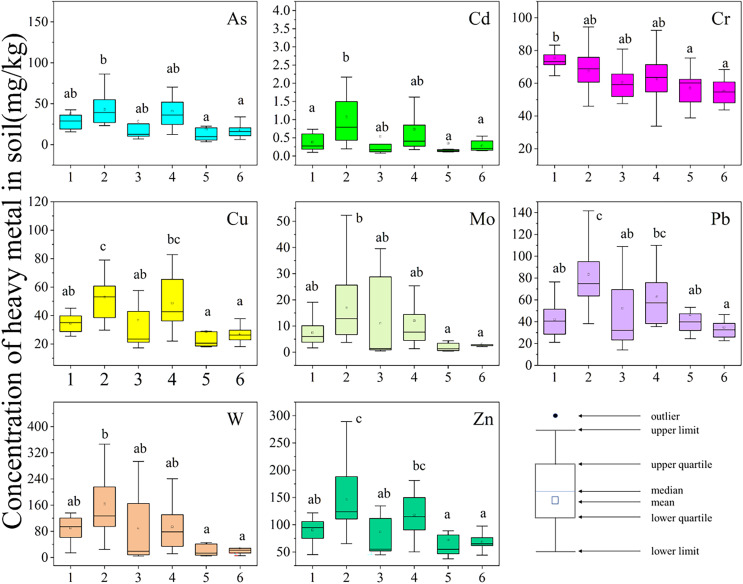
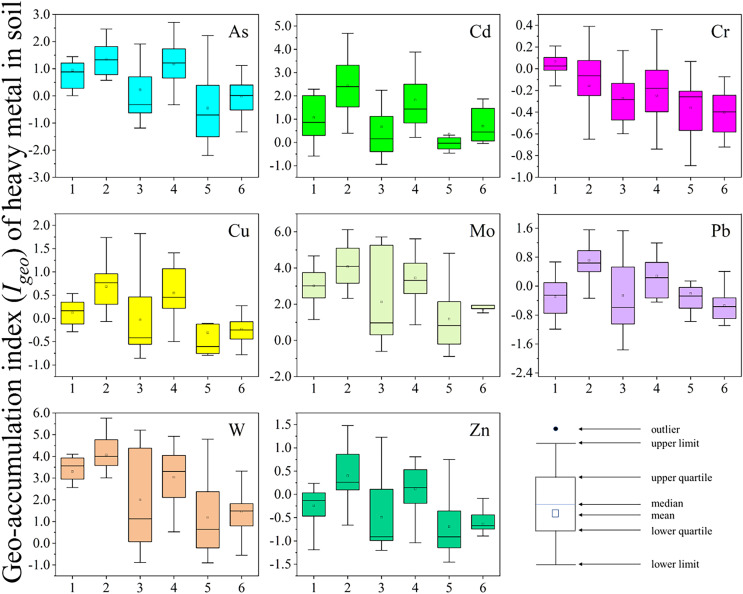
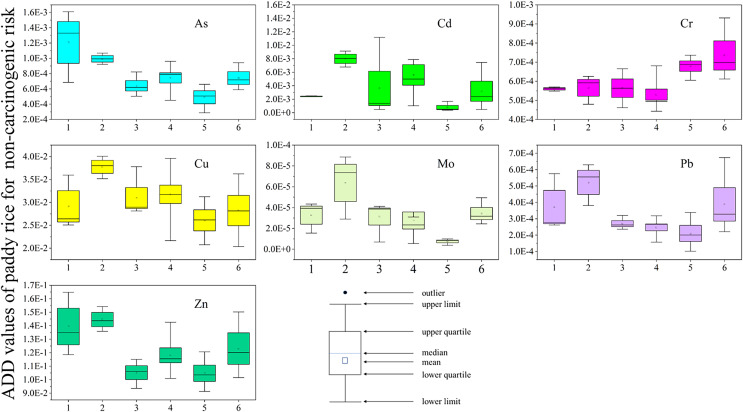
The concentrations of metals exceeded the respective average background values for soils (As: 10.4, Cd: 0.10, Cu: 20.8, Cr: 48.0, Pb: 32.1, Mo: 0.30, W: 4.93, Zn: 69.0, mg/kg). The levels of As, Cd, Mo, and tungsten(W) exceeded the risk screening values for Chinese agricultural soil contamination and the Dutch standard. The mean concentrations of the eight tested heavy metals followed the order FJ-S > QL > FJ-N > HL > CJ-E > CJ-W, with a significant distribution throughout the Zhangjiang River basin. Heavy metals, especially Cd, were enriched in paddy rice. The I and CF assessment indicated that the soil was moderately to heavily polluted by Mo, W and Cd, and the PLI assessment indicated the the sites of FJ-S and QL were extremely severely polluted due to the contribution of Cd, Mo and W. The RI results indicated that Cd posed the highest risk near tungsten mining areas. The non-carcinogenic and total carcinogenic risks were above the threshold values (non-carcinogenic risk by HQ > 1, carcinogenic risks by CR > 1 × 10 a) for As and Cd. Correlation analysis indicated that KO, NaO, and CaO are main factors affecting the accumulation and migration of heavy metals in soils and plants. Our findings reveal significant contamination of soils and crops with heavy metals, especially Cd, Mo, and W, near mining areas, highlighting serious health risks. This emphasizes the need for immediate remedial actions and the implementation of stringent environmental policies to safeguard health and the environment.
中国主要的钨产地大余县遭受严重重金属污染。本研究评估了大余县钨矿区附近农业土壤中重金属的污染状况、在水稻中的积累特征和潜在生态风险,并探讨了土壤性质对重金属在土壤中积累的影响。
采用地积累指数(I)、污染系数(CF)和污染负荷指数(PLI)评价土壤中金属(As、Cd、Cu、Cr、Pb、Mo、W 和 Zn)的污染状况。采用生态风险因子(RI)评价土壤中重金属的潜在生态风险。采用健康风险指数和迁移因子(TF)分别评估重金属在水稻中的健康风险和积累。采用 Pearson 相关系数探讨土壤因子对土壤重金属含量的影响。
金属浓度超过土壤平均背景值(As:10.4,Cd:0.10,Cu:20.8,Cr:48.0,Pb:32.1,Mo:0.30,W:4.93,Zn:69.0,mg/kg)。As、Cd、Mo 和钨(W)的含量超过中国农业土壤污染风险筛选值和荷兰标准。八种重金属的平均浓度顺序为 FJ-S>QL>FJ-N>HL>CJ-E>CJ-W,在整个樟江流域均有明显分布。重金属,尤其是 Cd,在水稻中富集。I 和 CF 评估表明,Mo、W 和 Cd 使土壤受到中度至重度污染,PLI 评估表明 FJ-S 和 QL 地区由于 Cd、Mo 和 W 的贡献而受到极度严重的污染。RI 结果表明,在钨矿区附近,Cd 造成的风险最高。As 和 Cd 的非致癌和总致癌风险均高于阈值(非致癌风险 HQ>1,致癌风险 CR>1×10 a)。相关分析表明,KO、NaO 和 CaO 是影响土壤和植物中重金属积累和迁移的主要因素。研究结果表明,矿区附近土壤和作物受到严重的重金属污染,特别是 Cd、Mo 和 W,存在严重的健康风险。这强调了需要立即采取补救措施和实施严格的环境政策,以保障健康和环境。