College of Pharmacy, Kyung Hee University, Seoul, 02447, Republic of Korea.
Department of Biomedical and Pharmaceutical Sciences, Kyung Hee University, Seoul, 02447, Republic of Korea.
Exp Mol Med. 2024 Apr;56(4):904-921. doi: 10.1038/s12276-024-01189-z. Epub 2024 Apr 1.
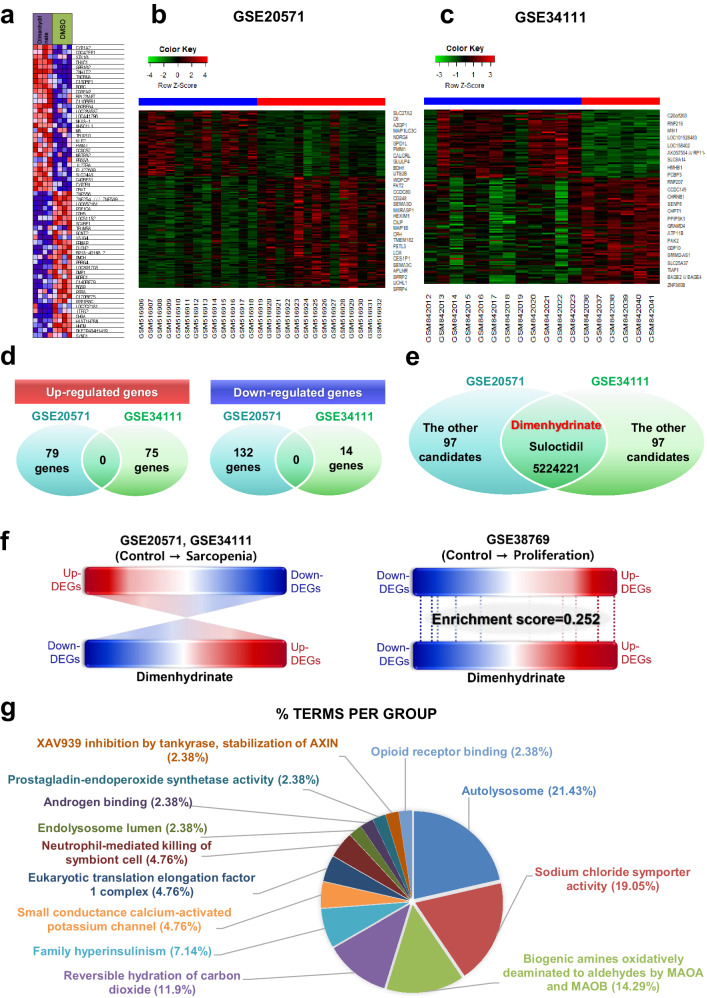
Sarcopenia, the progressive decline in skeletal muscle mass and function, is observed in various conditions, including cancer and aging. The complex molecular biology of sarcopenia has posed challenges for the development of FDA-approved medications, which have mainly focused on dietary supplementation. Targeting a single gene may not be sufficient to address the broad range of processes involved in muscle loss. This study analyzed the gene expression signatures associated with cancer formation and 5-FU chemotherapy-induced muscle wasting. Our findings suggest that dimenhydrinate, a combination of 8-chlorotheophylline and diphenhydramine, is a potential therapeutic for sarcopenia. In vitro experiments demonstrated that dimenhydrinate promotes muscle progenitor cell proliferation through the phosphorylation of Nrf2 by 8-chlorotheophylline and promotes myotube formation through diphenhydramine-induced autophagy. Furthermore, in various in vivo sarcopenia models, dimenhydrinate induced rapid muscle tissue regeneration. It improved muscle regeneration in animals with Duchenne muscular dystrophy (DMD) and facilitated muscle and fat recovery in animals with chemotherapy-induced sarcopenia. As an FDA-approved drug, dimenhydrinate could be applied for sarcopenia treatment after a relatively short development period, providing hope for individuals suffering from this debilitating condition.
肌肉减少症,即骨骼肌质量和功能的进行性下降,可见于多种情况,包括癌症和衰老。肌肉减少症的复杂分子生物学为开发获得 FDA 批准的药物带来了挑战,这些药物主要集中在饮食补充上。针对单一基因可能不足以解决涉及肌肉丧失的广泛过程。本研究分析了与癌症形成和 5-FU 化疗诱导的肌肉减少相关的基因表达特征。我们的研究结果表明,茶苯海明(8-氯茶碱和苯海拉明的混合物)是肌肉减少症的一种潜在治疗药物。体外实验表明,茶苯海明通过 8-氯茶碱使 Nrf2 磷酸化,促进肌肉祖细胞增殖,并通过苯海拉明诱导的自噬促进肌管形成。此外,在各种体内肌肉减少症模型中,茶苯海明诱导肌肉组织快速再生。它改善了杜氏肌营养不良症(DMD)动物的肌肉再生,并促进了化疗诱导的肌肉减少症动物的肌肉和脂肪恢复。作为一种获得 FDA 批准的药物,茶苯海明在相对较短的开发周期后可用于肌肉减少症的治疗,为患有这种衰弱性疾病的人带来了希望。