The First Clinical Medical College, Lanzhou University, Lanzhou, China.
Department of Gastroenterology, The First Hospital of Lanzhou University, Lanzhou, China.
PLoS One. 2024 Apr 1;19(4):e0301129. doi: 10.1371/journal.pone.0301129. eCollection 2024.
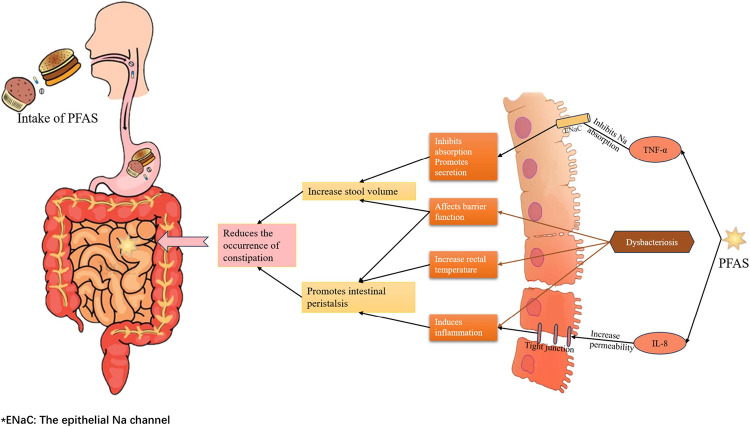
The impact of per- and polyfluoroalkyl substances (PFAS) on constipation, as mediated through gastrointestinal absorption and perturbations to the intestinal microecology, remains poorly understood.
This study seeks to explain the relationship between PFAS and constipation.
A total of 2945 adults from the National Health and Nutrition Examination Survey (NHANES) 2005-2010 were included in this study. Constipation was defined using the Bristol Stool Form Scale (BSFS) based on stool consistency. The relationship between PFAS and constipation was evaluated using weighted logistic regression and restricted cubic spline (RCS) analysis, while adjusting for confounding variables.
The weighted median concentration of total PFAS (ΣPFAS) was significantly lower in individuals with constipation (19.01 μg/L) compared to those without constipation (23.30 μg/L) (p < 0.0001). Subgroup analysis revealed that the cumulative effect of PFAS was more pronounced in the elderly, men, individuals with obesity, high school education or equivalent, and high-income individuals (p < 0.05). After adjusting for confounding factors, multivariable analysis demonstrated an inverse association between PFOA [OR (95% CI), 0.666(0.486,0.914)] and PFHxS [OR (95% CI), 0.699(0.482,1.015)], and constipation. None of the personal and lifestyle factors showed a significant correlation with this negative association, as confirmed by subgroup analysis and interaction testing (p for interaction > 0.05). The RCS analysis demonstrated a linear inverse relationship between PFAS levels and constipation.
The findings of this study provide evidence of a significant inverse correlation between serum concentrations of PFAS, particularly PFOA and PFHxS, and constipation.
全氟和多氟烷基物质(PFAS)通过胃肠道吸收和肠道微生态紊乱对便秘的影响尚不清楚。
本研究旨在解释 PFAS 与便秘之间的关系。
本研究共纳入了 2945 名来自 2005-2010 年国家健康和营养调查(NHANES)的成年人。便秘的定义基于粪便稠度的布里斯托粪便形态量表(BSFS)。使用加权逻辑回归和限制立方样条(RCS)分析来评估 PFAS 与便秘之间的关系,并调整混杂因素。
便秘患者的总 PFAS(ΣPFAS)加权中位数浓度[19.01μg/L]明显低于无便秘患者[23.30μg/L](p<0.0001)。亚组分析显示,PFAS 的累积效应在老年人、男性、肥胖者、高中及同等学历者和高收入者中更为明显(p<0.05)。调整混杂因素后,多变量分析显示,PFOA [比值比(95%置信区间),0.666(0.486,0.914)]和 PFHxS [比值比(95%置信区间),0.699(0.482,1.015)]与便秘呈负相关。个人和生活方式因素均未通过亚组分析和交互检验(p>0.05)与这种负相关相关。RCS 分析显示 PFAS 水平与便秘之间呈线性负相关。
本研究结果表明,血清 PFAS 浓度,尤其是 PFOA 和 PFHxS 与便秘之间存在显著的负相关。