• 文献检索
  • 文档翻译
  • 深度研究
  • 学术资讯
  • Suppr Zotero 插件Zotero 插件
  • 邀请有礼
  • 套餐&价格
  • 历史记录
应用&插件
Suppr Zotero 插件Zotero 插件浏览器插件Mac 客户端Windows 客户端微信小程序
定价
高级版会员购买积分包购买API积分包
服务
文献检索文档翻译深度研究API 文档MCP 服务
关于我们
关于 Suppr公司介绍联系我们用户协议隐私条款
关注我们

Suppr 超能文献

核心技术专利:CN118964589B侵权必究
粤ICP备2023148730 号-1Suppr @ 2026

文献检索

告别复杂PubMed语法,用中文像聊天一样搜索,搜遍4000万医学文献。AI智能推荐,让科研检索更轻松。

立即免费搜索

文件翻译

保留排版,准确专业,支持PDF/Word/PPT等文件格式,支持 12+语言互译。

免费翻译文档

深度研究

AI帮你快速写综述,25分钟生成高质量综述,智能提取关键信息,辅助科研写作。

立即免费体验

瑞典患有回避性限制性食物摄入障碍表型儿童的并存心理和躯体状况。

Co-existing mental and somatic conditions in Swedish children with the avoidant restrictive food intake disorder phenotype.

作者信息

Wronski Marie-Louis, Kuja-Halkola Ralf, Hedlund Elin, Martini Miriam I, Lichtenstein Paul, Lundström Sebastian, Larsson Henrik, Taylor Mark J, Micali Nadia, Bulik Cynthia M, Dinkler Lisa

机构信息

Department of Medical Epidemiology and Biostatistics, Karolinska Institutet, Stockholm, Sweden.

Neuroendocrine Unit, Department of Medicine, Massachusetts General Hospital and Harvard Medical School, Boston, MA, USA.

出版信息

medRxiv. 2024 Mar 15:2024.03.10.24304003. doi: 10.1101/2024.03.10.24304003.

DOI:10.1101/2024.03.10.24304003
PMID:38558975
原文链接:https://pmc.ncbi.nlm.nih.gov/articles/PMC10980122/
Abstract

BACKGROUND

Avoidant restrictive food intake disorder (ARFID) is a feeding and eating disorder, characterized by limited variety and/or quantity of food intake impacting physical health and psychosocial functioning. Children with ARFID often present with a range of psychiatric and somatic symptoms, and therefore consult various pediatric subspecialties; large-scale studies mapping comorbidities are however lacking. To characterize health care needs of people with ARFID, we systematically investigated ARFID-related mental and somatic conditions in 616 children with ARFID and >30,000 children without ARFID.

METHODS

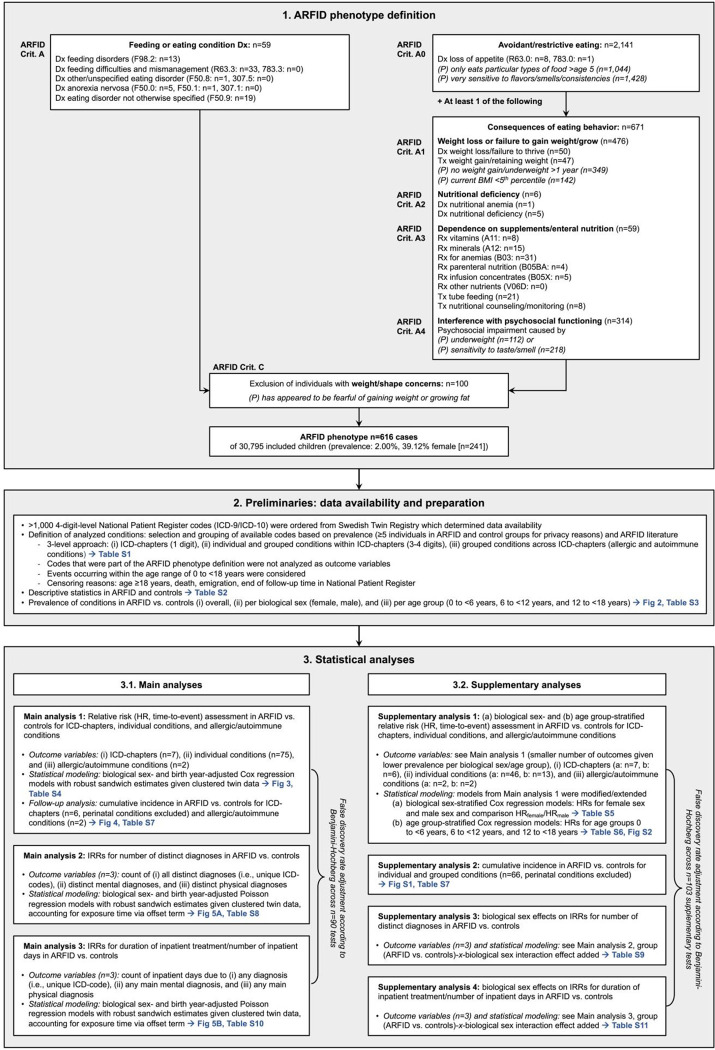
In a Swedish twin cohort, we identified the ARFID phenotype in 6-12-year-old children based on parent-reports and register data. From >1,000 diagnostic ICD-codes, we specified mental and somatic conditions within/across ICD-chapters, number of distinct per-person diagnoses, and inpatient treatment days between birth and 18 birthday (90 outcomes). Hazard ratios (HR) and incidence rate ratios (IRR) were calculated.

FINDINGS

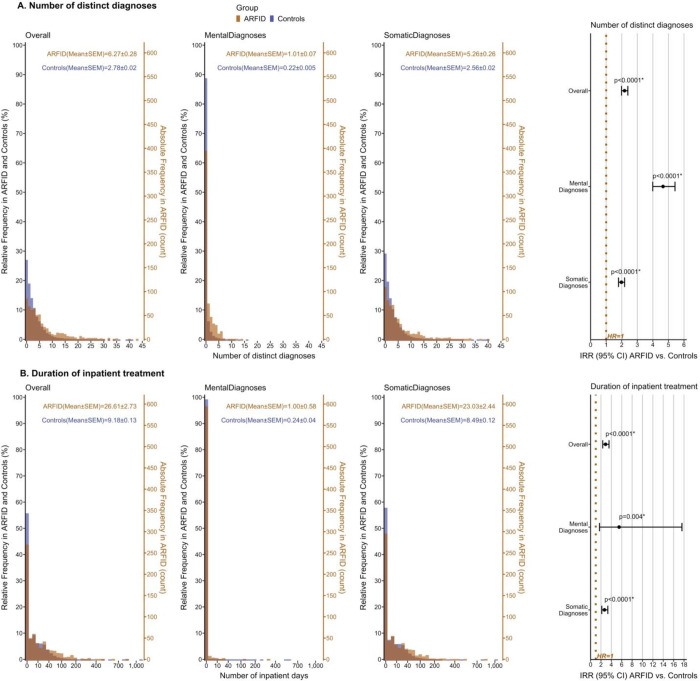
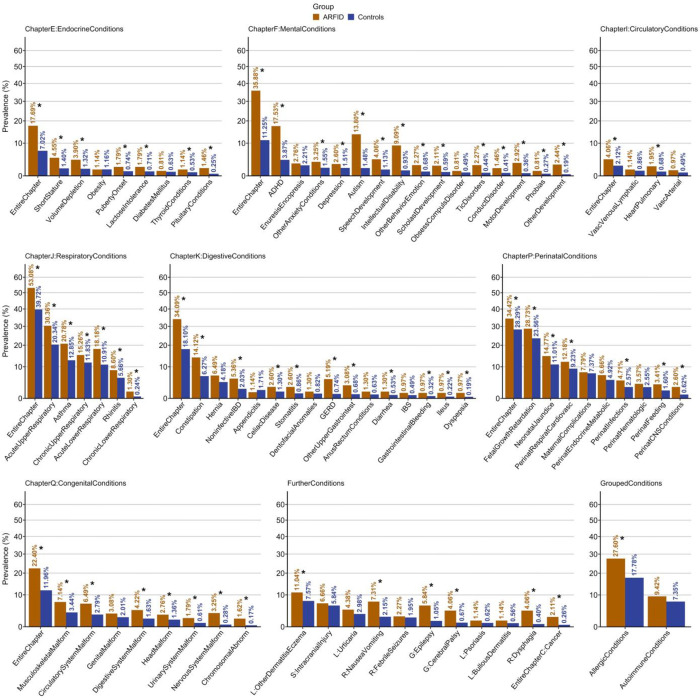
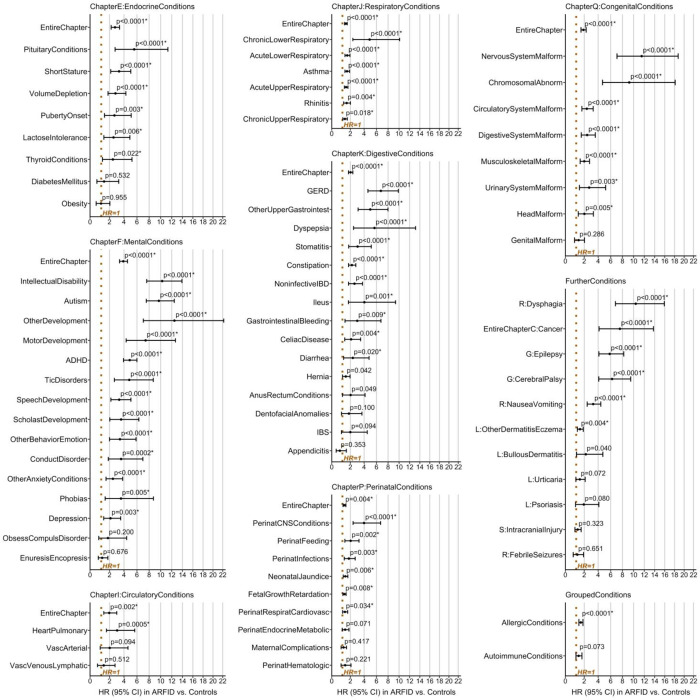
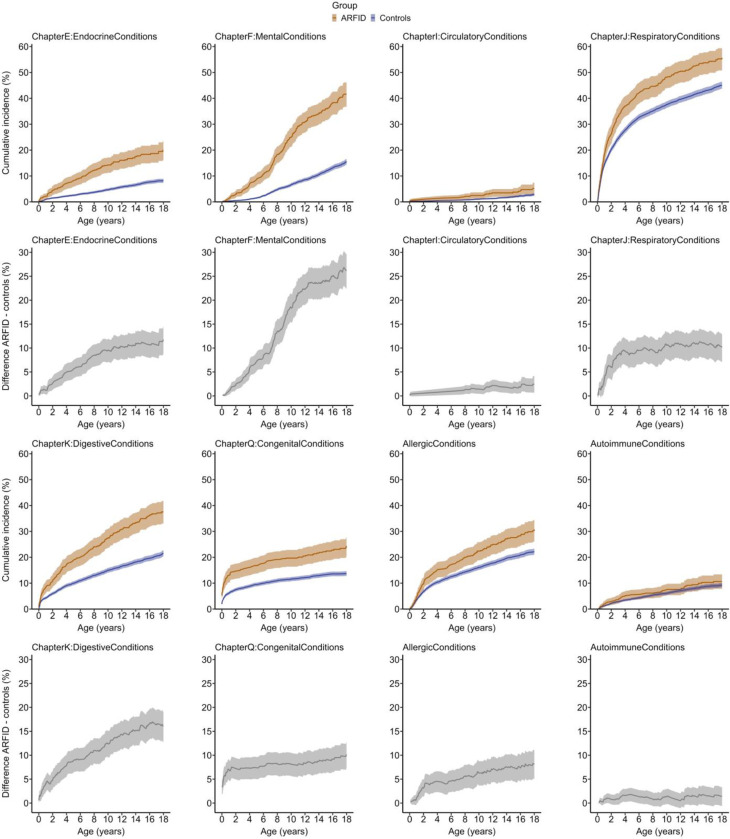
Relative risks of neurodevelopmental, gastrointestinal, endocrine/metabolic, respiratory, neurological, and allergic disorders were substantially increased in ARFID (e.g., autism HR[CI]=9.7[7.5-12.5], intellectual disability 10.3[7.6-13.9], gastroesophageal reflux disease 6.7[4.6-9.9], pituitary conditions 5.6[2.7-11.3], chronic lower respiratory diseases 4.9[2.4-10.1], epilepsy 5.8[4.1-8.2]). ARFID was not associated with elevated risks of autoimmune illnesses and obsessive-compulsive disorder. Children with ARFID had a significantly higher number of distinct mental diagnoses (IRR[CI]=4.7[4.0-5.4]) and longer duration of hospitalizations (IRR[CI]=5.5[1.7-17.6]) compared with children without ARFID. Children with ARFID were diagnosed earlier with a mental condition than children without ARFID. No sex-specific differences emerged.

INTERPRETATION

This study yields the broadest and most detailed evidence of co-existing mental and somatic conditions in the largest sample of children with ARFID to date. Findings suggest a complex pattern of health needs in youth with ARFID, underscoring the critical importance of attention to the illness across all pediatric specialties.

FUNDING

Fredrik and Ingrid Thurings Foundation, Mental Health Foundation.

摘要

背景

回避性限制性食物摄入障碍(ARFID)是一种进食障碍,其特征是食物摄入量的种类和/或数量有限,影响身体健康和心理社会功能。患有ARFID的儿童常伴有一系列精神和躯体症状,因此会咨询多个儿科亚专业;然而,缺乏对共病情况进行全面分析的大规模研究。为了明确ARFID患者的医疗需求,我们系统地调查了616名患有ARFID的儿童和30000多名未患ARFID的儿童中与ARFID相关的精神和躯体疾病。

方法

在一个瑞典双胞胎队列中,我们根据家长报告和登记数据,在6至12岁的儿童中确定ARFID表型。从1000多个诊断性国际疾病分类(ICD)编码中,我们明确了ICD各章节内/各章节间的精神和躯体疾病、每人不同诊断的数量,以及出生至18岁生日期间的住院天数(90项结果)。计算风险比(HR)和发病率比(IRR)。

结果

ARFID患者中神经发育、胃肠道、内分泌/代谢、呼吸、神经和过敏性疾病的相对风险大幅增加(例如,自闭症HR[CI]=9.7[7.5 - 12.5],智力残疾10.3[7.6 - 13.9],胃食管反流病6.7[4.6 - 9.9],垂体疾病5.6[2.7 - 11.3],慢性下呼吸道疾病4.9[2.4 - 10.1],癫痫5.8[4.1 - 8.2])。ARFID与自身免疫性疾病和强迫症风险升高无关。与未患ARFID的儿童相比,患有ARFID的儿童有明显更多不同的精神诊断(IRR[CI]=4.7[4.0 - 5.4])和更长的住院时间(IRR[CI]=5.5[1.7 - 17.6])。患有ARFID的儿童比未患ARFID的儿童更早被诊断出患有精神疾病。未发现性别差异。

解读

本研究在迄今为止最大规模的ARFID儿童样本中,得出了关于共存精神和躯体疾病最广泛、最详细的证据。研究结果表明,患有ARFID的青少年存在复杂的健康需求模式,凸显了所有儿科亚专业关注该疾病的至关重要性。

资助

弗雷德里克和英格丽德·图林斯基金会、心理健康基金会。

https://cdn.ncbi.nlm.nih.gov/pmc/blobs/6d24/10980122/8f1f0bbb5e1d/nihpp-2024.03.10.24304003v1-f0005.jpg
https://cdn.ncbi.nlm.nih.gov/pmc/blobs/6d24/10980122/8fa0e1c7e357/nihpp-2024.03.10.24304003v1-f0001.jpg
https://cdn.ncbi.nlm.nih.gov/pmc/blobs/6d24/10980122/6a51027cf910/nihpp-2024.03.10.24304003v1-f0002.jpg
https://cdn.ncbi.nlm.nih.gov/pmc/blobs/6d24/10980122/65e39887fd67/nihpp-2024.03.10.24304003v1-f0003.jpg
https://cdn.ncbi.nlm.nih.gov/pmc/blobs/6d24/10980122/aa00751a93ac/nihpp-2024.03.10.24304003v1-f0004.jpg
https://cdn.ncbi.nlm.nih.gov/pmc/blobs/6d24/10980122/8f1f0bbb5e1d/nihpp-2024.03.10.24304003v1-f0005.jpg
https://cdn.ncbi.nlm.nih.gov/pmc/blobs/6d24/10980122/8fa0e1c7e357/nihpp-2024.03.10.24304003v1-f0001.jpg
https://cdn.ncbi.nlm.nih.gov/pmc/blobs/6d24/10980122/6a51027cf910/nihpp-2024.03.10.24304003v1-f0002.jpg
https://cdn.ncbi.nlm.nih.gov/pmc/blobs/6d24/10980122/65e39887fd67/nihpp-2024.03.10.24304003v1-f0003.jpg
https://cdn.ncbi.nlm.nih.gov/pmc/blobs/6d24/10980122/aa00751a93ac/nihpp-2024.03.10.24304003v1-f0004.jpg
https://cdn.ncbi.nlm.nih.gov/pmc/blobs/6d24/10980122/8f1f0bbb5e1d/nihpp-2024.03.10.24304003v1-f0005.jpg

相似文献

1
Co-existing mental and somatic conditions in Swedish children with the avoidant restrictive food intake disorder phenotype.瑞典患有回避性限制性食物摄入障碍表型儿童的并存心理和躯体状况。
medRxiv. 2024 Mar 15:2024.03.10.24304003. doi: 10.1101/2024.03.10.24304003.
2
Mental and Somatic Conditions in Children With the Broad Avoidant Restrictive Food Intake Disorder Phenotype.具有广泛回避性限制性摄食障碍表型的儿童的心理和躯体状况
JAMA Pediatr. 2025 Apr 1;179(4):428-437. doi: 10.1001/jamapediatrics.2024.6065.
3
Neurodevelopmental and psychiatric conditions in 600 Swedish children with the avoidant/restrictive food intake disorder phenotype.600名患有回避/限制性食物摄入障碍表型的瑞典儿童的神经发育和精神疾病状况。
J Child Psychol Psychiatry. 2025 Sep;66(9):1333-1344. doi: 10.1111/jcpp.14134. Epub 2025 Mar 12.
4
Etiology of the Broad Avoidant Restrictive Food Intake Disorder Phenotype in Swedish Twins Aged 6 to 12 Years.6 至 12 岁瑞典双胞胎广泛回避限制型食物摄入障碍表型的病因。
JAMA Psychiatry. 2023 Mar 1;80(3):260-269. doi: 10.1001/jamapsychiatry.2022.4612.
5
Birth-related, medical, and diagnostic characteristics in younger versus older children with avoidant/restrictive food intake disorder (ARFID).患有回避/限制性食物摄入障碍(ARFID)的年幼儿童与年长儿童的出生相关、医学和诊断特征。
J Eat Disord. 2023 Oct 26;11(1):190. doi: 10.1186/s40337-023-00908-7.
6
The Polish Version of the Avoidant/Restrictive Food Intake Disorder Questionnaire-Parents Report (ARFID-Q-PR) and the Nine Items Avoidant/Restrictive Food Intake Disorder Screen-Parents Report (NIAS-PR): Maternal Perspective.《回避/限制型食物摄入障碍问卷-父母报告版(ARFID-Q-PR)》和《回避/限制型食物摄入障碍 9 项筛查-父母报告版(NIAS-PR)》的波兰语版本:母亲视角。
Nutrients. 2022 Aug 2;14(15):3175. doi: 10.3390/nu14153175.
7
Lifetime and current mental health based on avoidant/restrictive food intake disorder history versus other eating disorder history in the Healthy Minds Study.基于回避/限制型食物摄入障碍史与其他饮食障碍史,在“健康思维研究”中评估终生和当前心理健康状况。
Int J Eat Disord. 2024 Oct;57(10):1999-2005. doi: 10.1002/eat.24218. Epub 2024 Apr 17.
8
Clinical and psychological features of children and adolescents diagnosed with avoidant/restrictive food intake disorder in a pediatric tertiary care eating disorder program: a descriptive study.在儿科三级护理饮食失调项目中被诊断为回避/限制性食物摄入障碍的儿童和青少年的临床及心理特征:一项描述性研究
J Eat Disord. 2018 Apr 27;6:7. doi: 10.1186/s40337-018-0193-3. eCollection 2018.
9
Neurodevelopmental and psychiatric conditions in 600 Swedish Children with the ARFID phenotype.600名患有回避性/restrictive食物摄入障碍(ARFID)表型的瑞典儿童的神经发育和精神疾病状况。
medRxiv. 2024 May 16:2024.05.16.24307471. doi: 10.1101/2024.05.16.24307471.
10
Pediatric hospital utilization for patients with avoidant restrictive food intake disorder.患有回避性限制性食物摄入障碍的患者的儿科医院利用率。
J Eat Disord. 2024 Mar 25;12(1):42. doi: 10.1186/s40337-024-00996-z.

本文引用的文献

1
Birth-related, medical, and diagnostic characteristics in younger versus older children with avoidant/restrictive food intake disorder (ARFID).患有回避/限制性食物摄入障碍(ARFID)的年幼儿童与年长儿童的出生相关、医学和诊断特征。
J Eat Disord. 2023 Oct 26;11(1):190. doi: 10.1186/s40337-023-00908-7.
2
Large Number of People Diagnosed With Type 1 Diabetes After Age 30.大量30岁以后被诊断出患有1型糖尿病的人。
JAMA. 2023 Oct 24;330(16):1516. doi: 10.1001/jama.2023.19207.
3
The clinical presentation of avoidant restrictive food intake disorder in children and adolescents is largely independent of sex, autism spectrum disorder and anxiety traits.
儿童和青少年回避性限制性食物摄入障碍的临床表现很大程度上与性别、自闭症谱系障碍及焦虑特质无关。
EClinicalMedicine. 2023 Aug 30;63:102190. doi: 10.1016/j.eclinm.2023.102190. eCollection 2023 Sep.
4
Avoidant restrictive food intake disorder and pediatric feeding disorder: the pediatric gastroenterology perspective.回避限制型食物摄入障碍和小儿喂养障碍:儿科胃肠病学视角。
Curr Opin Pediatr. 2023 Oct 1;35(5):566-573. doi: 10.1097/MOP.0000000000001267. Epub 2023 Jul 17.
5
Early neurodevelopmental problems and risk for avoidant/restrictive food intake disorder (ARFID) in 4-7-year-old children: A Japanese birth cohort study.4至7岁儿童的早期神经发育问题及回避/限制性食物摄入障碍(ARFID)风险:一项日本出生队列研究。
JCPP Adv. 2022 Aug 7;2(3):e12094. doi: 10.1002/jcv2.12094. eCollection 2022 Sep.
6
The Intersection of Disorders of Gut-Brain Interaction With Avoidant/Restrictive Food Intake Disorder.肠脑互动障碍与回避/限制型食物摄入障碍的交集。
J Clin Gastroenterol. 2023 Aug 1;57(7):651-662. doi: 10.1097/MCG.0000000000001853.
7
Etiology of the Broad Avoidant Restrictive Food Intake Disorder Phenotype in Swedish Twins Aged 6 to 12 Years.6 至 12 岁瑞典双胞胎广泛回避限制型食物摄入障碍表型的病因。
JAMA Psychiatry. 2023 Mar 1;80(3):260-269. doi: 10.1001/jamapsychiatry.2022.4612.
8
Pulmonary complications of eating disorders: a literature review.饮食失调的肺部并发症:文献综述
J Eat Disord. 2023 Jan 30;11(1):12. doi: 10.1186/s40337-023-00735-w.
9
What do we know about the epidemiology of avoidant/restrictive food intake disorder in children and adolescents? A systematic review of the literature.我们对儿童和青少年回避/限制型食物摄入障碍的流行病学了解多少?文献系统评价。
Eur Eat Disord Rev. 2023 Mar;31(2):226-246. doi: 10.1002/erv.2964. Epub 2022 Dec 16.
10
Psychiatric and medical comorbidities of eating disorders: findings from a rapid review of the literature.饮食失调的精神和医学共病:文献快速综述的结果
J Eat Disord. 2022 Sep 5;10(1):132. doi: 10.1186/s40337-022-00654-2.