• 文献检索
  • 文档翻译
  • 深度研究
  • 学术资讯
  • Suppr Zotero 插件Zotero 插件
  • 邀请有礼
  • 套餐&价格
  • 历史记录
应用&插件
Suppr Zotero 插件Zotero 插件浏览器插件Mac 客户端Windows 客户端微信小程序
定价
高级版会员购买积分包购买API积分包
服务
文献检索文档翻译深度研究API 文档MCP 服务
关于我们
关于 Suppr公司介绍联系我们用户协议隐私条款
关注我们

Suppr 超能文献

核心技术专利:CN118964589B侵权必究
粤ICP备2023148730 号-1Suppr @ 2026

文献检索

告别复杂PubMed语法,用中文像聊天一样搜索,搜遍4000万医学文献。AI智能推荐,让科研检索更轻松。

立即免费搜索

文件翻译

保留排版,准确专业,支持PDF/Word/PPT等文件格式,支持 12+语言互译。

免费翻译文档

深度研究

AI帮你快速写综述,25分钟生成高质量综述,智能提取关键信息,辅助科研写作。

立即免费体验

儿童和青少年回避性限制性食物摄入障碍的临床表现很大程度上与性别、自闭症谱系障碍及焦虑特质无关。

The clinical presentation of avoidant restrictive food intake disorder in children and adolescents is largely independent of sex, autism spectrum disorder and anxiety traits.

作者信息

Watts Rosie, Archibald Tanith, Hembry Pippa, Howard Maxine, Kelly Cate, Loomes Rachel, Markham Laura, Moss Harry, Munuve Alfonce, Oros Anca, Siddall Amy, Rhind Charlotte, Uddin Mohammed, Ahmad Zain, Bryant-Waugh Rachel, Hübel Christopher

机构信息

Social, Genetic & Developmental Psychiatry Centre, Institute of Psychiatry, Psychology & Neuroscience, King's College London, United Kingdom.

Avoidant Restrictive Food Intake Disorder Outpatient Service, Maudsley Centre for Child and Adolescent Eating Disorders, South London and Maudsley NHS Foundation Trust, London, United Kingdom.

出版信息

EClinicalMedicine. 2023 Aug 30;63:102190. doi: 10.1016/j.eclinm.2023.102190. eCollection 2023 Sep.

DOI:10.1016/j.eclinm.2023.102190
PMID:37680940
原文链接:https://pmc.ncbi.nlm.nih.gov/articles/PMC10480549/
Abstract

BACKGROUND

Avoidant restrictive food intake disorder (ARFID) is a new eating disorder with a heterogeneous clinical presentation. It is unclear which patient characteristics contribute to its heterogeneity.

METHODS

To identify these patient characteristics, we performed symptom-level correlation and driver-level regression analyses in our cross-sectional study in up to 261 ARFID patients (51% female; median age = 12.7 years) who were assessed at the Maudsley Centre for Child and Adolescent Eating Disorders, London between November 2019 and July 2022.

FINDINGS

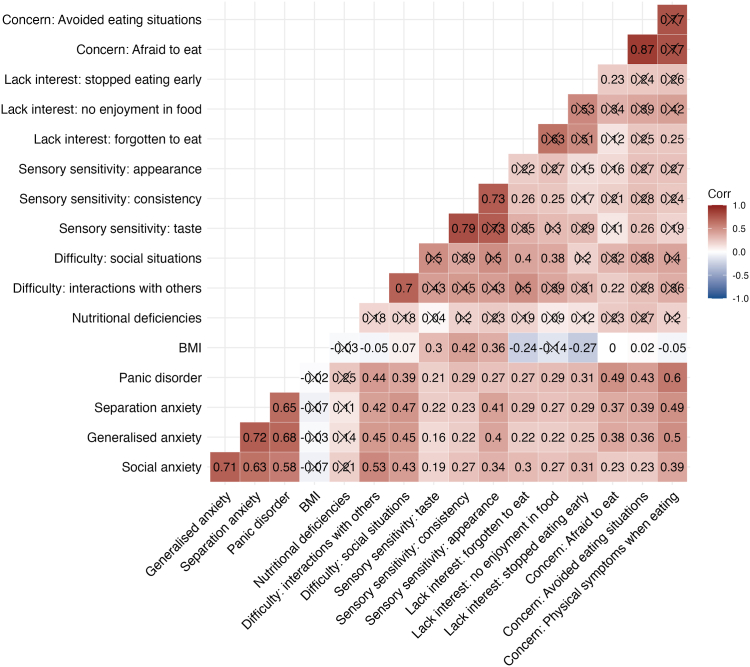
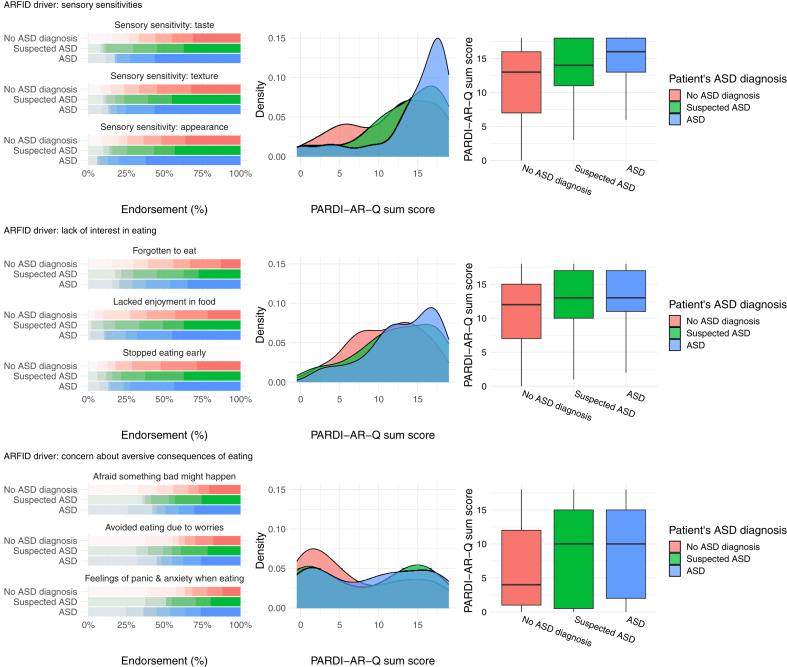
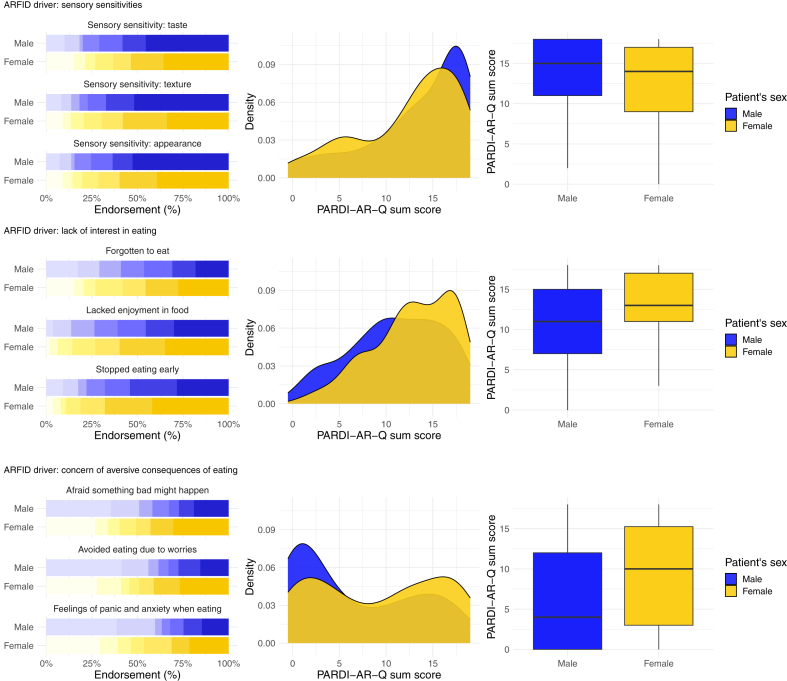
Symptoms across the three drivers 1) avoidance based on sensory characteristics of food; 2) apparent lack of interest in eating; and 3) concern about aversive consequences positively correlated with each other. Patients' anxiety traits showed the greatest positive correlations with symptoms of concern about aversive consequences of eating. Patient sex was not significantly associated with any of the three ARFID drivers. Patients with comorbid autism spectrum disorder (ASD; 28%) showed more food-related sensory sensitivities (RR = 1.26) and greater lack of interest in eating (RR = 1.18) than those of patients without ASD (49%).

INTERPRETATION

In our clinical sample, the ARFID drivers occurred together and did not show clinically meaningful differences between the sexes. ASD may accentuate food-related sensory sensitivities and lack of interest, but may not drive a completely different symptom presentation. ARFID is multi-faceted and heterogenous, requiring a comprehensive multidisciplinary assessment to sufficiently understand the drivers of the restrictive eating behaviour. Results need replication in larger samples with more statistical power.

FUNDING

None.

摘要

背景

回避性限制性食物摄入障碍(ARFID)是一种临床表现异质性的新型饮食障碍。目前尚不清楚哪些患者特征导致了其异质性。

方法

为了确定这些患者特征,我们在2019年11月至2022年7月期间于伦敦莫兹利儿童与青少年饮食障碍中心对多达261名ARFID患者(51%为女性;中位年龄 = 12.7岁)进行的横断面研究中,进行了症状水平的相关性分析和驱动因素水平的回归分析。

研究结果

在三个驱动因素方面的症状,即1)基于食物感官特征的回避;2)明显缺乏进食兴趣;3)对不良后果的担忧,相互之间呈正相关。患者的焦虑特质与对进食不良后果担忧的症状显示出最强的正相关。患者性别与ARFID的三个驱动因素均无显著关联。患有共病自闭症谱系障碍(ASD;28%)的患者比无ASD的患者(49%)表现出更多与食物相关的感官敏感性(相对风险 = 1.26)和对进食更大的缺乏兴趣(相对风险 = 1.18)。

解读

在我们的临床样本中,ARFID的驱动因素共同出现,且在性别之间未显示出具有临床意义的差异。ASD可能会加重与食物相关的感官敏感性和缺乏兴趣,但可能不会导致完全不同的症状表现。ARFID是多方面且异质的,需要进行全面的多学科评估,以充分理解限制性饮食行为的驱动因素。结果需要在具有更大统计效力的更大样本中进行重复验证。

资金来源

无。

https://cdn.ncbi.nlm.nih.gov/pmc/blobs/441e/10480549/ea661b8d32a8/gr3.jpg
https://cdn.ncbi.nlm.nih.gov/pmc/blobs/441e/10480549/3e71ffd3d471/gr1.jpg
https://cdn.ncbi.nlm.nih.gov/pmc/blobs/441e/10480549/9495b1376a17/gr2.jpg
https://cdn.ncbi.nlm.nih.gov/pmc/blobs/441e/10480549/ea661b8d32a8/gr3.jpg
https://cdn.ncbi.nlm.nih.gov/pmc/blobs/441e/10480549/3e71ffd3d471/gr1.jpg
https://cdn.ncbi.nlm.nih.gov/pmc/blobs/441e/10480549/9495b1376a17/gr2.jpg
https://cdn.ncbi.nlm.nih.gov/pmc/blobs/441e/10480549/ea661b8d32a8/gr3.jpg

相似文献

1
The clinical presentation of avoidant restrictive food intake disorder in children and adolescents is largely independent of sex, autism spectrum disorder and anxiety traits.儿童和青少年回避性限制性食物摄入障碍的临床表现很大程度上与性别、自闭症谱系障碍及焦虑特质无关。
EClinicalMedicine. 2023 Aug 30;63:102190. doi: 10.1016/j.eclinm.2023.102190. eCollection 2023 Sep.
2
The factor structure and validity of a diagnostic interview for avoidant/restrictive food intake disorder in a sample of children, adolescents, and young adults.在儿童、青少年和年轻成年人样本中,用于诊断回避/限制型食物摄入障碍的诊断访谈的因子结构和有效性。
Int J Eat Disord. 2022 Nov;55(11):1575-1588. doi: 10.1002/eat.23792. Epub 2022 Aug 18.
3
Eating behaviour, behavioural problems and sensory profiles of children with avoidant/restrictive food intake disorder (ARFID), autistic spectrum disorders or picky eating: Same or different?患有回避/限制型食物摄入障碍(ARFID)、自闭症谱系障碍或挑食的儿童的饮食行为、行为问题和感觉特征:相同还是不同?
Eur Psychiatry. 2019 Sep;61:56-62. doi: 10.1016/j.eurpsy.2019.06.008. Epub 2019 Jul 13.
4
Anticipatory and consummatory pleasure in avoidant/restrictive food intake disorder.回避/限制性食物摄入障碍中的预期性和满足性愉悦感。
J Eat Disord. 2023 Nov 10;11(1):198. doi: 10.1186/s40337-023-00921-w.
5
Clinical characteristics, treatment course and outcome of adults treated for avoidant/restrictive food intake disorder (ARFID) at a tertiary care eating disorders program.在一家三级医疗饮食失调项目中接受回避/限制性食物摄入障碍(ARFID)治疗的成年人的临床特征、治疗过程及结果
J Eat Disord. 2024 Jan 23;12(1):15. doi: 10.1186/s40337-024-00973-6.
6
The Sensory Profiles, Eating Behaviors, and Quality of Life of Children with Autism Spectrum Disorder and Avoidant/Restrictive Food Intake Disorder.自闭症谱系障碍及回避/限制型食物摄入障碍儿童的感觉特征、进食行为和生活质量。
Psychiatr Q. 2024 Mar;95(1):85-106. doi: 10.1007/s11126-023-10063-6. Epub 2023 Dec 12.
7
Avoidant/restrictive food intake disorder and severe food selectivity in children and young people with autism: A scoping review.自闭症儿童和青少年的回避/限制型食物摄入障碍和严重食物选择性:范围综述。
Dev Med Child Neurol. 2022 Jun;64(6):691-700. doi: 10.1111/dmcn.15139. Epub 2022 Feb 2.
8
Oxytocin response to food intake in avoidant/restrictive food intake disorder.进食回避/限制型进食障碍患者摄食诱导的催产素反应。
Eur J Endocrinol. 2023 Aug 2;189(2):149-155. doi: 10.1093/ejendo/lvad087.
9
Subtypes of avoidant/restrictive food intake disorder in children and adolescents: a latent class analysis.儿童和青少年回避/限制性食物摄入障碍的亚型:一项潜在类别分析。
EClinicalMedicine. 2024 Feb 1;68:102440. doi: 10.1016/j.eclinm.2024.102440. eCollection 2024 Feb.
10
Youth with Avoidant/Restrictive Food Intake Disorder: Examining Differences by Age, Weight Status, and Symptom Duration.青少年回避/限制型食物摄入障碍:按年龄、体重状况和症状持续时间的差异研究。
Nutrients. 2019 Aug 20;11(8):1955. doi: 10.3390/nu11081955.

引用本文的文献

1
Avoidant restrictive food intake disorder (ARFID) in Swedish preschool children: a screening study.瑞典学龄前儿童的回避性限制性食物摄入障碍(ARFID):一项筛查研究。
J Eat Disord. 2025 Aug 18;13(1):179. doi: 10.1186/s40337-025-01369-w.
2
Screening for Avoidant/Restrictive Food Intake Disorder Symptoms Among Autistic Adults: Measurement Invariance With a Comparison General Sample.自闭症成年人中回避/限制型食物摄入障碍症状的筛查:与一般对照样本的测量不变性
Autism Res. 2025 Apr 19. doi: 10.1002/aur.70039.
3
The Association of Avoidant/Restrictive Food Intake Disorder (ARFID) and Neurogastroenterology Disorders (Including Disorders of Gut-Brain Interaction [DGBI]): A Scoping Review.

本文引用的文献

1
What do we know about the epidemiology of avoidant/restrictive food intake disorder in children and adolescents? A systematic review of the literature.我们对儿童和青少年回避/限制型食物摄入障碍的流行病学了解多少?文献系统评价。
Eur Eat Disord Rev. 2023 Mar;31(2):226-246. doi: 10.1002/erv.2964. Epub 2022 Dec 16.
2
Depression, anxiety and PTSD symptoms before and during the COVID-19 pandemic in the UK.英国在 COVID-19 大流行前后的抑郁、焦虑和创伤后应激障碍症状。
Psychol Med. 2023 Sep;53(12):5428-5441. doi: 10.1017/S0033291722002501. Epub 2022 Jul 26.
3
Avoidant/restrictive food intake disorder and severe food selectivity in children and young people with autism: A scoping review.
回避/限制性食物摄入障碍(ARFID)与神经胃肠病学疾病(包括肠-脑相互作用障碍[DGBI])的关联:一项范围综述。
Neurogastroenterol Motil. 2025 Mar 30:e70039. doi: 10.1111/nmo.70039.
4
Prevalence, Phenotype, and Correlates of Avoidant/Restrictive Food Intake Disorder Symptoms in the Gulf Cooperation Council: An Underserved Region.海湾合作委员会中回避/限制型食物摄入障碍症状的患病率、表型及相关因素:一个未得到充分服务的地区
Int J Eat Disord. 2025 Jun;58(6):1060-1071. doi: 10.1002/eat.24400. Epub 2025 Mar 14.
5
Avoidant/restrictive food intake disorder (ARFID) symptoms in gender diverse adults and their relation to autistic traits, ADHD traits, and sensory sensitivities.性别多样化成年人的回避/限制性食物摄入障碍(ARFID)症状及其与自闭症特征、注意力缺陷多动障碍(ADHD)特征和感官敏感性的关系。
J Eat Disord. 2025 Feb 17;13(1):33. doi: 10.1186/s40337-025-01215-z.
6
Mental and Somatic Conditions in Children With the Broad Avoidant Restrictive Food Intake Disorder Phenotype.具有广泛回避性限制性摄食障碍表型的儿童的心理和躯体状况
JAMA Pediatr. 2025 Apr 1;179(4):428-437. doi: 10.1001/jamapediatrics.2024.6065.
7
Unraveling the Connections: Eating Issues, Microbiome, and Gastrointestinal Symptoms in Autism Spectrum Disorder.揭示关联:自闭症谱系障碍中的饮食问题、微生物群和胃肠道症状
Nutrients. 2025 Jan 29;17(3):486. doi: 10.3390/nu17030486.
8
The Co-Occurrence of Autism and Avoidant/Restrictive Food Intake Disorder (ARFID): A Prevalence-Based Meta-Analysis.自闭症与回避/限制性食物摄入障碍(ARFID)的共现:一项基于患病率的荟萃分析。
Int J Eat Disord. 2025 Mar;58(3):473-488. doi: 10.1002/eat.24369. Epub 2025 Jan 6.
9
Incidence of avoidant/restrictive food intake disorder in children and adolescents across the UK and Ireland: a BPSU and CAPSS surveillance study.英国和爱尔兰儿童和青少年回避/限制型食物摄入障碍的发生率:BPSU 和 CAPSS 监测研究。
BMJ Open. 2024 Nov 27;14(11):e088129. doi: 10.1136/bmjopen-2024-088129.
10
Assessing Fears of Negative Consequences in Children With Symptoms of Avoidant Restrictive Food Intake Disorder.评估患有回避性限制性食物摄入障碍症状儿童对负面后果的恐惧。
Int J Eat Disord. 2024 Dec;57(12):2329-2340. doi: 10.1002/eat.24303. Epub 2024 Nov 8.
自闭症儿童和青少年的回避/限制型食物摄入障碍和严重食物选择性:范围综述。
Dev Med Child Neurol. 2022 Jun;64(6):691-700. doi: 10.1111/dmcn.15139. Epub 2022 Feb 2.
4
Avoidant Restrictive Food Intake Disorder-What Are We Missing? What Are We Waiting for?回避性限制性食物摄入障碍——我们遗漏了什么?我们在等待什么?
JAMA Pediatr. 2021 Dec 1;175(12):e213858. doi: 10.1001/jamapediatrics.2021.3858. Epub 2021 Dec 6.
5
Incidence and Age- and Sex-Specific Differences in the Clinical Presentation of Children and Adolescents With Avoidant Restrictive Food Intake Disorder.儿童和青少年回避限制型食物摄入障碍的临床表现的发生率及年龄和性别差异。
JAMA Pediatr. 2021 Dec 1;175(12):e213861. doi: 10.1001/jamapediatrics.2021.3861. Epub 2021 Dec 6.
6
Avoidant/restrictive food intake disorder and autism spectrum disorder: clinical implications for assessment and management.回避/限制型食物摄入障碍与自闭症谱系障碍:评估和管理的临床意义。
Dev Med Child Neurol. 2022 Feb;64(2):176-182. doi: 10.1111/dmcn.14977. Epub 2021 Aug 17.
7
Avoidant/restrictive food intake disorder: Psychopathological similarities and differences in comparison to anorexia nervosa and the general population.回避/限制型食物摄入障碍:与神经性厌食症和普通人群相比的心理病理学异同。
Eur Eat Disord Rev. 2021 Mar;29(2):245-256. doi: 10.1002/erv.2815. Epub 2020 Dec 11.
8
Health professionals' familiarity and experience with providing clinical care for pediatric avoidant/restrictive food intake disorder.卫生专业人员提供儿科回避/限制型食物摄入障碍临床护理的熟悉程度和经验。
Int J Eat Disord. 2021 Apr;54(4):587-594. doi: 10.1002/eat.23438. Epub 2020 Dec 10.
9
Who is treating ARFID, and how? The need for training for community clinicians.谁在治疗回避性/restrictive食物摄入障碍(ARFID),以及如何治疗?社区临床医生的培训需求。
Eat Weight Disord. 2021 May;26(4):1279-1280. doi: 10.1007/s40519-020-01007-1. Epub 2020 Sep 14.
10
Avoidant/restrictive food intake disorder: A systematic scoping review of the current literature.回避/限制型食物摄入障碍:当前文献的系统范围综述。
Psychiatry Res. 2020 Jun;288:112961. doi: 10.1016/j.psychres.2020.112961. Epub 2020 Apr 4.