Do Anh N, Ali Muhammad, Timsina Jigyasha, Wang Lihua, Western Daniel, Liu Menghan, Sanford Jessie, Rosende-Roca Matitee, Boada Merce, Puerta Raquel, Wilson Ted, Ruiz Agustin, Pastor Pau, Wyss-Coray Tony, Cruchaga Carlos, Sung Yun Ju
Division of Biostatistics, Washington University School of Medicine, St. Louis, MO, USA.
NeuroGenomics and Informatics Center, Washington University School of Medicine, St. Louis, MO, USA.
medRxiv. 2024 Mar 16:2024.03.15.24304164. doi: 10.1101/2024.03.15.24304164.
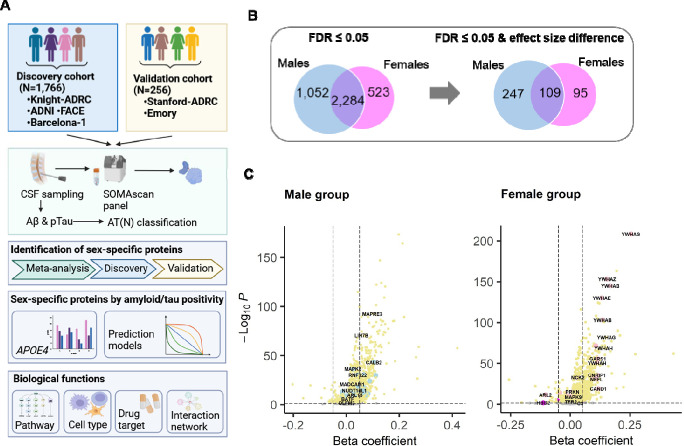
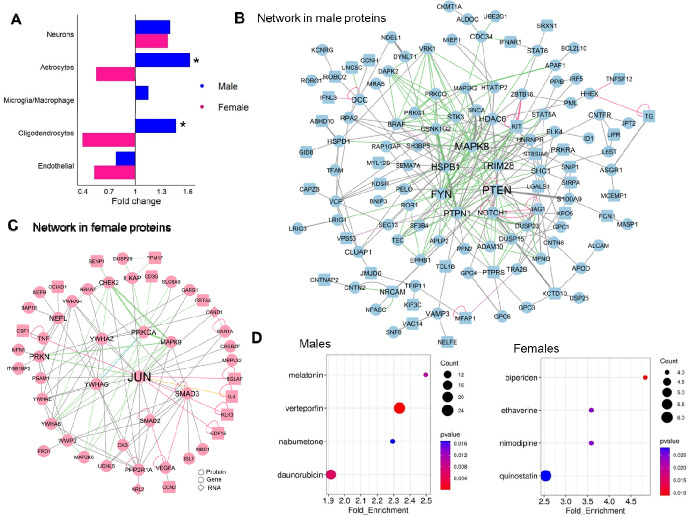
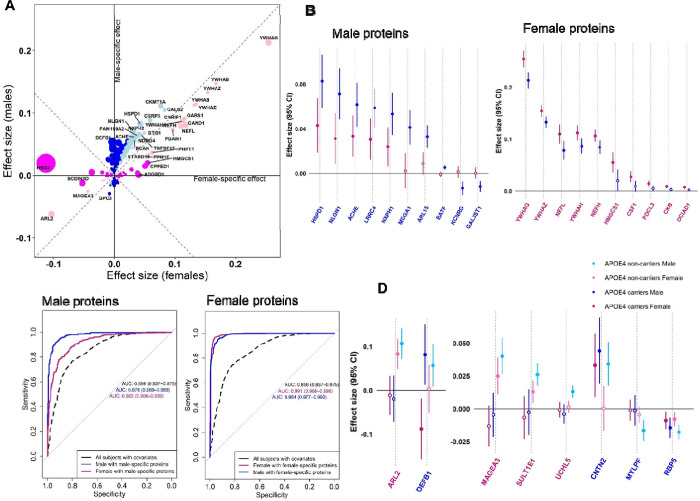
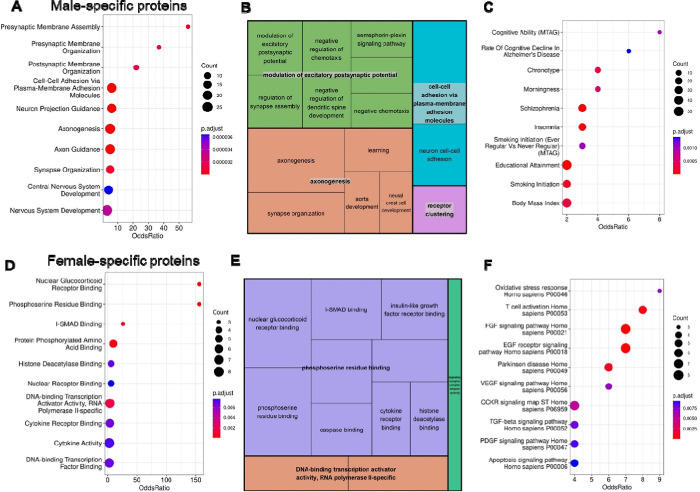
In Alzheimer's disease (AD), the most common cause of dementia, females have higher prevalence and faster progression, but sex-specific molecular findings in AD are limited. Here, we comprehensively examined and validated 7,006 aptamers targeting 6,162 proteins in cerebral spinal fluid (CSF) from 2,077 amyloid/tau positive cases and controls to identify sex-specific proteomic signatures of AD. In discovery (N=1,766), we identified 330 male-specific and 121 female-specific proteomic alternations in CSF (FDR <0.05). These sex-specific proteins strongly predicted amyloid/tau positivity (AUC=0.98 in males; 0.99 in females), significantly higher than those with age, sex, and APOE-ε4 (AUC=0.85). The identified sex-specific proteins were well validated (r≥0.5) in the Stanford study (N=108) and Emory study (N=148). Biological follow-up of these proteins led to sex differences in cell-type specificity, pathways, interaction networks, and drug targets. Male-specific proteins, enriched in astrocytes and oligodendrocytes, were involved in postsynaptic and axon-genesis. The male network exhibited direct connections among 152 proteins and highlighted PTEN, NOTCH1, FYN, and MAPK8 as hubs. Drug target suggested melatonin (used for sleep-wake cycle regulation), nabumetone (used for pain), daunorubicin, and verteporfin for treating AD males. In contrast, female-specific proteins, enriched in neurons, were involved in phosphoserine residue binding including cytokine activities. The female network exhibits strong connections among 51 proteins and highlighted JUN and 14-3-3 proteins (YWHAG and YWHAZ) as hubs. Drug target suggested biperiden (for muscle control of Parkinson's disease), nimodipine (for cerebral vasospasm), quinostatin and ethaverine for treating AD females. Together, our findings provide mechanistic understanding of sex differences for AD risk and insights into clinically translatable interventions.
在痴呆症最常见的病因阿尔茨海默病(AD)中,女性的患病率更高且病情进展更快,但AD中性别特异性的分子研究结果有限。在此,我们全面检测并验证了针对2077例淀粉样蛋白/ tau蛋白阳性病例和对照的脑脊液(CSF)中6162种蛋白质的7006种适体,以确定AD的性别特异性蛋白质组特征。在发现阶段(N = 1766),我们在脑脊液中鉴定出330种男性特异性和121种女性特异性蛋白质组变化(FDR <0.05)。这些性别特异性蛋白质能强烈预测淀粉样蛋白/ tau蛋白阳性(男性AUC = 0.98;女性AUC = 0.99),显著高于年龄、性别和APOE-ε4所对应的预测能力(AUC = 0.85)。所鉴定出的性别特异性蛋白质在斯坦福大学研究(N = 108)和埃默里大学研究(N = 148)中得到了很好的验证(r≥0.5)。对这些蛋白质的生物学追踪揭示了细胞类型特异性、信号通路、相互作用网络和药物靶点方面的性别差异。男性特异性蛋白质在星形胶质细胞和少突胶质细胞中富集,参与突触后和轴突生成。男性网络显示152种蛋白质之间存在直接联系,并突出显示PTEN、NOTCH1、FYN和MAPK8为枢纽。药物靶点提示褪黑素(用于调节睡眠-觉醒周期)、萘丁美酮(用于止痛)、柔红霉素和维替泊芬可用于治疗男性AD患者。相比之下,女性特异性蛋白质在神经元中富集,参与包括细胞因子活性在内的磷酸丝氨酸残基结合。女性网络在51种蛋白质之间表现出强烈联系,并突出显示JUN和14-3-3蛋白(YWHAG和YWHAZ)为枢纽。药物靶点提示安坦(用于帕金森病的肌肉控制)、尼莫地平(用于脑血管痉挛)、喹诺他汀和依沙维林可用于治疗女性AD患者。总之,我们的研究结果为AD风险的性别差异提供了机制性理解,并为临床可转化干预提供了见解。