Ly Ngoc Bao, Kim Yoo Ri, Lee Ki Hong, Yoon Namsik, Park Hyung Wook
Department of Internal Medicine, Chonnam National University Medical School, Gwangju, Republic of Korea.
Department of Cardiovascular Medicine, Chonnam National University Hospital, Gwangju, Republic of Korea.
Front Cardiovasc Med. 2024 Mar 15;11:1334096. doi: 10.3389/fcvm.2024.1334096. eCollection 2024.
Brugada syndrome (BrS) is a channelopathy that can lead to sudden cardiac death in the absence of structural heart disease. Patients with BrS can be asymptomatic or present with symptoms secondary to polymorphic ventricular tachycardia or ventricular fibrillation. Even though BrS can exhibit autosomal dominant inheritance, it is not easy to identify the phenotype and genotype in a family thoroughly.
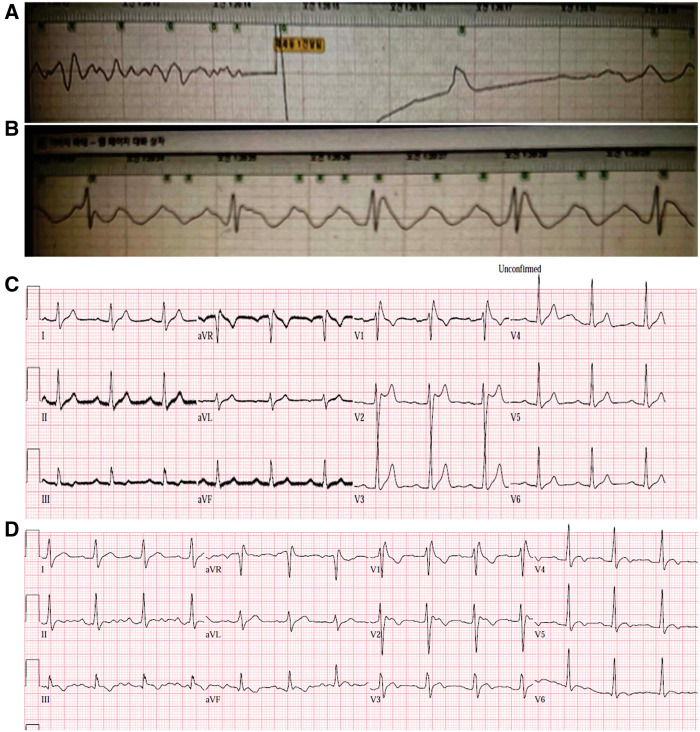
We report the case of a 20-year-old man with variants in and genes who was resuscitated from sudden cardiac death during sleep due to a ventricular fibrillation. The patient did not have underlying diseases. The routine laboratory results, imaging study, coronary angiogram, and echocardiogram (ECG) were normal. A type 1 BrS pattern was identified in one resting ECG. Furthermore, prominent J wave accentuation with PR interval prolongation was identified during therapeutic hypothermia. Therefore, we were easily able to diagnose BrS. For secondary prevention, the patient underwent implantable cardioverter defibrillator implantation. Before discharge, a genetic study was performed using next-generation sequencing. Genotyping was performed in the first-degree relatives, and ECG evaluations of almost all maternal and paternal family members were conducted. The proband and his mother showed and variants However, his mother did not show the BrS phenotype on an ECG. One maternal aunt and uncle showed BrS phenotypes.
Genetics alone cannotdiagnose BrS. However, genetics could supply evidence or direction for evaluating ECG phenotypes in family groups. This case report shows how family evaluation using ECGs along with a genetic study can be used in BrS diagnosis.
Brugada综合征(BrS)是一种离子通道病,可在无结构性心脏病的情况下导致心源性猝死。BrS患者可能无症状,或出现多形性室性心动过速或心室颤动继发的症状。尽管BrS可表现为常染色体显性遗传,但在一个家族中彻底识别其表型和基因型并不容易。
我们报告了一名20岁男性患者的病例,该患者的 和 基因存在变异,因睡眠期间心室颤动导致心源性猝死,后经复苏成功。患者无基础疾病。常规实验室检查结果、影像学检查、冠状动脉造影和超声心动图(ECG)均正常。一份静息心电图显示为1型BrS模式。此外,在治疗性低温期间发现明显的J波增强伴PR间期延长。因此,我们很容易诊断出BrS。为进行二级预防,患者接受了植入式心律转复除颤器植入术。出院前,使用下一代测序技术进行了基因研究。对一级亲属进行了基因分型,并对几乎所有母系和父系家庭成员进行了ECG评估。先证者及其母亲显示出 和 基因变异。然而,他的母亲在ECG上未表现出BrS表型。一位姨妈和一位舅舅表现出BrS表型。
仅靠遗传学不能诊断BrS。然而,遗传学可为评估家族群体中的ECG表型提供证据或方向。本病例报告展示了如何将ECG家族评估与基因研究一起用于BrS诊断。