Swart Daniël H, de Haan Martin, Stevens Jasper, Henning Rob H, Adel Sovan, van der Graaf Adrianus C, Ulu Nadir, Touw Daan J, Krenning Guido
Department of Clinical Pharmacy and Pharmacology, University of Groningen, University Medical Center Groningen, Hanzeplein 1, Groningen 9713GZ, the Netherlands.
Sulfateq B.V., Admiraal de Ruyterlaan 5, Groningen 9726GN, the Netherlands.
Toxicol Rep. 2024 Mar 19;12:345-355. doi: 10.1016/j.toxrep.2024.03.009. eCollection 2024 Jun.
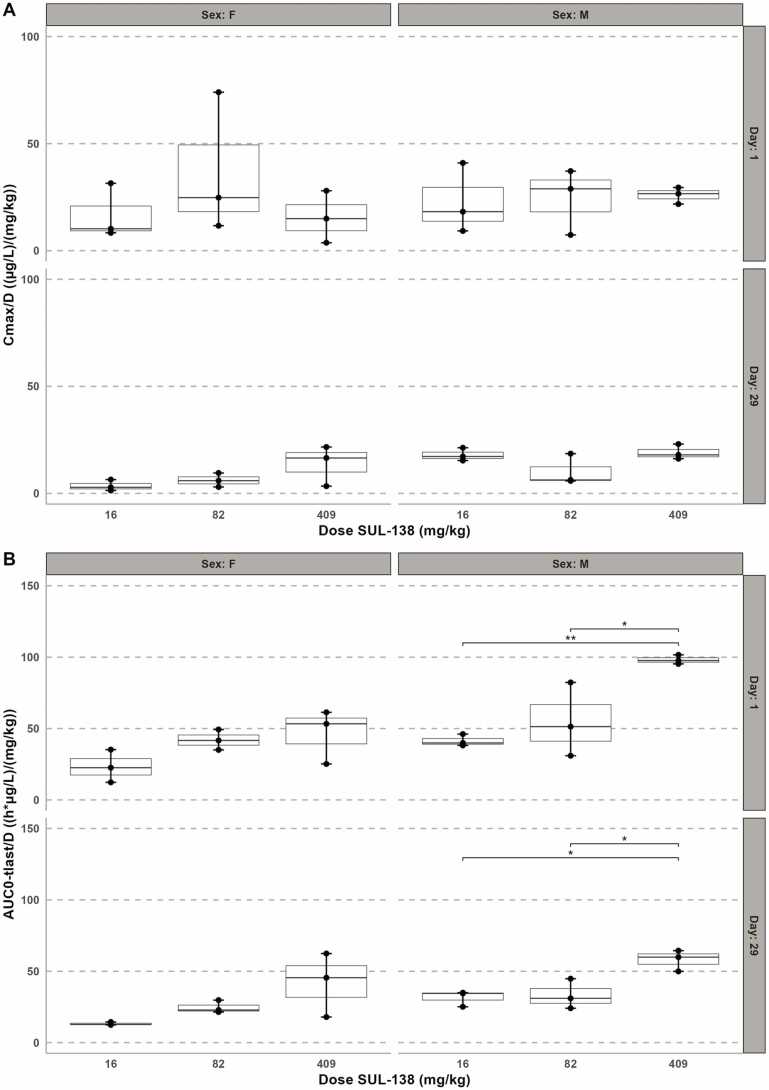
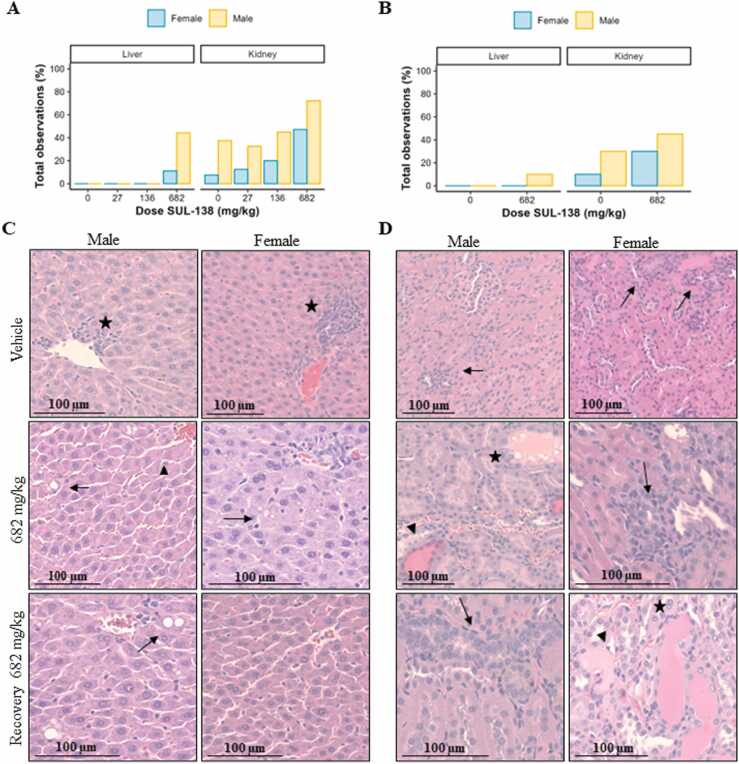
Noncommunicable Chronic Diseases (NCD) are a socioeconomic burden and considered one of the major health challenges for coming decades. Mitochondrial dysfunction has been implicated mechanistically in their pathophysiology. Therefore, targeting mitochondria holds great promise to improve clinical outcomes in NCDs. SUL-138, an orally bioavailable small molecule efficacious from 0.5 mg/kg, improves mitochondrial function during disease in several preclinical animal models. As preparation for a First-in-Human (FIH) trial, SUL-138 was investigated in 30-day GLP repeated dose toxicity studies in rat and minipig, selected based on their comparability with human metabolism, to determine toxicokinetics, potential toxicity and its reversibility. Rats were allocated to either vehicle, 27, 136 or 682 mg/kg SUL-138 dose groups and minipigs were allocated to either vehicle, 16, 82 or 409 mg/kg. Treatment occurred orally for 30 days followed by a recovery period of 14 days. During these studies clinical observations, toxicokinetic, clinical pathology, necropsy and histopathology evaluations were performed. There was significant systemic exposure to SUL-138 and toxicokinetics was characterized by a rapid absorption and elimination. In the rat, toxicokinetics was dose-proportional and AUC ratios in both species indicated that SUL-138 does not accumulate . No treatment-related adverse effects were observed for dose levels up to 136 and 82 mg/kg/day in rat and minipig respectively. In conclusion, these preclinical studies demonstrate that SUL-138 is well tolerated after repeated administration in rat and minipig, with NOAELs of 136 and 82 mg/kg/day, respectively.
非传染性慢性病(NCD)是一种社会经济负担,被认为是未来几十年主要的健康挑战之一。线粒体功能障碍在其病理生理学机制中具有重要作用。因此,针对线粒体有望改善非传染性慢性病的临床结局。SUL-138是一种口服生物利用度高的小分子,在0.5mg/kg时即有效,在几种临床前动物模型的疾病过程中可改善线粒体功能。作为首次人体试验(FIH)的准备工作,基于大鼠和小型猪与人类代谢的可比性,在30天的GLP重复剂量毒性研究中对SUL-138进行了研究,以确定毒代动力学、潜在毒性及其可逆性。将大鼠分为赋形剂组、27、136或682mg/kg SUL-138剂量组,将小型猪分为赋形剂组、16、82或409mg/kg剂量组。口服给药30天,随后有14天的恢复期。在这些研究过程中,进行了临床观察、毒代动力学、临床病理学、尸检和组织病理学评估。SUL-138有显著的全身暴露,其毒代动力学特征为快速吸收和消除。在大鼠中,毒代动力学呈剂量正比关系,两个物种的AUC比值均表明SUL-138不会蓄积。在大鼠和小型猪中,分别在高达136和82mg/kg/天的剂量水平下未观察到与治疗相关的不良反应。总之,这些临床前研究表明,SUL-138在大鼠和小型猪重复给药后耐受性良好,无观察到不良反应的最高剂量分别为136和82mg/kg/天。