Yazdani Akram, Samms-Vaughan Maureen, Saroukhani Sepideh, Bressler Jan, Hessabi Manouchehr, Tahanan Amirali, Grove Megan L, Gangnus Tanja, Putluri Vasanta, Mostafa Kamal Abu Hena, Putluri Nagireddy, Loveland Katherine A, Rahbar Mohammad H
Division of Clinical and Translational Sciences, Department of Internal Medicine, McGovern Medical School, The University of Texas Health Science Center at Houston, Houston, Texas, USA.
Biostatistics/Epidemiology/Research Design (BERD) Component, Center for Clinical and Translational Sciences (CCTS), The University of Texas Health Science Center at Houston, Houston, Texas, USA.
ArXiv. 2024 Mar 11:arXiv:2403.07147v1.
Autism spectrum disorder (ASD) is a complex neurodevelopmental condition with a wide range of behavioral and cognitive impairments. While genetic and environmental factors are known to contribute to its etiology, the underlying metabolic perturbations associated with ASD which can potentially connect genetic and environmental factors, remain poorly understood. Therefore, we conducted a metabolomic case-control study and performed a comprehensive analysis to identify significant alterations in metabolite profiles between children with ASD and typically developing (TD) controls.
To elucidate potential metabolomic signatures associated with ASD in children and identify specific metabolites that may serve as biomarkers for the disorder.
We conducted metabolomic profiling on plasma samples from participants in the second phase of Epidemiological Research on Autism in Jamaica (ERAJ-2), which was a 1:1 age (±6 months)-and sex-matched cohort of 200 children with ASD and 200 TD controls (2-8 years old). Using high-throughput liquid chromatography-mass spectrometry techniques, we performed a targeted metabolite analysis, encompassing amino acids, lipids, carbohydrates, and other key metabolic compounds. After quality control and imputation of missing values, we performed univariable and multivariable analysis using normalized metabolites while adjusting for covariates, age, sex, socioeconomic status, and child's parish of birth.
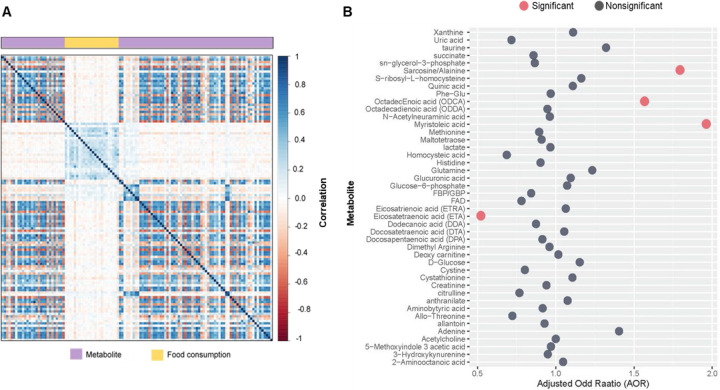
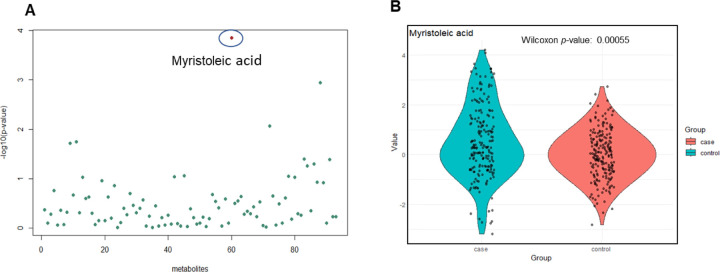
Our findings revealed unique metabolic patterns in children with ASD for four metabolites compared to TD controls. Notably, three of these metabolites were fatty acids, including myristoleic acid, eicosatetraenoic acid, and octadecenoic acid. Additionally, the amino acid sarcosine exhibited a significant association with ASD.
These findings highlight the role of metabolites in the etiology of ASD and suggest opportunities for the development of targeted interventions.
自闭症谱系障碍(ASD)是一种复杂的神经发育疾病,伴有广泛的行为和认知障碍。虽然已知遗传和环境因素对其病因有影响,但与ASD相关的潜在代谢紊乱(可能将遗传和环境因素联系起来)仍知之甚少。因此,我们进行了一项代谢组学病例对照研究,并进行了全面分析,以确定ASD儿童与正常发育(TD)对照儿童之间代谢物谱的显著变化。
阐明与儿童ASD相关的潜在代谢组学特征,并确定可能作为该疾病生物标志物的特定代谢物。
我们对牙买加自闭症流行病学研究第二阶段(ERAJ - 2)参与者的血浆样本进行了代谢组学分析,该研究是一个年龄(±6个月)和性别匹配的队列,包括200名ASD儿童和200名TD对照儿童(2至8岁)。使用高通量液相色谱 - 质谱技术,我们进行了靶向代谢物分析,涵盖氨基酸、脂质、碳水化合物和其他关键代谢化合物。在对缺失值进行质量控制和插补后,我们使用标准化代谢物进行单变量和多变量分析,同时调整协变量、年龄、性别、社会经济地位和儿童出生教区。
我们的研究结果显示,与TD对照相比,ASD儿童中有四种代谢物呈现出独特的代谢模式。值得注意的是,其中三种代谢物是脂肪酸,包括肉豆蔻油酸、二十碳四烯酸和十八碳烯酸。此外,氨基酸肌氨酸与ASD存在显著关联。
这些发现突出了代谢物在ASD病因中的作用,并为开发靶向干预措施提供了机会。