Sotelo-Orozco Jennie, Abbeduto Leonard, Hertz-Picciotto Irva, Slupsky Carolyn M
Department of Public Health Sciences, University of California, Davis, Davis, CA, United States.
Department of Psychiatry and Behavioral Sciences, University of California Davis Health, Sacramento, CA, United States.
Front Psychiatry. 2020 Dec 22;11:579538. doi: 10.3389/fpsyt.2020.579538. eCollection 2020.
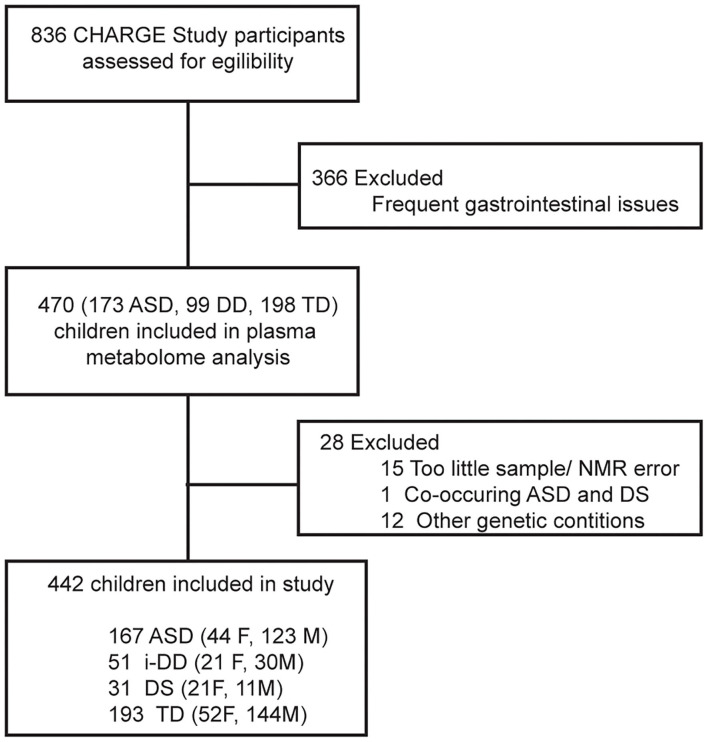
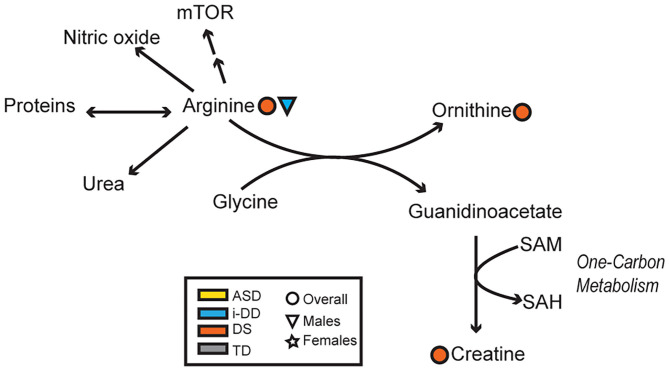
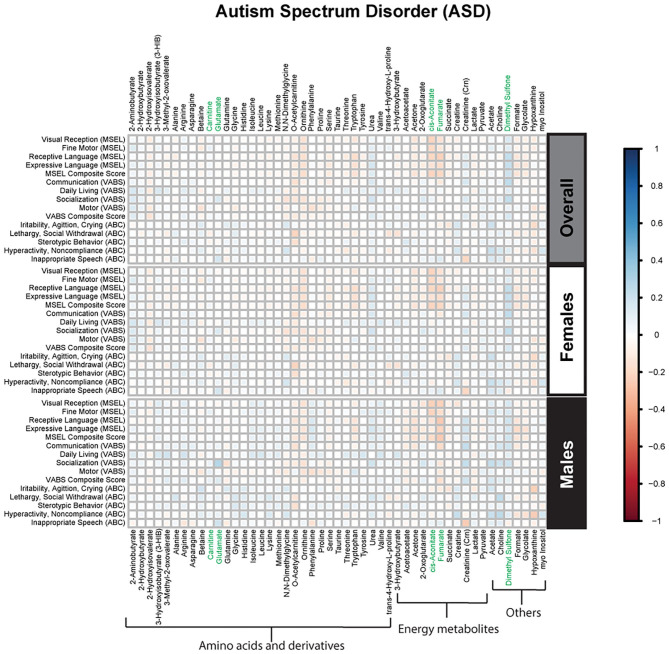
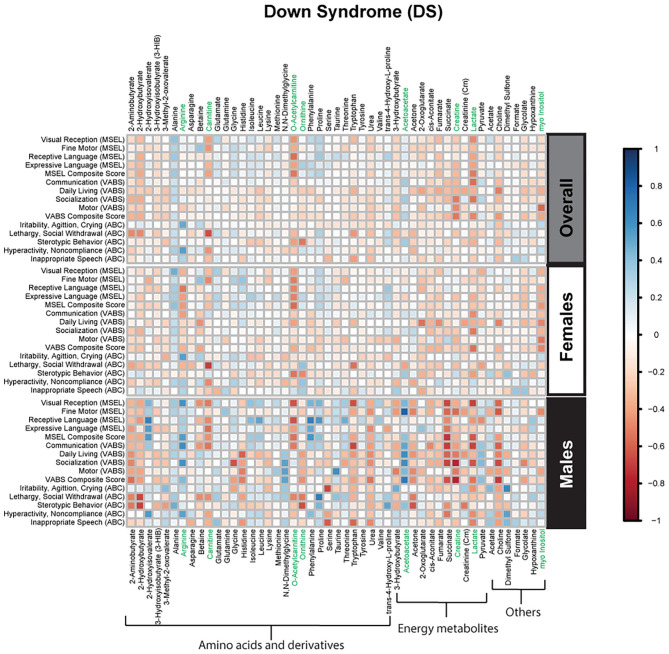
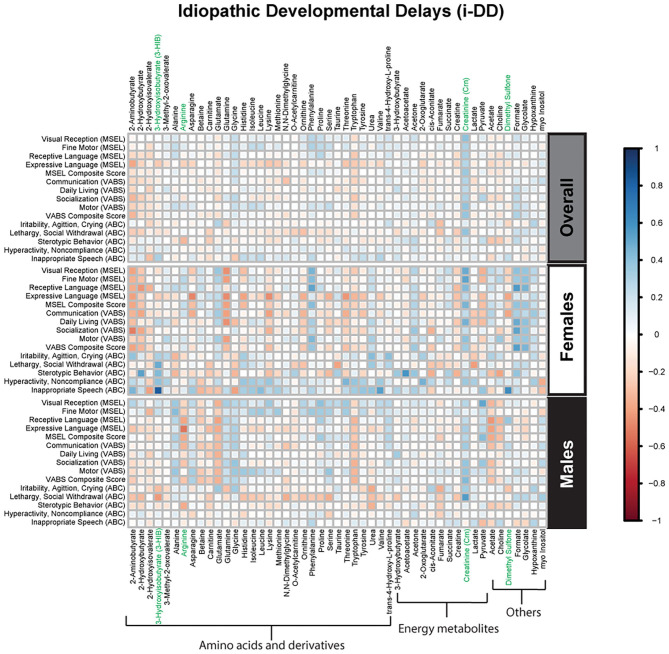
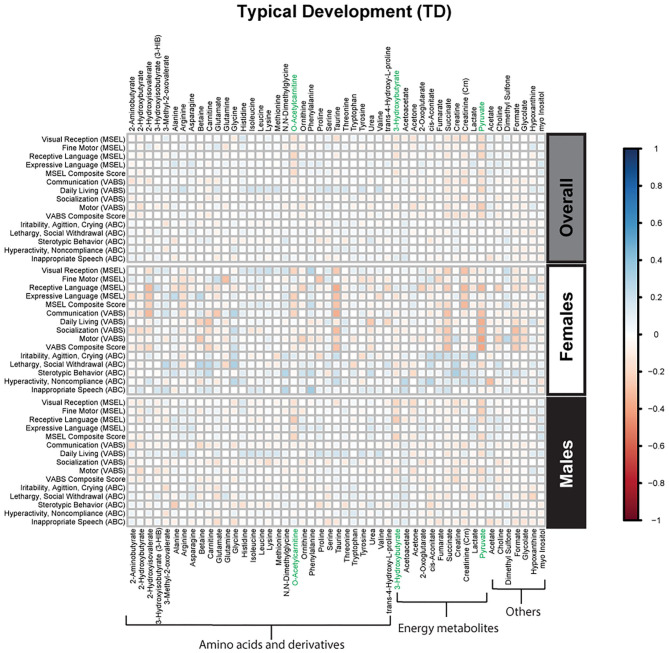
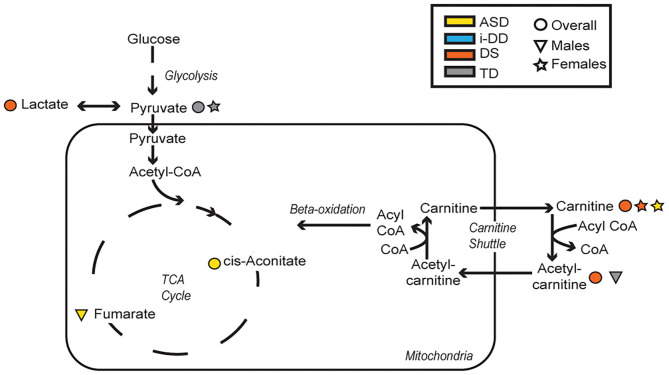
Developmental disabilities are defined by delays in learning, language, and behavior, yet growing evidence has revealed disturbances in metabolic systems that may also be present. Little is known about whether these metabolic issues contribute to the symptoms or severity of these disabilities, or whether sex plays a role in these associations, given that boys are disproportionately affected by some developmental disabilities. Here we sought to investigate the correlation between psychometric scores, sex, and the plasma metabolome. The plasma metabolomes of children with autism spectrum disorder (ASD; = 167), idiopathic developmental delay (i-DD; = 51), Down syndrome (DS; = 31), and typically developing controls (TD; = 193) were investigated using NMR spectroscopy. Spearman rank correlations and multiple linear regression models (adjusted for child's neurodevelopmental diagnosis, child's sex, child's age, child's race/ethnicity, maternal age at child's birth, and parental homeownership) were used to examine the association between plasma metabolites and sex in relation to psychometric measures of cognitive skills, adaptive behavior, and maladaptive behavior in our study population. Higher levels of metabolites involved in cellular energy and mitochondrial function among children with ASD (fumarate and cis-aconitate), DS (lactate), and TD (pyruvate) are associated with poorer cognitive and adaptive subscales. Similarly, higher o-acetylcarnitine associated with deficits in cognitive subscales among all DS cases and TD boys, and carnitine correlated with increased maladaptive behavior among girls with ASD and girls with DS. Among children with DS, elevated myo-inositol, ornithine, and creatine correlated with poorer scores across several subscales. Even among TD cases, elevated 3-hydroxybutyrate correlated with decreased receptive language. In contrast, higher levels of glutamate were associated with better socialization skills among ASD cases. Even after adjusting for the child's neurodevelopmental diagnosis, sex, and other possible confounders, key metabolites including glycolysis metabolites (lactate and pyruvate), ketone bodies (3-hydroxybutyrate and acetoacetate), TCA cycle metabolites (cis-aconitate and fumarate), as well as ornithine were associated with deficits in multiple domains of cognitive function, adaptive skills, and aberrant behaviors. Our results highlight that some plasma metabolites may relate to specific functional subdomains within cognitive, adaptive, and behavioral development with some variation by diagnosis and sex.
发育障碍是由学习、语言和行为方面的延迟所定义的,但越来越多的证据表明,代谢系统中也可能存在紊乱。鉴于男孩受某些发育障碍的影响比例过高,对于这些代谢问题是否会导致这些障碍的症状或严重程度,或者性别在这些关联中是否起作用,我们知之甚少。在这里,我们试图研究心理测量分数、性别与血浆代谢组之间的相关性。我们使用核磁共振波谱法研究了自闭症谱系障碍(ASD;n = 167)、特发性发育延迟(i-DD;n = 51)、唐氏综合征(DS;n = 31)以及发育正常的对照组(TD;n = 193)儿童的血浆代谢组。我们使用斯皮尔曼等级相关性和多元线性回归模型(根据儿童的神经发育诊断、儿童性别、儿童年龄、儿童种族/民族、儿童出生时母亲的年龄以及父母的房屋所有权进行调整)来检验血浆代谢物与性别之间的关联,以及它们与我们研究人群中认知技能、适应性行为和适应不良行为的心理测量指标之间的关系。在患有ASD(富马酸盐和顺乌头酸盐)、DS(乳酸盐)和TD(丙酮酸盐)的儿童中,参与细胞能量和线粒体功能的代谢物水平较高与较差的认知和适应性子量表得分相关。同样,在所有DS病例和TD男孩中,较高的O-乙酰肉碱与认知子量表缺陷相关,而肉碱与患有ASD的女孩和患有DS的女孩中增加的适应不良行为相关。在患有DS的儿童中,肌醇、鸟氨酸和肌酸水平升高与多个子量表的较差得分相关。即使在TD病例中,较高的3-羟基丁酸盐与接受性语言能力下降相关。相比之下,在患有ASD的儿童中,较高水平的谷氨酸与更好的社交技能相关。即使在对儿童的神经发育诊断、性别和其他可能的混杂因素进行调整之后,关键代谢物,包括糖酵解代谢物(乳酸盐和丙酮酸盐)、酮体(3-羟基丁酸盐和乙酰乙酸盐)、三羧酸循环代谢物(顺乌头酸盐和富马酸盐)以及鸟氨酸,仍与认知功能、适应技能和异常行为的多个领域的缺陷相关。我们的结果强调,一些血浆代谢物可能与认知、适应和行为发育中的特定功能子领域相关,并且在诊断和性别方面存在一些差异。