Karaman Nilay, Düzkalir Ali Haluk, Askeroglu Mehmet Orbay, Senturk Yunus Emre, Samanci Yavuz, Peker Selcuk
1School of Medicine, Istanbul University-Cerrahpasa, Istanbul, Türkiye.
2Department of Neurosurgery, Koç University Hospital, Gamma Knife Center, Istanbul, Türkiye.
J Neurosurg Case Lessons. 2024 Apr 1;7(14). doi: 10.3171/CASE2437.
Eagle syndrome, an uncommon condition, causes symptoms due to neural and/or vascular compression from an elongated styloid process or calcified stylohyoid ligament and can also complicate other planned surgical procedures.
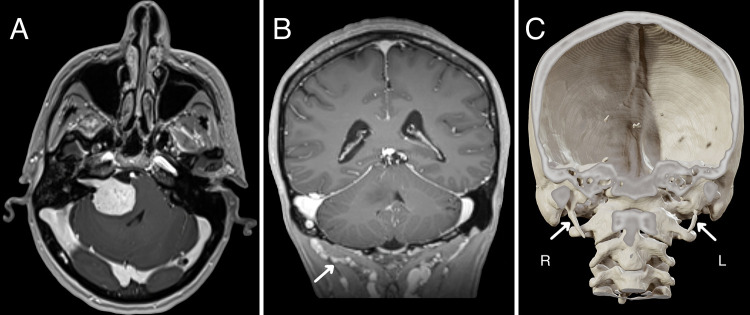
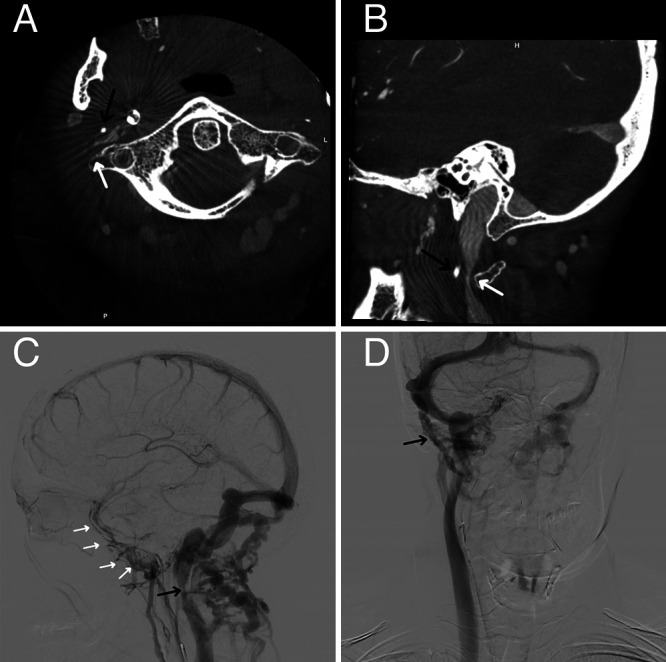
A 42-year-old female with loss of balance, dizziness, and ataxic gait underwent cranial magnetic resonance imaging (MRI), revealing a right-sided Koos grade IV vestibular schwannoma. Initially, a retrosigmoid craniotomy for tumor resection was planned. However, preoperative MRI and computed tomography (CT) showed a dilated right-sided mastoid emissary vein, tortuous scalp and paraspinal veins, and bilateral elongated styloid processes. CT angiography and digital subtraction angiography indicated Eagle syndrome-related compression of both internal jugular veins and concurrent occlusion of the left internal jugular vein at the jugular foramen. Consequently, given the risk of damaging venous structures, Gamma Knife radiosurgery was chosen over resection.
This case highlights the importance of adapting treatment plans based on patient-specific anatomical and pathological factors. In situations in which traditional surgery poses risks to sensitive structures such as the venous system, alternative approaches like radiosurgery offer safer yet effective options. Comprehensive risk-benefit evaluations are crucial for such decisions.
鹰综合征是一种罕见疾病,因茎突过长或茎突舌骨韧带钙化导致神经和/或血管受压而引发症状,且还可能使其他 planned 手术操作变得复杂。
一名42岁女性,出现平衡失调、头晕和共济失调步态,接受了头颅磁共振成像(MRI)检查,发现右侧有一枚库斯四级前庭神经鞘瘤。最初计划采用乙状窦后开颅术切除肿瘤。然而,术前MRI和计算机断层扫描(CT)显示右侧乳突导静脉扩张、头皮和椎旁静脉迂曲,以及双侧茎突过长。CT血管造影和数字减影血管造影显示鹰综合征导致双侧颈内静脉受压,且左侧颈内静脉在颈静脉孔处同时闭塞。因此,鉴于存在损伤静脉结构的风险,选择了伽玛刀放射外科治疗而非切除术。
本病例凸显了根据患者特定的解剖和病理因素调整治疗方案的重要性。在传统手术对静脉系统等敏感结构构成风险的情况下,放射外科等替代方法提供了更安全且有效的选择。全面的风险效益评估对于此类决策至关重要。