Faculty of Medicine, University of Helsinki, Helsinki, Finland.
Population Health Research Institute, McMaster University, Hamilton, Ontario, Canada.
JAMA Netw Open. 2024 Apr 1;7(4):e244581. doi: 10.1001/jamanetworkopen.2024.4581.
Although major bleeding is among the most common and prognostically important perioperative complications, the relative timing of bleeding events is not well established. This information is critical for preventing bleeding complications and for informing the timing of pharmacologic thromboprophylaxis.
To determine the timing of postoperative bleeding among patients undergoing surgery for up to 30 days after surgery.
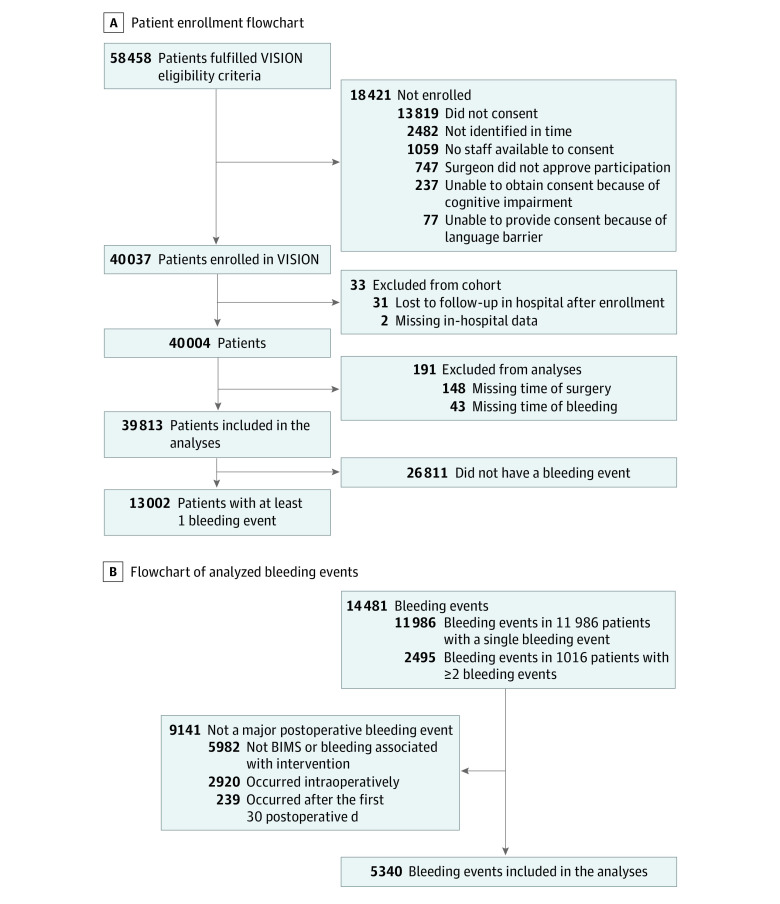
DESIGN, SETTING, AND PARTICIPANTS: This is a secondary analysis of a prospective cohort study. Patients aged 45 years or older who underwent inpatient noncardiac surgery were recruited in 14 countries between 2007 and 2013, with follow-up until December 2014. Data analysis was performed from June to July 2023.
Noncardiac surgery requiring overnight hospital admission.
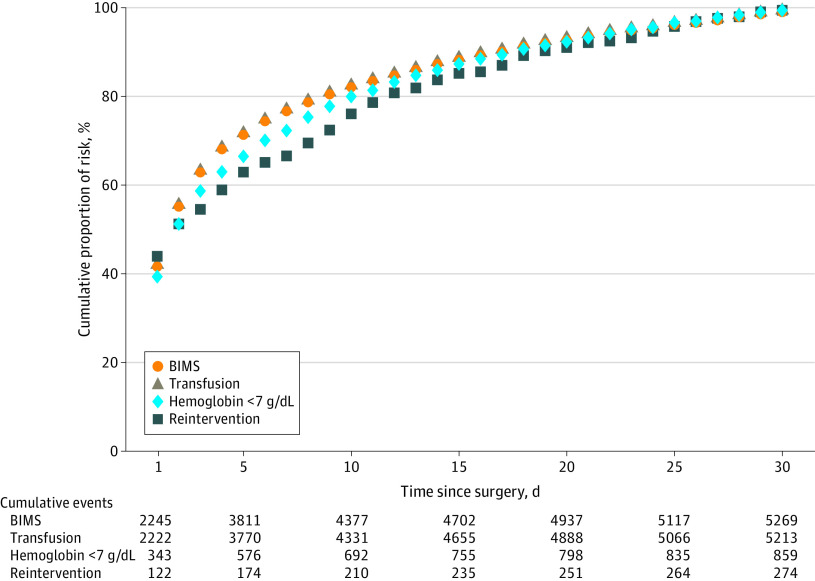
The primary outcome (postoperative major bleeding) was a composite of the timing of the following bleeding outcomes: (1) bleeding leading to transfusion, (2) bleeding leading to a postoperative hemoglobin level less than 7 g/dL, (3) bleeding leading to death, and (4) bleeding associated with reintervention. Each of the components of the composite primary outcome (1-4) and bleeding independently associated with mortality after noncardiac surgery, which was defined as a composite of outcomes 1 to 3, were secondary outcomes.
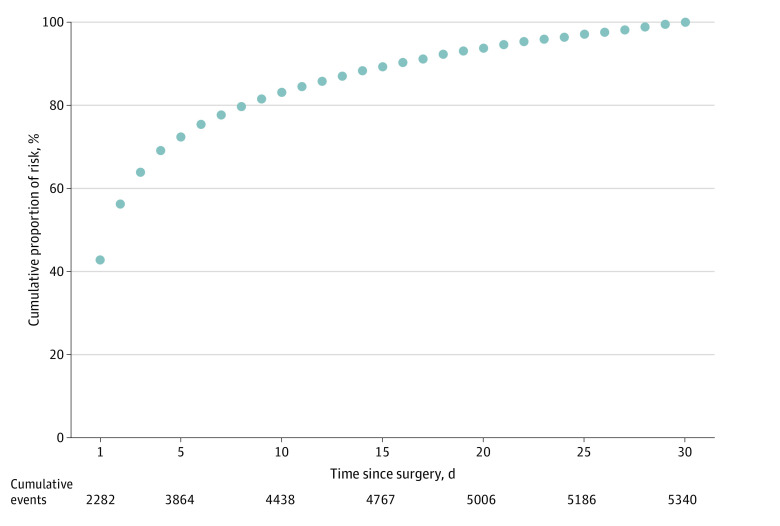
Among 39 813 patients (median [IQR] age, 63.0 [54.8-72.5] years; 19 793 women [49.7%]), there were 5340 major bleeding events (primary outcome) in 4638 patients (11.6%) within the first 30 days after surgery. Of these events, 42.7% (95% CI, 40.9%-44.6%) occurred within 24 hours after surgery, 77.7% (95% CI, 75.8%-79.5%) by postoperative day 7, 88.3% (95% CI, 86.5%-90.2%) by postoperative day 14, and 94.6% (95% CI, 92.7%-96.5%) by postoperative day 21. Within 48 hours of surgery, 56.2% of major bleeding events, 56.2% of bleeding leading to transfusion, 56.1% of bleeding independently associated with mortality after noncardiac surgery, 51.8% of bleeding associated with hemoglobin less than 7 g/dL, and 51.8% of bleeding associated with reintervention had occurred.
In this cohort study, of the major postoperative bleeding events in the first 30 days, more than three-quarters occurred during the first postoperative week. These findings are useful for researchers for the planning future clinical research and for clinicians in prevention of bleeding-related surgical complications and in decision-making regarding starting of pharmacologic thromboprophylaxis after surgery.
尽管大出血是围手术期最常见和预后最重要的并发症之一,但出血事件的相对时间尚不清楚。这些信息对于预防出血并发症和告知术后药物预防血栓形成的时机至关重要。
确定接受手术治疗的患者在术后 30 天内的术后出血时间。
设计、地点和参与者:这是一项前瞻性队列研究的二次分析。2007 年至 2013 年间,在 14 个国家招募了年龄在 45 岁及以上、需要住院过夜的非心脏手术患者,并随访至 2014 年 12 月。数据分析于 2023 年 6 月至 7 月进行。
需要住院过夜的非心脏手术。
主要结局(术后大出血)是以下出血结局的时间组合:(1)导致输血的出血,(2)导致术后血红蛋白水平低于 7 g/dL 的出血,(3)导致死亡的出血,以及(4)与再干预相关的出血。非心脏手术后与死亡率相关的每个复合主要结局(1-4)和出血的独立成分(定义为结局 1-3 的组合)均为次要结局。
在 39813 名患者(中位数[IQR]年龄,63.0[54.8-72.5]岁;19793 名女性[49.7%])中,在术后 30 天内有 4638 名患者(11.6%)发生 5340 例大出血(主要结局)。其中,42.7%(95%CI,40.9%-44.6%)发生在术后 24 小时内,77.7%(95%CI,75.8%-79.5%)发生在术后第 7 天,88.3%(95%CI,86.5%-90.2%)发生在术后第 14 天,94.6%(95%CI,92.7%-96.5%)发生在术后第 21 天。在手术 48 小时内,56.2%的主要出血事件、56.2%的输血相关出血、56.1%的非心脏手术后与死亡率相关的独立出血、51.8%的血红蛋白水平低于 7 g/dL 的出血和 51.8%的与再干预相关的出血已经发生。
在这项队列研究中,在第一个 30 天内的主要术后出血事件中,超过四分之三发生在术后第一周内。这些发现对研究人员进行未来的临床研究以及临床医生预防与手术相关的出血并发症和决定术后开始药物预防血栓形成有用。